Data Analytics Course Details
| Course Details |
Information |
| Course Duration |
56 Hours |
| Mode of Delivery |
Classroom, Online
|
| Student-Trainer Ratio |
1:5, 1:1 (Available upon request)
|
| Accreditation |
ACTVET |
| Corporate Training Duration |
5–7 days |
About Our Data Analytics Course
Time Training Center is an ACTVET-approved institute offering a 60-hour Data Analytics Course in Abu Dhabi for students, professionals, and corporate teams. The programme provides a structured learning journey, taking participants from fundamental data concepts to advanced analytics applications while developing the skills needed to work with real-world data.
The curriculum covers SQL, Python, Advanced Excel, Statistics, database management, data cleaning, statistical analysis, and Power BI dashboard development. Participants work with real-world datasets from sources such as Kaggle and government data portals, applying their knowledge through guided exercises, practical assignments, and industry-focused projects.
The course is available through classroom training at Al Otaiba Tower, Electra Street, and live online sessions. Participants receive software setup assistance, guided practice, immediate support during exercises, and focused learning in small groups. Customised, industry-specific training content is also available for corporate teams.
Training is led by Usman Ahmad, who brings 16 years of experience in data analytics and technology. Through practical projects using Pandas, SQL, statistical analysis, and Power BI, participants build an analytics portfolio and develop skills relevant to industries such as finance, healthcare, e-commerce, and logistics.
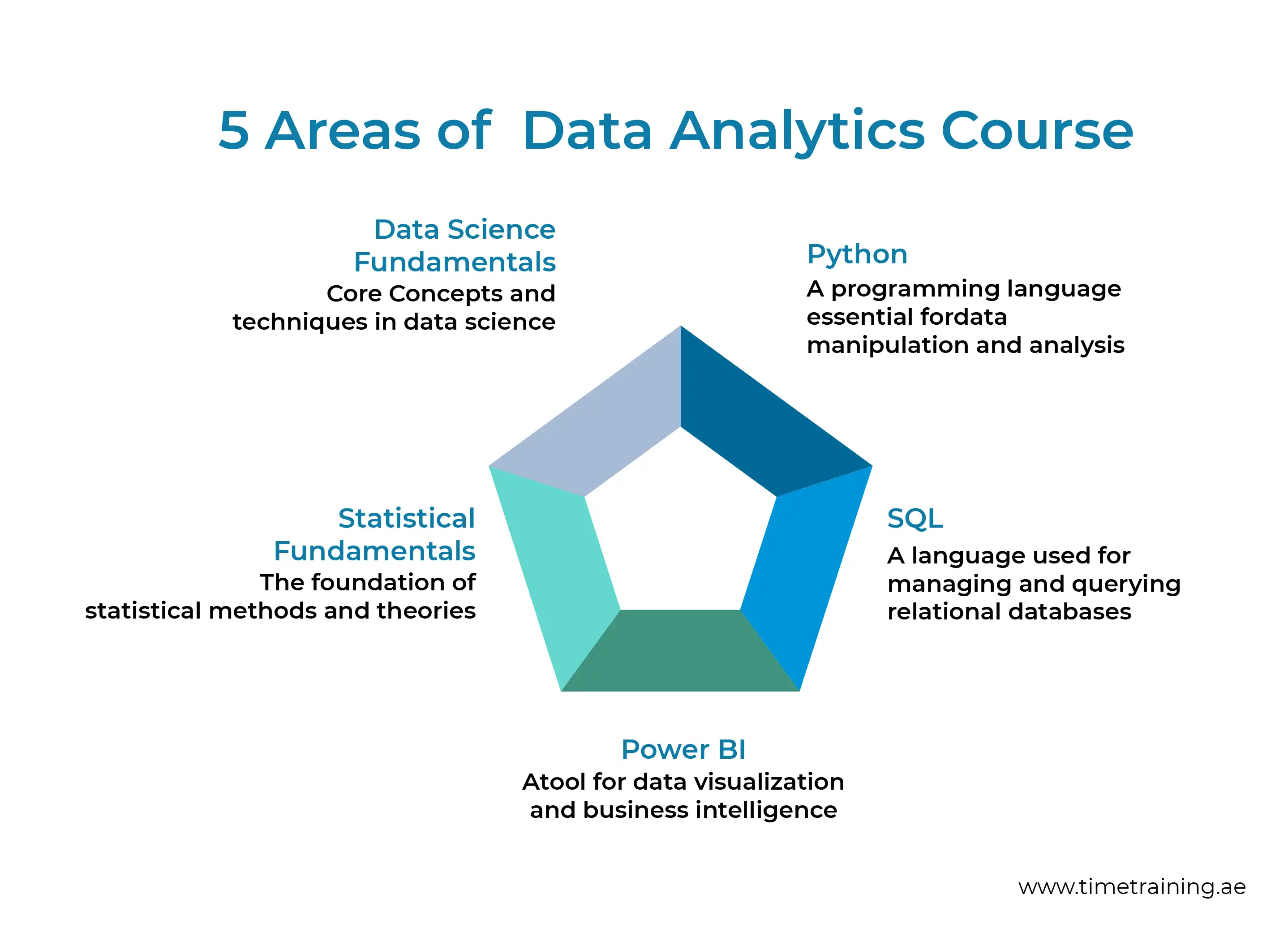
What is Data Analytics?
Data Analytics is the process of collecting, cleaning, organising, and analysing data to find useful information, patterns, and trends. It helps organisations understand what has happened, why it happened, and what may happen in the future. Common tools used for Data Analytics include Excel, SQL, Python, R, Power BI, and Tableau. In simple terms, Data Analytics converts raw data into meaningful insights that can be used to make informed decisions.
What You'll Learn from the Data Analytics Course in Abu Dhabi
- Python Data Analysis Fundamentals: Master Pandas, NumPy, and Matplotlib. Build skills in data manipulation, cleaning, and visualisation using Jupyter Notebooks.
- SQL Database Querying Skills: Write complex queries, joins, and CTEs. Extract insights from MySQL databases using window functions.
- Power BI & Excel Dashboard Creation: Design interactive dashboards using Power Query. Transform raw data into compelling visual stories for stakeholders.
- Statistical Analysis and Hypothesis Testing: Apply SciPy for A/B testing and p-value analysis. Make data-driven decisions using confidence intervals.
- Data Cleaning and Transformation: Handle missing values, outliers, and duplicates. Master feature engineering and encoding techniques for analysis-ready datasets.
- Real-World Project Implementation: Complete e-commerce, healthcare, and finance projects. Build an industry-ready portfolio showcasing end-to-end analytics workflows.
Data Analytics Course Features
- Real-World Dataset Exercises: Practice with Kaggle, government, and Maven Analytics datasets across all modules for authentic industry experience.
- Comprehensive Study Resources: Access Microsoft documentation guides, practice notebooks, Excel templates, SQL queries, and Power BI files throughout training.
- Interactive Coding Sessions: Engage in live coding, data cleaning drills, SQL writing, and dashboard building with peer reviews.
- Tailored Learning Path: Progress through modules customised to your skill level, from data fundamentals to advanced analytics with clear milestones.
- Industry-Standard Tool Stack: Master Python, MySQL, Power BI, Excel, SciPy, and Seaborn for complete analytics capabilities.
- End-to-End Capstone Project: Complete a full data pipeline from cleaning to presentation, building portfolio-ready analytics solutions.
Who Can Join Our Data Analytics Course in Abu Dhabi?
- Fresh Graduates & STEM Professionals: Start a career in data analytics.
- Business & Marketing Analysts: Strengthen analytics and BI skills.
- Finance & Operations Professionals: Apply data to business decisions.
- IT & Software Professionals: Expand into data analytics and BI.
- Healthcare, Retail & E-commerce Professionals: Turn data into actionable insights.
- Career Transitioners: Move into data analytics with foundational skills.
Prerequisites for the Data Analytics Training in Abu Dhabi
- Open to learners from all academic and professional backgrounds
- Basic computer skills and an interest in Excel are sufficient
Data Analytics Course Module
Module 1: Python Fundamentals
- Chapter 1.1: Introduction to Python
- Lesson 1.1.1: Applications of Python
- Lesson 1.1.2: Setting up the Python development environment
- Chapter 1.2: Python Basics
- Lesson 1.2.1: Basic syntax and data types in Python
- Lesson 1.2.2: Control flow and conditional statements
- Lesson 1.2.3: Looping structures and iterations
- Chapter 1.3: Python Functions and Modules
- Lesson 1.3.1: Defining and Using Functions
- Lesson 1.3.2: Introduction to Modules
- Chapter 1.4: File Handling and Error Management
- Lesson 1.4.1: File input/output operations
- Lesson 1.4.2: Exception handling and error management
Module 2: Python Advanced Concepts
- Chapter 2.1: Object-Oriented Programming (OOP) in Python
- Lesson 2.1.1: Introduction to OOP
- Lesson 2.2.2: Classes, objects, and inheritance
- Chapter 2.2: Working with Python Libraries
- Lesson 2.2.1: Overview of NumPy, Pandas, and Matplotlib
- Lesson 2.2.2: Dataframe basics
- Lesson 2.2.3: Reading data from CSV/Excel files
- Chapter 2.3: Data Manipulation in Python
- Lesson 2.3.1: Data cleaning and filtering
- Lesson 2.3.2: Handling missing data
- Lesson 2.3.3: Group by, Concat, Merge operations
- Chapter 2.4: Data Visualization in Python
- Lesson 2.4.1: Introduction to data visualization
- Lesson 2.4.2: Using Matplotlib, Seaborn, and Plotly
Module 3: MySQL Database Management
- Chapter 3.1: Introduction to Relational Databases
- Lesson 3.1.1: Understanding relational databases and MySQL
- Lesson 3.1.2: Installing and setting up the MySQL server
- Chapter 3.2: Database Fundamentals
- Lesson 3.2.1: Creating databases and tables
- Lesson 3.2.2: Data types, constraints, and indexes
- Chapter 3.3: SQL Querying
- Lesson 3.3.1: SELECT, INSERT, UPDATE, DELETE statements
- Lesson 3.3.2: Joins, sub-queries, and aggregations
- Lesson 3.3.3: CTE and window functions
- Chapter 3.4: Advanced MySQL Features
- Lesson 3.4.1: Introduction to stored procedures
Module 4: Power BI
- Chapter 4.1: Introduction to Power BI
- Lesson 4.1.1: Overview of Power BI features
- Lesson 4.1.2: Importing data into Power BI
- Chapter 4.2: Data Transformation and Modelling
- Lesson 4.2.1: Data transformation using Power Query
- Lesson 4.2.2: Data modelling and relationships
- Lesson 4.2.3: Creating calculated columns and measures
- Chapter 4.3: Interactive Reporting
- Lesson 4.3.1: Designing interactive reports and dashboards
- Lesson 4.3.2: Adding visuals and customising properties
- Lesson 4.3.3: Sharing and publishing reports
Module 5: Fundamentals of Statistics for Data Analysis
- Chapter 5.1: Foundations of Statistics
- Lesson 5.1.1: Introduction to statistical concepts and terminologies
- Lesson 5.1.2: Descriptive statistics: measures of central tendency and variability
- Chapter 5.2: Probability and Hypothesis Testing
- Lesson 5.2.1: Probability distributions: discrete and continuous
- Lesson 5.2.2: Hypothesis testing and statistical significance
- Chapter 5.3: Statistical Analysis
- Lesson 5.3.1: Correlation and regression analysis
- Lesson 5.3.2: Introduction to ANOVA (Analysis of Variance)
Module 6: Data Science Fundamentals
- Chapter 6.1: Introduction to Data Science
- Lesson 6.1.1: Understanding the Data Science Workflow
- Lesson 6.1.2: Data acquisition and cleaning techniques
- Chapter 6.2: Exploratory Data Analysis (EDA)
- Lesson 6.2.1: EDA techniques
- Lesson 6.2.2: Data visualisation methods
- Chapter 6.3: Machine Learning Basics
- Lesson 6.3.1: Supervised and Unsupervised Machine Learning Algorithms
- Lesson 6.3.2: Model evaluation and performance metrics
- Chapter 6.4: Advanced Topics in Data Science
- Lesson 6.4.1: Introduction to natural language processing (NLP)
- Lesson 6.4.2: Introduction to deep learning and neural networks
Industry-Ready Data Analytics Projects
Time Training Centre teaches data analytics through a clear, step-by-step approach. Students master technical skills before working on industry projects. Our instructors help students set up and use all required software tools. We provide a technical learning path with guided exercises:
| Module |
Practical Learning Exercises
|
| Python Data Analysis |
- Analyse real datasets using Pandas libraries
- Create visualisations with Matplotlib
- Apply statistical analysis methods
- Generate actionable insights
|
| MySQL Database Design |
- Design database schemas from scratch
- Implement table relationships
- Write complex SQL queries
- Build enterprise database applications
|
| Power BI Dashboards |
- Connect to multiple data sources
- Create interactive visualisations
- Develop calculated measures
- Design business intelligence reports
|
| Predictive Analytics |
- Build machine learning models
- Process and clean datasets
- Evaluate model performance
- Present analytical findings
|
Build Your Analytics Portfolio Through Industry Application
- Anti-Money Laundering Analysis: Students develop AML compliance systems using Python and SQL. They implement data validation protocols and create automated alert mechanisms.
- Transport Network Analytics: Participants analyse Abu Dhabi's transportation data using Power BI. They build predictive models for traffic patterns and route optimisation.
- Healthcare Analytics: Students create predictive models for patient data analysis. They develop dashboards to visualise health trends and medical outcomes.
- Banking Operations: Participants design database systems for banking operations. They build fraud detection models using SQL and automated reporting workflows.
- Market Research Projects: Students analyse Amazon product datasets. They create visualisations of customer behaviour and market trends using Python libraries.
- Sports Performance Analytics: Participants develop interactive Power BI dashboards. They analyse team statistics and create performance metric visualisations.
Data Analytics Course Outcomes and Professional Benefits
- Develop Core Data Analytics Skills: Learn to collect, clean, analyse, and interpret data to generate meaningful business insights.
- Gain Proficiency in Analytics Tools: Build practical skills in Python, SQL, Power BI, Advanced Excel, and Statistics.
- Create Effective Data Visualisations: Design interactive dashboards and present complex data in a clear, easy-to-understand format.
- Apply Skills to Real-World Projects: Work with industry-focused datasets and scenarios to gain practical analytics experience.
- Build a Professional Analytics Portfolio: Develop projects that demonstrate your ability to handle data from preparation through analysis and presentation.
- Strengthen Data-Driven Decision-Making: Use analytical methods to identify trends, evaluate performance, and support informed business decisions.
- Apply Analytics Across Industries: Develop transferable skills relevant to finance, healthcare, e-commerce, retail, logistics, and other sectors.
- Develop Job-Ready Skills: Build the technical and practical foundation relevant to roles such as Data Analyst, BI Specialist, and Analytics Consultant.
Career Opportunities After the Data Analytics Course
Data Analyst | Business Analyst | Business Intelligence Analyst | Data Visualization Analyst | Marketing Analyst | Financial Analyst | Operations Analyst | Junior Data Scientist.
Industries Where Data Analytics Skills Are Relevant -
IT and Software | Banking and finance | Healthcare | Retail and E-commerce | Marketing and Advertising | Manufacturing | Telecommunications | Logistics and Supply Chain | Education, Insurance | Government services.
How to Get Data Analytics Certification in Abu Dhabi?
- Enrol in Time Training Center’s Data Analytics course in Abu Dhabi
- Complete the required training and practical projects.
- Pass the final assessment or certification exam.
- Receive your Data Analytics Certification and add it to your CV
Data Analytics Training Options
| Classroom Training |
- Learn through direct instructor interaction
- Receive hands-on software setup assistance
- Practice exercises with immediate guidance
- Work in small focused learning groups
- Get real-time feedback during sessions
- Access our professional training facility
|
| Live Online Training |
- Join live instructor-led sessions
- Access virtual lab environments
- Get software installation support
- Review recorded sessions anytime
- Participate in online exercises
- Clear doubts in real-time
|
| Corporate Training |
- Choose your preferred training location
- Opt for virtual or in-person sessions
- Food and refreshments included
- Customized industry specific content
- Schedule flexible 5-7 day programs
- Practice with business datasets
|
Why Choose Time Training Center for Data Analytics Course?
Time Training Center is an ACTVET-approved training provider with 33 years of experience in delivering professional training programs. Here are some key reasons to choose Time Training Center for a Data Analytics course:
- ACTVET-Approved Training: Learn from a recognized training provider committed to professional training standards.
- Experienced Trainer: Learn from Usman Ahmad, who has 16 years of training experience and has trained over 3,000 professionals in Data Analytics and technology.
- Hands-On Training: Develop practical skills through exercises, projects, and real-world Data Analytics applications.
- Industry-Relevant Curriculum: Gain knowledge of essential tools and concepts such as Excel, SQL, Python, Power BI, data visualisation, and analytics.
- Career-Focused Learning: Build practical technical and analytical skills to prepare for opportunities in the growing field of Data Analytics.
- Convenient Abu Dhabi Location: Our training center is located at Al Otaiba Tower – Office 901, Khalaf – Electra Street, Abu Dhabi, providing a convenient location for learners in Abu Dhabi.
Meet Your Expert Data Analytics Trainer
Shahista Tabassum
Shahista Tabassum is an experienced data analytics and Python trainer with over 14 years of combined industry and training experience. She has trained more than 2,000 students and brings a decade of dedicated training expertise, supported by hands-on experience with multinational corporations and an M.E. in Web Technologies. Her expertise covers Python programming, data science, statistical analysis, machine learning, database management, and data visualisation.
Shahista uses a project-based teaching approach that connects technical concepts with real-world business scenarios and industry challenges. Her training emphasises practical application, data storytelling, and effective communication of insights. Through real-world case studies and portfolio-focused projects, she helps learners develop practical, job-ready skills that can be applied confidently in professional environments.
 +971 2 6713828