Quick Answer
The six most common mistakes candidates make while preparing for the HAAD exam in Abu Dhabi are:
1. Studying From Outdated "HAAD" Material Instead of Current DOH Content
2. Treating HAAD as a Memorisation Test, Not a Clinical Reasoning Test
3. Ignoring the Exam Blueprint and Subject Weightage
4. Skipping Timed Mock Exams Until the Last Minute
5. Underestimating Medical English Under Pressure
6. Leaving DataFlow Verification and Exam Booking Until Prep Is "Done"
Most candidates who fail the HAAD exam on their first attempt don't fail because they lack clinical knowledge. They fail because they prepare for the wrong exam, studying old material, ignoring the blueprint, or walking in without ever practising under real-time pressure.
The HAAD exam, now officially run by the Department of Health Abu Dhabi (DOH) and delivered through Pearson VUE, rewards applied clinical reasoning over rote memorisation, and that single shift in approach is where most preparation plans quietly fall apart.
If you're a doctor, nurse, pharmacist, or allied health professional getting ready to apply for a Jawaz licence to practise in Abu Dhabi or Al Ain, this guide breaks down exactly where candidates go wrong and what to do instead.
Table of Contents
|
1. What are the Six Most Common Mistakes Candidates Make While Preparing for the HAAD Exam in Abu Dhabi?
Studying From Outdated "HAAD" Material Instead of Current DOH Content
Treating HAAD as a Memorisation Test, Not a Clinical Reasoning Test
Ignoring the Exam Blueprint and Subject Weightage
Skipping Timed Mock Exams Until the Last Minute
Underestimating Medical English Under Pressure
Leaving DataFlow Verification and Exam Booking Until Prep Is "Done"
2. Key Takeaways
3. FAQs: Six Most Common Mistakes Candidates Make While Preparing for the HAAD Exam in Abu Dhabi |
What are the Six Most Common Mistakes Candidates Make While Preparing for the HAAD Exam in Abu Dhabi?
The six most common mistakes that candidates make while preparing for the HAAD exam are:
-
Studying from outdated “HAAD” material instead of current DOH content.
-
Treating HAAD as a Memorisation Test, Not a Clinical Reasoning Test
-
Ignoring the Exam Blueprint and Subject Weightage
-
Skipping Timed Mock Exams Until the Last Minute
-
Underestimating Medical English Under Pressure
-
Leaving DataFlow Verification and Exam Booking Until Prep Is "Done"
1. Studying From Outdated "HAAD" Material Instead of Current DOH Content
The Health Authority Abu Dhabi has been rebranded as the Department of Health since 2019. Even though the name of the examination has retained its significance, the body itself, including PQR and parts of the blueprint questions, has advanced since then.
-
Many aspirants continue to purchase or download question banks compiled several years ago based on the old HAAD pattern without verifying the relevance of their content to the new DOH guidelines.
-
Studying from outdated HAAD materials is a serious mistake, more than it sounds:
-
Clinical protocols change.
-
Drug guidelines get revised.
-
The weighting given to certain specialities shifts as Abu Dhabi's healthcare priorities evolve.
-
Preparing from a five-year-old PDF that a friend forwarded you is a bit like training for a race using last year's route map.
Solution: Cross-check any prep material against the current PQR listed on the DOH website for your profession, and favour resources updated within the last twelve months.
Confused about UAE healthcare licensing? Read HAAD vs. DHA: Which One is Right for You? to choose the right path for your medical career.
2. Treating HAAD as a Memorisation Test, Not a Clinical Reasoning Test
Treating HAAD as a memorisation test and not as a clinical reasoning test is probably the single biggest misconception.
-
Many candidates approach the HAAD exam the way they approached university finals, memorising facts, drug doses, and definitions in isolation.
-
But the HAAD exam in Abu Dhabi is built around single-best-answer, scenario-based questions. You're given:
-
A candidate who has memorised every antibiotic dosage but hasn't practised applying that knowledge inside a messy, multi-symptom clinical vignette will often freeze when the question doesn't match the "clean" version they studied.
Solution: Practise with scenario-based question banks rather than flashcard-style recall tools, and get comfortable with the "which of the following is the most appropriate" phrasing that dominates the exam.
You can join a DOH (HAAD) course in Abu Dhabi to get curated practice papers, tests, and other materials.
3. Ignoring the Exam Blueprint and Subject Weightage
Ignoring the exam blueprint and subject weightage is a major mistake.
-
Every profession category, General Practitioner, Specialist, Registered Nurse, Pharmacist, and so on, has a different weightage across subjects like:
-
Internal Medicine
-
Surgery
-
Paediatrics
-
Obstetrics & Gynaecology
-
Candidates who study everything equally, without checking which areas carry more questions for their specific category, often:
-
It's a planning failure dressed up as a knowledge gap.
Solution: Get the official blueprint for your professional category first, then build your study plan backwards from the heaviest-weighted subjects, getting the most hours.
Preparing for the DOH exam? Discover the Top 10 study tips for the HAAD exam in Abu Dhabi and boost your chances of passing on the first attempt.
4. Skipping Timed Mock Exams Until the Last Minute
Knowledge and applying that knowledge under time pressure are two distinct sets of skills. Considering that there are about 150 questions that need to be answered in three hours, each question should ideally take less than one minute.
-
The problem with this is that clinical vignettes are much harder to comprehend than regular multiple-choice questions.
-
As a result, candidates who leave time management practice until the last week may discover too late that:
-
Clinical scenarios take longer to read and analyse.
-
They are spending too much time on individual questions.
-
They lack sufficient time to complete the exam.
-
On exam day, some candidates realise they still have 20 questions left when the clock is running out.
Solution: Start full-length, timed mock exams at least four to six weeks out, not four to six days out. Treat pacing as a skill you train, not a problem you'll figure out on the day.
Expert Insight
Having an active DHA or DOH/HAAD license significantly improves employability because UAE healthcare facilities can onboard licensed professionals faster and with fewer compliance requirements. Many job advertisements specifically state "DHA License" or "DOH License" as a mandatory or preferred qualification.
5. Underestimating Medical English Under Pressure
The majority of applicants for the HAAD examination in Abu Dhabi are very proficient clinicians who come from foreign universities; sometimes these individuals also hail from other countries, which means their mother tongue is not Arabic or English but a third language altogether.
Just because one possesses clinical skills in one's native language does not mean that one will be able to understand complex English questions within a limited amount of time, especially under pressure.
Solution: Read every question twice before answering during practice, specifically hunting for qualifier words, and build a habit of mentally flagging them as you read.
Planning to get licensed in Abu Dhabi? Read DOH Abu Dhabi Exam 2026: Complete guide to your UAE healthcare license for everything you need to know.
6. Leaving DataFlow Verification and Exam Booking Until Prep Is "Done"
Now, HAAD is not a clinical skills test; it throws off more applicants than anything else in this post. The DataFlow Primary Source Verification process can last up to several weeks, and any inaccuracies in the form, wrong date, or confusing experience letter may render you ineligible for the examination altogether.
Those candidates who try to begin this process once they "feel ready" usually see their test date postponed by a month or even longer.
Solution: Start DataFlow verification and exam booking in parallel with your study plan, not after it.
The Six Common Mistakes and Their Solutions
| Common Mistake |
Why It Hurts Your Score |
What To Do Instead |
| Studying outdated HAAD-era material |
Content and weightage have shifted under DOH |
Use resources updated against the current PQR |
| Memorising facts instead of practising reasoning |
Exam questions are scenario-based, not recall-based |
Drill clinical vignettes, not flashcards |
| Ignoring subject weightage for your category |
Time gets wasted on low-yield topics |
Study against the official blueprint |
| Leaving timed mocks for the final week |
Pacing collapses under real-time pressure |
Start full-time mocks 4-6 weeks early |
| Underestimating English qualifiers |
One missed word can flip the correct answer |
Re-read questions, flag qualifier terms |
| Delaying DataFlow and booking |
Can push your exam date back by weeks |
Run paperwork and study in parallel |
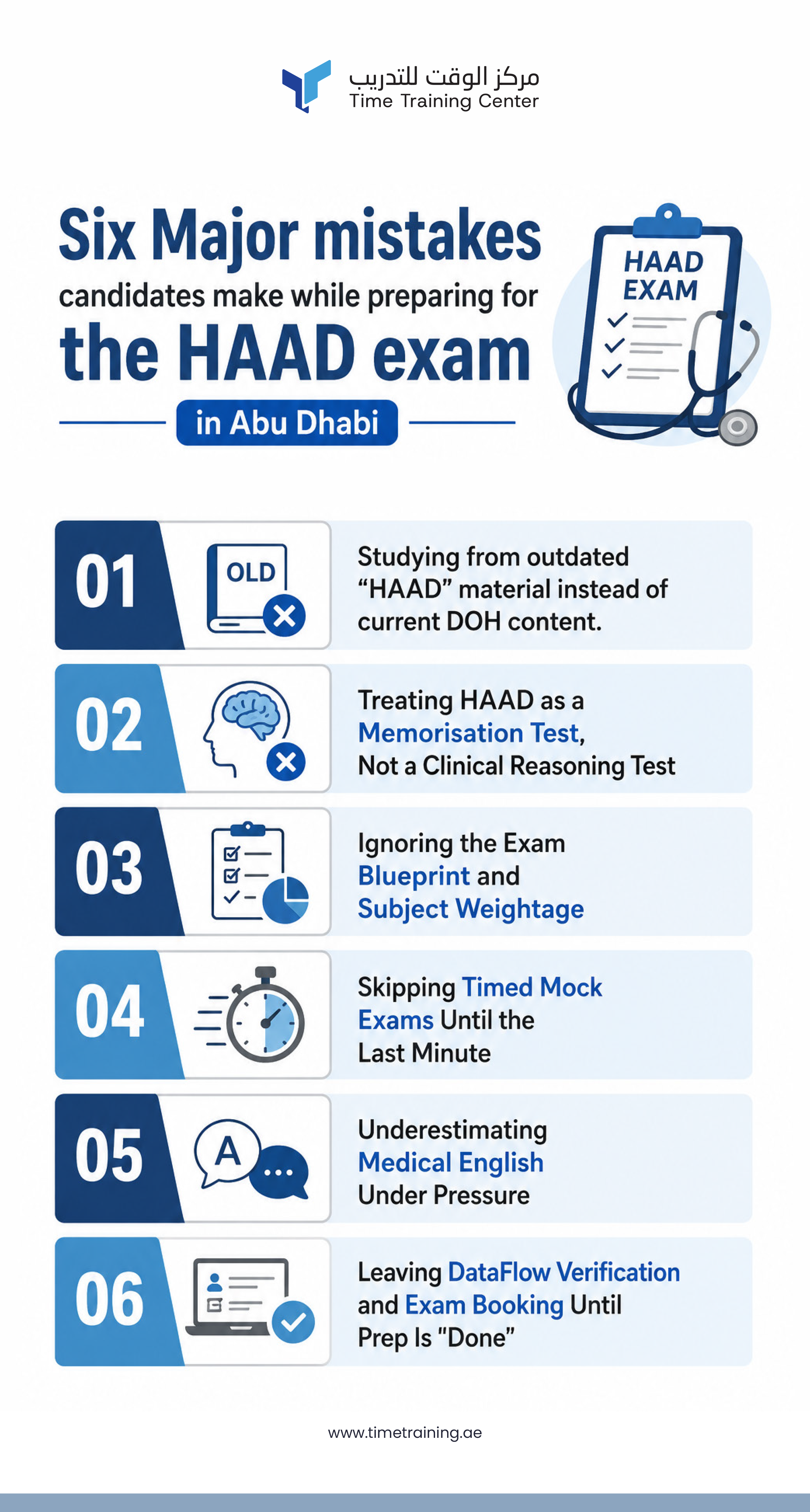
The sum-up of the top 6 common mistakes aspirants make while they prepare for the HAAD exam in Abu Dhabi is in the infographic below:
Major Companies Hiring Professionals with HAAD (DOH) or DHA Licenses
The major companies hiring professionals with HAAD (DOH) or DHA licenses are:
Most In-Demand Roles for HAAD Professionals in Abu Dhabi
The most in-demand roles for HAAD professionals in Abu Dhabi are:
Why HAAD Matters for Your Career in Abu Dhabi?
There was never a better time than now. Abu Dhabi requires about 11,000 nurses and 5,000 allied health professionals in addition to doctors specialising in psychiatry, emergency medicine, intensive care, and orthopaedic surgery by the year 2030.
On the regional front, a report by the GCC Health Council mentions a requirement for 50,000 health care professionals as of 2025.
Yet all of these opportunities will not avail you anything should your preparation go wrong and you find yourself with a failure and a six-month waiting period for retaking the exam.
Quick Reference: HAAD/DOH Exam Snapshot
| Detail |
Information |
| Regulatory body |
Department of Health Abu Dhabi (DOH), formerly HAAD
|
| Test delivery partner |
Pearson VUE |
| Question format |
Single-best-answer, clinical scenario-based MCQs
|
| Approximate exam length |
~150 questions in 3 hours |
| Typical passing benchmark |
Around 60% (can vary by category and demand)
|
| Licence coverage |
Valid for Abu Dhabi and Al Ain only |
| Separate exams needed for |
Dubai (DHA), other emirates (MOH) |
Key Takeaways
-
The exam is still widely called "HAAD," but it's administered by DOH Abu Dhabi through Pearson VUE, not Prometric, and using outdated guides can cost you.
-
A pass typically requires scoring around 60% or higher, though the cut-off can shift depending on demand for your speciality.
-
The test runs to roughly 150 single-best-answer, scenario-based MCQs across a three-hour sitting, and pacing is a skill in itself.
-
Abu Dhabi is projected to face a shortfall of 11,000 nurses and 5,000 allied health professionals by 2030, so the opportunity on the other side of this exam is real and growing.
-
Most failed attempts trace back to outdated content, poor time practice, or leaving DataFlow verification too late, not a lack of clinical ability.
Passing the HAAD exam on your first attempt rarely comes down to raw clinical knowledge. Most candidates sitting this exam are already competent, practising professionals.
It comes down to preparing for the exam that's actually in front of you: current DOH content, scenario-based reasoning, realistic time pressure, and paperwork that's moving forward in parallel with your study plan.
Fix those six habits, and you've already removed the reasons most people don't pass the first time.
FAQs
Is the HAAD exam the same as the DOH exam?
Yes. The Health Authority Abu Dhabi (HAAD) was restructured in 2019 and is now known as the Department of Health Abu Dhabi (DOH). The licensing exam, eligibility process, and Jawaz licence are unchanged in purpose, but candidates should reference current DOH terminology and guidelines rather than older HAAD-branded materials.
How many questions are on the HAAD/DOH exam, and how long do I get?
The exam typically consists of around 150 single-best-answer, scenario-based multiple-choice questions, delivered over a three-hour testing window via Pearson VUE.
What score do I need to pass the HAAD/DOH exam?
Most categories require a score of roughly 60% or above, though the exact cut-off can vary by professional category and current demand for that speciality in Abu Dhabi.
Is a HAAD/DOH licence valid in Dubai?
No. A DOH (HAAD) licence only permits practice in Abu Dhabi and Al Ain. Practising in Dubai requires a separate DHA licence, and other emirates require an MOH licence.
How long should I prepare for the HAAD/DOH exam?
Most candidates benefit from six to twelve weeks of structured preparation, including at least four to six weeks of timed, full-length mock exams, alongside parallel progress on DataFlow verification.
 +971 2 6713828