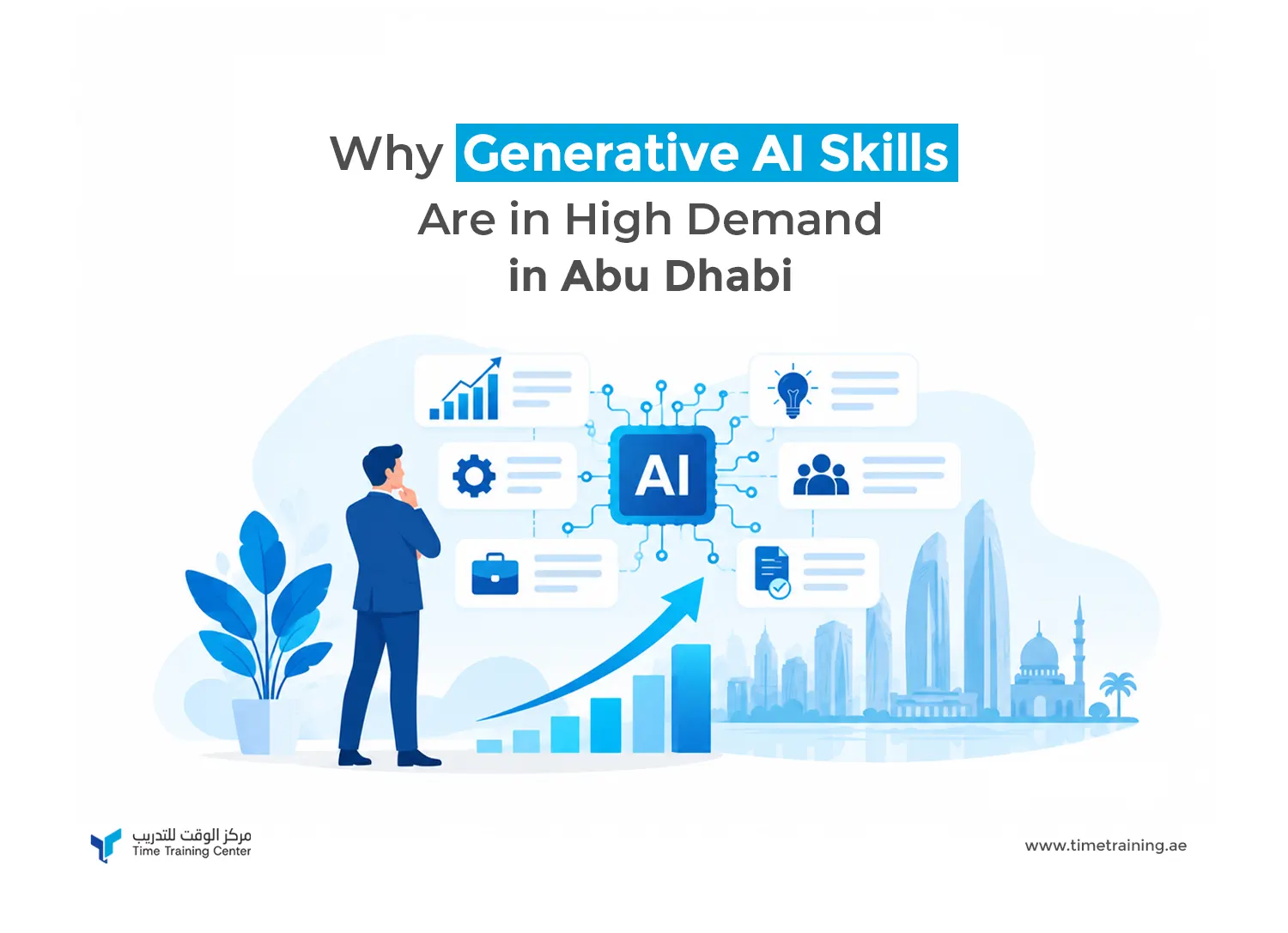
To start a career in artificial intelligence in Abu Dhabi, you must acquire core technical skills, gain practical project experiences, and get a globally recognised AI certification in the UAE. Abu Dhabi has transformed into the strongest AI hub in the Middle East thanks to the UAE Vision 2031.
Extensive investments are happening in diverse fields like government digital transformation, aviation technology, finance automation, smart mobility and healthcare. A PwC report expects AI to contribute up to USD 320 billion to the Middle East by 2030. This has created an increasing demand in the city for AI engineers, machine learning experts, data scientists, NLP engineers, and automation professionals has generated numerous opportunities for both freshers and experienced professionals.
If you're a student looking to pursue your first technology career, a recent graduate entering the workforce, an IT professional seeking to upgrade your skill set, or an expat seeking high-demand tech positions, Abu Dhabi provides clear pathways, accessible training options, and a high demand for new talent.
This guide outlines a structured pathway to achieving professional status as an AI expert in Abu Dhabi. Understand the skills, certifications, tools, salary, local training, job demands, and the jobs that will be looking for the AI workers.
Step-by-Step: How to Start Your Career in Artificial Intelligence in Abu Dhabi
Below are the steps to be followed by freshers and professionals who wish to start a career in artificial intelligence in Dubai.
- Step 1: Build Strong Foundations in Programming and Mathematics
- Step 2: Choose the Right AI Certification or Training Program in Abu Dhabi
- Step 3: Specialise: Focus on a Sub-Domain (e.g., ML, NLP, Data Science)
- Step 4: Master Key Tools and Technologies Used in Abu Dhabi’s AI Ecosystem
- Step 5: Build Projects & a Portfolio
- Step 6: Prepare for Job Applications & Interviews
- Step 7: Gain AI Experience Through Internships or Entry-Level Roles
- Step 8: Commit to Continuous Learning and Professional Growth
Step 1: Build Strong Foundations in Programming and Mathematics
Your primary task is to build a strong foundation in mathematics and programming languages. Python is the most used programming language, and having a good understanding of Python will help you get comfortable with code, data structures and algorithms. Having a robust knowledge of mathematical concepts like linear algebra, statistics and probability is also essential to get a thorough grasp of structured AI. Studies and comparisons like Python vs VB have repeatedly emphasised why Python is preferred for modern AI workloads. Building Python programming expertise is most certainly the best way to start an AI career in Dubai
Step 2: Choose the Right AI Certification or Training Program in Abu Dhabi
In Abu Dhabi, AI courses provide opportunities for beginners and experienced professionals to acquire practical skills in data modelling, machine learning, AI engineering, and cloud-based platforms. For example, the Artificial Intelligence Course offered by the Time Training Centre is a local programme that gives both practical insights and theoretical knowledge through labs, case studies and guided projects. The programmes are aligned with international certifications such as AWS AI Practitioner, Microsoft Azure AI Engineer Associate, Google TensorFlow Developer Certificate, and IBM AI Engineering.
Step 3: Specialise: Focus on a Sub-Domain (e.g., ML, NLP, Data Science)
In the vast domain of artificial intelligence, choosing a specialisation that aligns with your interests and the current job market will give you a competitive edge. It could be:
- Machine Learning: Machine learning is creating a program that would give computers the ability to learn from data and make predictions or decisions without explicit programming.
- Deep Learning: Deep learning is a subset of machine learning that employs multi-layered neural networks to process high-dimensional data such as images, audio, and text.
- Data Science: Data science applies statistical techniques, programming, and domain-specific knowledge to analyse data and generate insights.
- Data Analysis: Data analysis involves the systematic process of examining and interpreting data to derive insights, identify trends, and inform decision-making.
- Natural Language Processing (NLP): NLP encompasses the computational processing of human language input, such as translation and speech recognition.
- Computer Vision: This pertains to the functionality of algorithms in software that process visual input to perform tasks like object recognition or categorisation.
- Robotics or Automation with AI: Application of AI to robotic systems and automation processes, enabling autonomous operation, task execution, and adaptive responses.
- Sector-Specific AI: Involves the utilisation of AI technologies tailored to particular industries, such as healthcare, to optimise sector-specific processes and outcomes.
Specialising matters because employers often look for specific skills — not just “general AI”. Also, some sectors in Abu Dhabi (like finance, healthcare, logistics, and smart-city projects) are prioritising certain specialities.
Step 4: Master Key Tools and Technologies Used in Abu Dhabi’s AI Ecosystem
The tools used by AI engineers in Abu Dhabi are:
- TensorFlow: TensorFlow is an open-source machine learning framework widely used by AI engineers to build, train, and deploy scalable deep learning models across industries.
- PyTorch: PyTorch is a flexible deep learning library preferred for research and production due to its dynamic computation graphs and ease of model experimentation.
- Keras: Keras is a high-level neural network API that simplifies deep learning development by enabling fast model building and prototyping on top of TensorFlow.
- Scikit-learn: Scikit-learn is a popular Python library used for classical machine learning tasks such as classification, regression, clustering, and data preprocessing.
They also utilise cloud platforms such as:
- AWS AI: AWS AI provides cloud-based machine learning services that help AI engineers design, train, and deploy intelligent applications at scale.
- Azure Machine Learning: Azure Machine Learning is a cloud platform that supports end-to-end AI model development, from data preparation to deployment and monitoring.
- Google Cloud AI: Google Cloud AI offers advanced machine learning tools and APIs that enable AI engineers to build, deploy, and manage AI solutions efficiently
These tools are essential to operate with actual data, construct AI workflows, and implement models in production settings. The familiarity with RPA tools, IoT systems, and MLOps platforms provides an upper hand in automation engineering or AI robotics fields.
Step 5: Build Projects & a Portfolio
Theory isn't enough. Employers want to see that you can use what you have learnt. Construct practical projects, such as:
- A machine-learning model predicting business trends
- A data-analysis dashboard using real or public data
- A chatbot using NLP
- Computer-vision-based automation tool
Use open datasets or volunteer for small projects — even pro bono — to build your portfolio. This practical engagement enables you to learn about issues like data preprocessing, model assessment, deployment, and scalability. Having a portfolio is critical when you are a fresher, changing your career or have no professional background in AI.
Step 6: Gain AI Experience Through Internships or Entry-Level Roles
Various government bodies, technology corporations, and innovation centers offer internships tailored for individuals new to AI. These roles offer practical experience in data analysis, automation, machine learning model development, and deployment on cloud platforms. Initial positions include:
- Data analyst junior
- Artificial intelligence assistant
- Machine learning intern
- Research associate
- Automation technician
- Artificial intelligence support engineer.
Internships present a chance to obtain full-time employment. They also offer the opportunity to work alongside experienced engineers and access real AI systems used in aviation, healthcare, and transportation.
Step 7: Commit to Continuous Learning and Professional Growth
You have to keep upgrading your skills, tools, and certifications to keep up. With the right learning habits, you can progress from a junior AI engineer to a senior AI engineer, ML architect, or AI project manager. Always look at articles that give you ways to master new skills, like programming languages. Additionally, remain informed about emerging trends within your industry, such as the impact of AI on human resources, to develop a successful career approach.
Potential AI Career Paths in Abu Dhabi
Once you break in, here are common roles and the core responsibilities:
| Job Title |
Responsibilities |
| AI / ML Engineer |
Build and deploy AI models; often an entry or mid-level role
|
| Data Scientist / AI Analyst |
Focus on data analytics, insights, and building predictive models
|
| NLP / Computer Vision Engineer |
Specialise in language- or image-based AI applications
|
| AI Researcher / Research Assistant |
For those inclined toward deep research or academic-style AI work.
|
| AI Consultant / Solutions Architect |
Oversee AI strategy, implementation, and custom solutions for organisations.
|
As you gain experience, you can advance to senior engineer, team lead, architect, or even managerial/executive roles, depending on your domain and interest.
Expected AI Salary in Abu Dhabi
One compelling reason to consider AI in Abu Dhabi: competitive, tax-free salaries. Here is the salary data from Zerotaxjobs and The National:
| Position |
Salary |
| Entry-level AI/ML engineers |
AED 15,000–20,000/month |
| Mid-level professionals (5–10 years of experience) |
AED 30,000–38,000/month |
| Senior or principal AI engineers |
AED 50,000–65,000/month |
Abu Dhabi offers a cost-free tax environment. The employers in the city generally provide living allowances too. Hence, the take-home pay is relatively higher in Abu Dhabi, making it an excellent career destination for AI professionals.
Start an AI Career in Abu Dhabi
Starting a career in artificial intelligence in Abu Dhabi is an excellent strategic career choice for students, fresh graduates and professionals eyeing long-term growth. Abu Dhabi is one of the world's fastest-growing AI hubs due to the newly introduced UAE National AI Strategy, strong digital transformation investments and a vibrant innovation ecosystem. Artificial intelligence courses in Abu Dhabi act as your stepping stone to become an AI engineer, data scientist, NLP specialist, ML engineer and automation expert. Abu Dhabi offers structured training, Apple career growth opportunities and competitive salary potential to build a successful career in artificial intelligence.
This guide is a simple roadmap offering the essential steps, like learning programming, studying core AI concepts, building projects, joining certification programmes in reputed institutes like Time Training Center, gaining experience through internships and staying updated with the industry trends. This makes you a confident AI professional in Abu Dhabi, ready to work in emerging sectors like smart cities, aviation technology, finance automation, energy optimisation and healthcare AI.
Kick off your adventure in AI to enjoy a fulfilling career in one of the UAE's rapidly growing tech fields.
FAQs
1. Can freshers start a career in AI in Abu Dhabi?
Yes. Numerous organisations employ new graduates as AI interns, junior analysts, and research assistants. With a good portfolio and certifications, you are more likely to be noticed.
2. What skills do I need to become an AI engineer in Abu Dhabi?
You require Python, machine learning, deep learning, NLP, cloud, data analysis and maths. Also, learn soft skills like communication and problem-solving.
3. What is the AI salary in Abu Dhabi?
Glassdoor UAE statistics indicate an average monthly salary of AED 18,000-35,000 for AI engineers, subject to experience and sector.
4. Which industries offer the most AI jobs in Abu Dhabi?
Government, aviation, healthcare, banking, logistics, oil & gas, and smart city projects.
5. Which certifications are best for starting an AI career in Abu Dhabi?
AWS AI Practitioner, Azure AI Engineer Associate, Google TensorFlow Developer, IBM AI Engineering, and regional AI courses.
 +971 2 6713828