The job responsibilities of an AI Engineer in Abu Dhabi involve designing intelligent agents, making suitable improvements in cloud infrastructure, and ensuring performance is satisfactory in different domains such as finance, government, and energy. AI Engineers in Abu Dhabi create and implement smart applications utilising machine learning frameworks such as LLMs and computer vision in their software.
AI engineers also manage MLOps workflows to deploy, monitor, and maintain AI systems in production. They collaborate closely with data scientists, software developers, and product teams to deliver AI solutions.
An increasingly important responsibility is ensuring AI systems comply with UAE data residency requirements and AI governance standards aligned with the UAE National AI Strategy 2031.
If you've been eyeing the AI Engineer career path in Abu Dhabi, this article is for you. The article explains how AI engineering roles in Abu Dhabi differ from generic "AI job" listings found elsewhere in the world.
To better understand the role, let's explore the job responsibilities of an AI Engineer in Abu Dhabi.
Table of Contents
|
|
1. What are the core AI Engineer job responsibilities in Abu Dhabi?
2. What are employers in Abu Dhabi looking for in AI Engineers?
2.1 How much do AI Engineers earn in Abu Dhabi?
2.2 What makes AI Engineering careers in Abu Dhabi unique?
2.3 Common Interview Focus Areas
3. FAQs: Job Responsibilities of an AI Engineer in Abu Dhabi
|
What are the Core AI Engineer Job Responsibilities in Abu Dhabi?
The core AI Engineer job responsibilities in Abu Dhabi include:
1.1 Designing and Building Machine Learning Models
1.2 Managing Data Pipelines
1.3 Training, Fine-Tuning, and Testing Models
1.4 Deploying and Maintaining AI Systems (MLOps)
1.5 Ensuring Governance, Security, and Data Residency Compliance
1.6 Cross-Functional Collaboration
1.1 Designing and Building Machine Learning Models
Designing and building machine learning models is the foundation of the AI Engineer roles in Abu Dhabi.
Business problems, such as fraud detection, patient triage, or predictive maintenance in energy infrastructure, must be translated into viable models by AI engineers. This includes:
-
Choosing the appropriate algorithm or architecture to tackle the problem
-
Deciding if you are going to build a new model from scratch, apply fine-tuning to an existing model, or use a pre-trained language model
-
Verifying model performance against real business metrics as opposed to only relying on academic accuracy scores.
Peng Xiao, Group CEO of G42, said, “The launch of Stargate UAE is a significant step in the UAE-U.S. AI partnership. As a founding partner, we’re proud to work alongside institutions that share our belief in responsible innovation and meaningful global progress. This initiative is about building a bridge - rooted in trust and ambition - that helps bring the benefits of AI to economies, societies, and people around the world.”
1.2 Managing Data Pipelines
Managing data pipelines is crucial, as no model is better than the data feeding it. Much of the job involves routine but necessary tasks:
-
Creating pipelines that clean, change, and format raw data.
-
Working with data engineers to make sure that pipelines work efficiently in difficult conditions.
-
Dealing with multilingual databases since many projects in the UAE require processing data in both Arabic and English.
1.3 Training, Fine-Tuning, and Testing Models
After the selection of a model framework, engineers devote enough time to training and evaluation processes:
-
Conducting training jobs on GPU clusters (which are increasingly becoming local due to expanding computing power in Abu Dhabi).
-
Modifying basic models for different uses in companies.
-
Examining models for bias, changes in accuracy, and failures in difficult conditions before implementation.
Discover the top Artificial Intelligence training institutes in Abu Dhabi and find the right programme to kick-start your AI career.
1.4 Deploying and Maintaining AI Systems (MLOps)
Constructing the model is just part of the work; the other part is getting it into production and operation:
-
Creating CI/CD pipelines to deploy the model
-
Constantly monitoring the performance of the operational models
-
Interacting with providers of cloud and sovereign infrastructures to ensure compliance and uptime
1.5 Ensuring Governance, Security, and Data Residency Compliance
It is at this point that the Abu Dhabi role is different from a standard AI engineering job in other locations. Here, engineers must do the following things:
-
Create systems that conform to UAE data protection and NESA/UAE IA information security standards
-
Utilise sovereign cloud environments instead of public cloud settings
-
Protect records of how models have been used and how data have been used in terms of audit and regulation.
1.6 Cross-Functional Collaboration
AI engineers rarely work in isolation. Expect regular collaboration with:
-
Data scientists, on model design and experimentation
-
Product managers, when translating business requirements into technical specs
-
Compliance and legal teams, particularly for government or financial-sector projects
-
Leadership, presenting AI capability and risk trade-offs in plain language
AI Engineer Job Responsibilities in Abu Dhabi: A Quick Comparison Table
| Responsibility Area |
What It Involves |
Local Relevance in Abu Dhabi
|
| Model development |
Building, selecting, and fine-tuning ML/GenAI models |
Falcon-style LLM work, Arabic NLP demand
|
| Data engineering |
Pipeline design, cleaning, and structuring data |
Multilingual datasets, sovereign data sources
|
| MLOps & deployment |
CI/CD, monitoring, scaling models |
Sovereign cloud, Khazna data centre infrastructure
|
| Governance & compliance |
Data residency, audit trails, security standards |
NESA/UAE IA alignment, government-sector demand
|
| Cross-team collaboration |
Working with product, legal, and leadership |
Sector-specific: energy, healthcare, banking
|
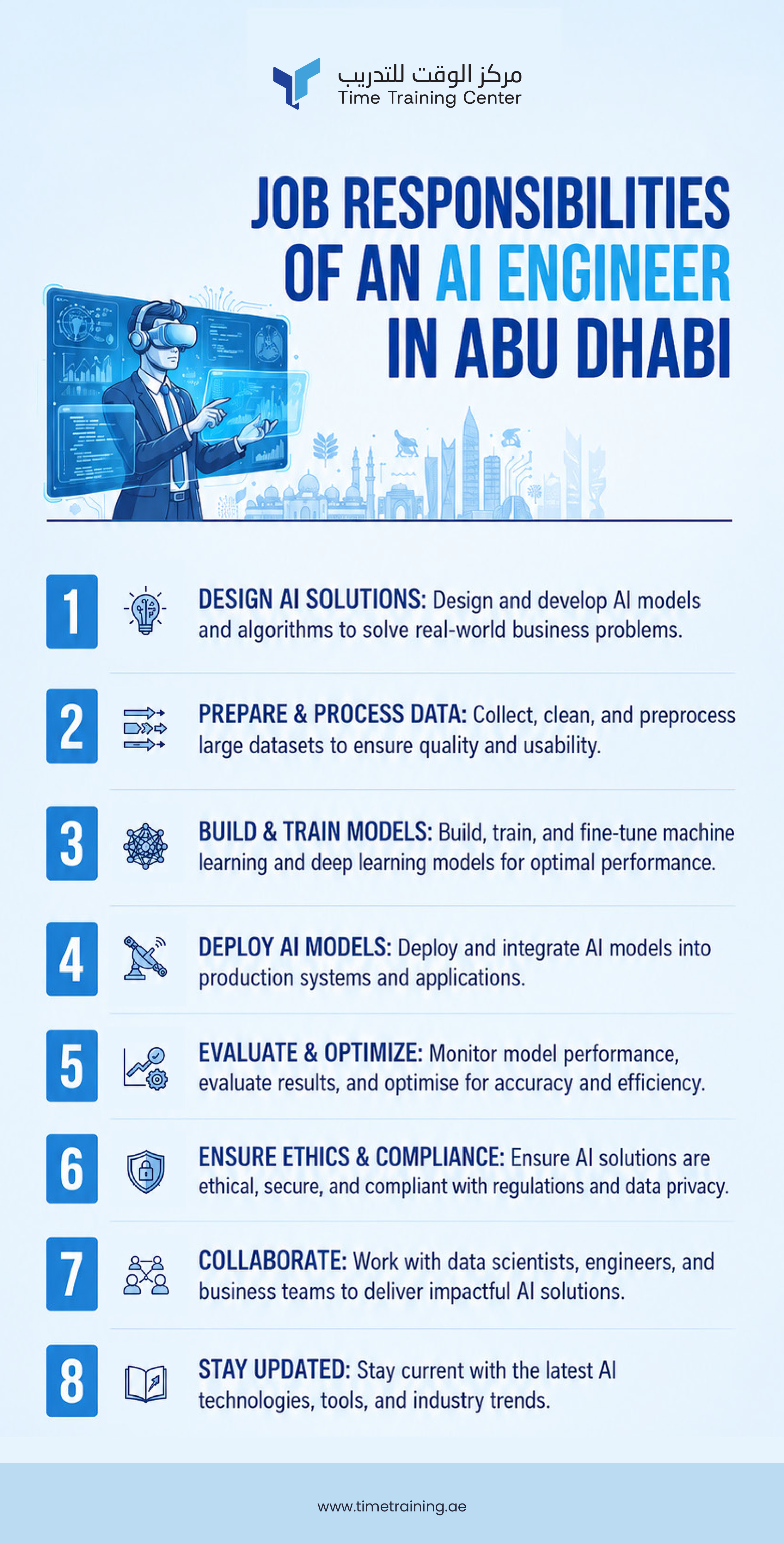
The complete job responsibilities of an AI Engineer in Abu Dhabi are presented in the infographics below:
What Are Employers in Abu Dhabi Looking for in AI Engineers?
Job listings across G42, MGX-linked ventures, AIQ, and Khazna consistently point to a similar profile: strong Python programming and ML framework fundamentals (TensorFlow, PyTorch), practical experience with large language models, and, critically, the ability to connect technical work to national AI strategy outcomes.
Recruiters in this space report that the strongest candidates are those who can link their skills directly to the UAE National AI Strategy 2031 priorities: energy-sector applied AI, healthcare and genomics, sovereign cloud, and Arabic-language model capability, rather than presenting a generic, one-size-fits-all AI CV.
That's a notable shift from a few years ago, when a strong GitHub profile and a computer science degree were often enough. In Abu Dhabi's current market, sector fluency and sovereign-context awareness are becoming just as important as raw technical skill.
Explore the latest job opportunities for Machine Learning Engineers in Abu Dhabi and discover the industries driving AI hiring.
2.1 How Much Do AI Engineers Earn in Abu Dhabi?
The earnings of AI engineers in Abu Dhabi depend on the source and how "AI engineer" is defined, but a consistent pattern emerges: entry-level roles start modestly, while Generative AI and LLM specialists at sovereign-backed entities command a real premium.
Average Salary of AI Engineers in Abu Dhabi
| Experience Level |
Approximate Annual Salary (AED) |
| Entry-level (0–2 years) |
180,000 - 250,000 |
| Mid-level (3–6 years) |
280,000 - 420,000 |
| Senior / GenAI specialist |
450,000 - 600,000+ |
(Source: Glassdoor)
Salaries at G42, MGX-backed ventures, and other Mubadala portfolio companies often exceed these bands, particularly when equity or performance incentives are included.
UAE income is also tax-free, which meaningfully changes the take-home comparison against hubs like London or New York.
Explore the latest AI Engineer salary trends in Abu Dhabi and see how experience, skills, and industry influence earnings.
Expert Insight
"The AI engineers who thrive in Abu Dhabi aren't just strong coders; they understand why the UAE is building sovereign AI infrastructure in the first place. Candidates who can speak to data governance, Arabic-language capability, and applied use cases in sectors like healthcare or energy stand out immediately in interviews."
Shahista Tabassum
Senior IT Technical Trainer at Time Training Centre Abu Dhabi
2.2 What Makes AI Engineering Careers in Abu Dhabi Unique?
Before getting into the day-to-day, it's worth understanding the context, because it genuinely changes what the job involves.
Abu Dhabi isn't hiring AI engineers to bolt a chatbot onto a website. The emirate has positioned itself as a sovereign AI power, with government-backed entities investing tens of billions of dollars into compute infrastructure, homegrown language models, and applied AI across healthcare, energy, and finance.
G42's Falcon models, the Stargate UAE compute cluster, and MGX's global AI investments all point to one thing: this is state-level AI ambition, and engineers hired here are expected to operate inside that reality.
Practically, that means an AI engineer working for a Mubadala-linked entity or a government-adjacent enterprise needs more than technical chops. They need comfort with regulated environments, an understanding of UAE data residency rules, and increasingly the ability to build systems that work in Arabic as well as English.
AI Engineer in Abu Dhabi job description: Build, deploy, and maintain AI and ML systems, including LLM and RAG solutions, while working with data, cloud, and compliance teams.
The major skills needed to break into AI Engineer careers in Abu Dhabi are given below:
Skills Employers Want in AI Engineer in Abu Dhabi
| Skill Area |
What It Includes |
| Python Programming |
Writing production-ready code, scripting, data handling, and automation
|
| Machine Learning |
Model selection, training, validation, evaluation
|
| Deep Learning |
Neural networks, NLP, computer vision, transformers
|
| Data Engineering |
Cleaning data, pipelines, feature preparation, ETL
|
| MLOps |
Deployment, monitoring, CI/CD, model versioning
|
| Cloud Platforms |
AWS, Azure, Google Cloud, sovereign cloud environments
|
| Docker & Kubernetes |
Containerization, orchestration, and scalable deployment
|
| SQL |
Querying, joining, filtering, working with structured data
|
| Generative AI |
LLMs, prompt workflows, RAG, fine-tuning
|
| Arabic/Multilingual NLP |
Processing bilingual or Arabic datasets and use cases
|
| Communication |
Explaining technical ideas to non-technical teams
|
| Problem Solving |
Translating business needs into AI solutions
|
2.3 Common Interview Focus Areas
Interviewers in Abu Dhabi tend to assess not only technical competence but also practical acumen. One may be asked about how models were chosen, how features were dealt with, how pipelines were deployed, how errors were tackled, and monitored.
They may also be interested in knowing the way data privacy, compliance, or governance issues were approached. In many cases, interviewers look for candidates who have product-building skills rather than simple coding skills.
A good answer typically indicates that a candidate understands the whole life cycle of an AI system, starting from data collection, through deployment and up to maintenance.
Follow a step-by-step guide to learn the skills, qualifications, and career path needed to become an AI Engineer in Abu Dhabi.
Key Takeaways
-
AI engineering in Abu Dhabi is shaped heavily by sovereign-tech priorities; data residency, Arabic-language models, and national governance frameworks aren't optional extras; they're part of the job.
-
Core technical responsibilities are on par with the world, while the duties are all about Python, ML frameworks, model training, and deployment pipes.
-
Companies like G42, MGX-backed projects, AIQ, and Khazna Data Centres are looking for specialists, as well as banking, healthcare, and public organisations.
-
Employers like G42, MGX-backed ventures, AIQ, and Khazna DataCentress are driving demand, alongside banks, healthcare groups, and government entities.
-
Salaries vary widely by source and seniority, but mid-to-senior AI engineers in Abu Dhabi commonly earn AED 280,000-450,000+ annually, with GenAI specialists commanding a premium.
-
Certifications and applied project experience matter more locally than raw academic credentials alone.
FAQ's:
1. What qualifications do I need to become an AI engineer in Abu Dhabi?
Most roles require a bachelor's degree in computer science, engineering, or a related field, along with practical skills in Python, machine learning frameworks, and, for senior roles, a portfolio of deployed AI projects.
2. Is AI engineering in demand in Abu Dhabi?
Yes. With sovereign investment vehicles like G42, MGX, and Mubadala scaling AI infrastructure, demand for AI/ML engineers, MLOps specialists, and applied research talent is rising steadily across 2026.
3. Do AI engineers in Abu Dhabi need to know Arabic?
It's not always mandatory, but it's a significant advantage. Many local projects involve Arabic-language model development, which makes bilingual technical talent especially valuable.
4. How is an AI engineer different from a data scientist in the UAE job market?
Data scientists typically focus on analysis, experimentation, and insight generation, while AI engineers focus on building, deploying, and maintaining production-ready AI systems, though the two roles overlap heavily in smaller teams.
5. What industries hire AI engineers in Abu Dhabi?
AI engineers are hired across government, healthcare, finance, energy, aviation, logistics, manufacturing, and smart city projects. Abu Dhabi's growing AI ecosystem also creates opportunities with technology firms, sovereign AI initiatives, and startups developing enterprise AI solutions.
6. What tools and technologies do AI engineers in Abu Dhabi use?
AI engineers commonly work with Python, TensorFlow, PyTorch, Scikit-learn, SQL, Docker, Kubernetes, Git, MLflow, and cloud AI platforms such as Microsoft Azure AI, AWS, and Google Cloud. Many organisations also expect experience with MLOps, large language models (LLMs), and retrieval-augmented generation (RAG) frameworks for enterprise AI applications.
 +971 2 6713828