The generative AI tools every professional in Abu Dhabi and across the UAE should know in 2026 fall into five practical groups: ChatGPT, Claude and Gemini for writing and decision support, Midjourney, DALL·E 3 and Canva for visuals, GitHub Copilot and Cursor for code, Synthesia and ElevenLabs for video and voice, and Zapier and Microsoft Copilot for automating everyday workflows.
Below, you can find out exactly what each does, why the UAE is leading the world in using them, and how to build these skills properly rather than picking them up by accident.
If you work in marketing, project management, document control, data analysis or IT support anywhere in the UAE, the question is no longer whether you should use generative AI. It's which tools, and how well you can use them, that now separates an average professional from an indispensable one.
Here's what this guide covers:
Table of Contents
|
|
1. What Counts as a 'Generative AI Tool'?
2. Why Generative AI Matters for Every Professional Right Now?
3. Why Abu Dhabi and the UAE Lead the World in Generative AI Adoption?
4. The 8 Categories of Generative AI Tools Every Professional Should Know
4.1 Text and Chat Assistants: The Everyday Workhorses
4.2 Image and Video Tools: Levelling the Design Playing Field
4.3 Coding Assistants: Productivity Without Replacing Developers
4.4 Automation and Agents: The Next Layer
5. The Enterprise Scaling Gap: Why Generative AI Usage Doesn't Always Equal Value
6. The Trust Divide: 'Magic' vs 'Lies'
7. From Creator to Curator: How Generative AI Is Changing Your Role
8. Frequently Asked Questions on Top Generative AI Tools
|
What Counts as a 'Generative AI Tool'?
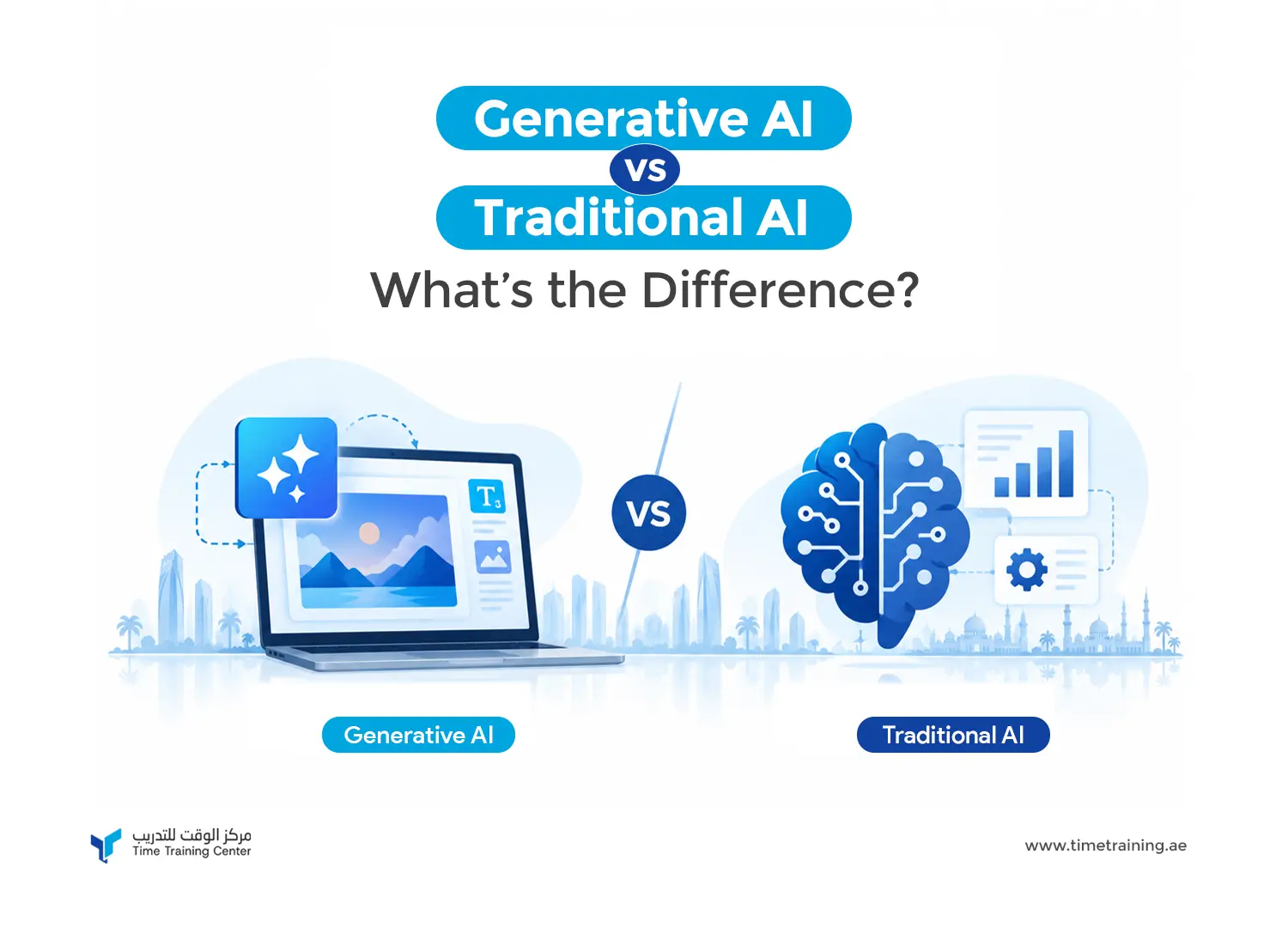
A generative AI tool is software that creates new content (text, images, code, audio or video) from a prompt, rather than simply retrieving or analysing existing data. ChatGPT writes a report from a short brief. Midjourney paints an image from a sentence. GitHub Copilot writes code from a comment. That single shift, from retrieving information to generating it, is why these tools have moved from novelty to necessity in just three years.
Globally, generative AI usage reached 17.8% of the world's working-age population in early 2026, nearly double the rate from two years earlier. In the UAE, that figure is 70.1%, almost four times the global average, and the country remains the only economy in the world to cross the 70% threshold. To become an advanced professional in your field, learn Generative AI in Abu Dhabi.
Why This Matters for Every Professional Right Now
Generative AI adoption inside organisations has matured quickly. 65% of companies worldwide now use generative AI in at least one business function, nearly double the 2023 rate, concentrated heavily in marketing, software engineering and customer operations.
Yet usage and value are two different things. Only around one in three organisations has managed to scale generative AI beyond a single pilot project to a genuine, organisation-wide impact. The gap isn't the technology. It's the people who know how to direct it properly. That's precisely the skill gap Time Training Center is built to close. Check out the top AI training institutes in Abu Dhabi.
AI and generative AI may be the most important technology of any lifetime.
— Marc Benioff, CEO, Salesforce
Why Abu Dhabi and the UAE Lead the World in Generative AI Adoption
The UAE didn't reach 70.1% adoption by accident. The country appointed the world's first Minister of State for Artificial Intelligence back in 2017, five years before ChatGPT existed, and has followed through with the National AI Strategy 2031, mandatory AI education across all school levels from the 2025–26 academic year, and sovereign, Arabic-first AI models.
-
Sovereign AI models: Abu Dhabi's Technology Innovation Institute built Falcon, an open-source LLM with global reach, and Jais, the world's leading bilingual Arabic-English model.
-
Talent growth: UAE AI talent concentration grew by more than 100% between 2019 and 2025.
-
Trust: UAE residents report markedly higher trust in AI systems than users in the US or Western Europe, according to recent global trust barometers.
-
Government-led pace: Abu Dhabi entities across finance, energy and the public sector are early adopters, creating strong local demand for AI-literate professionals.
For Abu Dhabi-based professionals, this means generative AI fluency isn't a 'nice to have' on a CV any more. It's an expected baseline skill, much like spreadsheet literacy was twenty years ago. You can check out the career opportunities available in artificial intelligence in Abu Dhabi before sending your CV.
Check Out: What Are the Roles and Responsibilities of a Generative AI Engineer?
The 8 Categories of Generative AI Tools Every Professional Should Know
Rather than learning tools one by one, it's far more useful to understand the eight categories they fall into, and which one solves your specific work problem.
Top Generative AI Tools and What They’re Used For
| Category |
Leading Tools |
Best For |
| Language & Assistants |
ChatGPT (GPT-5), Claude, Gemini |
Reports, emails, document analysis, multi-step planning |
| Research & Search |
Perplexity, NotebookLM |
Market research, citations, and summarising long documents
|
| Marketing & Copy |
Jasper AI, Copy.ai, Writer.com |
SEO content, brand-consistent campaigns, and regulated writing
|
| Visual & Design |
Midjourney, DALL·E 3, Canva |
Photorealistic imagery, social graphics, brand assets |
| Video & Media |
Synthesia, Runway, Veo |
Training videos, localised content, AI avatars |
| Audio & Voice |
ElevenLabs, Suno |
Voice cloning, multilingual narration, and podcasts |
| Software Engineering |
GitHub Copilot, Cursor |
Code completion, debugging, refactoring |
| Automation & Agents |
Zapier, Microsoft Copilot |
Connecting apps, multi-step task automation |
Text and Chat Assistants: The Everyday Workhorses
ChatGPT, Claude and Gemini remain the most widely used tools because they handle the broadest range of office tasks: drafting reports, summarising meetings, analysing documents and supporting decisions. For document controllers and project coordinators across Abu Dhabi, these tools cut report drafting time significantly, provided the output is always checked by a human before it goes out the door.
Image and Video Tools: Levelling the Design Playing Field
Midjourney and DALL·E 3 let non-designers produce professional-quality visuals in minutes, while Synthesia turns a script into a presenter-led training video without a camera crew, ideal for multilingual induction content across UAE worksites.
Coding Assistants: Productivity Without Replacing Developers
A common myth is that AI coding tools are shrinking the developer job market. The data says the opposite: US software developer employment hit a record 2.2 million in 2025, up 8.5% year-on-year, even as GitHub Copilot and similar tools cut coding time by around 55%. Cheaper, faster development simply means organisations build more software, not less of it.
Automation and Agents: The Next Layer
Tools such as Zapier and Microsoft Copilot connect generative AI to everyday business systems, triggering multi-step actions across email, spreadsheets and project trackers without manual handling. For UAE businesses managing large project portfolios, this category is where 'AI agents' move from buzzword to genuinely useful colleague, capable of planning and completing several linked tasks before a human even checks in.
The Enterprise Scaling Gap: Why Generative AI Usage Doesn't Always Equal Value
Plenty of teams now use generative AI somewhere in their workflow, yet far fewer have turned that usage into measurable business results. McKinsey's research highlights a consistent pattern: organisations that simply 'bolt on' AI tools to an unchanged process rarely see lasting gains. The ones that succeed redesign the whole workflow around the tool, not the other way round.
-
Underestimated integration costs: Change management, retraining staff and redesigning approval steps, often costs several times more than the AI subscription itself.
-
Workflow redesign: High performers rebuild entire processes, such as document review or sales handoffs, with AI as the default first step rather than an optional extra.
-
Weak measurement: Many organisations track tool usage but not output quality or business impact, making it hard to justify further investment.
-
'Shadow AI': Employees often use AI tools more than leadership realises, which points to a need for clear policy and proper training rather than informal bans.
For professionals, this gap is an opportunity. The individuals who understand how to redesign a process around AI, not just use a chatbot for odd tasks, are the ones organisations are actively trying to hire and promote in 2026. Check out how to start a career in Artificial Intelligence in Abu Dhabi.
The Trust Divide: 'Magic' vs 'Lies'
Not every expert agrees on how reliable generative AI should be. This debate matters because it shapes which tools are safe to use for client-facing or regulated work.
I don't call them hallucinations, I call them lies, for enterprise applications, trust, accuracy and data consistency are non-negotiable.
— Marc Benioff, CEO, Salesforce
OpenAI's Sam Altman takes a different view, arguing that a degree of unpredictability is part of what makes generative reasoning creative rather than purely mechanical. For professional use, the safest approach sits between both views: use generative AI to draft and explore, but always keep a human checking facts, figures and sources before anything goes external, a principle often called Human-in-the-Loop.
Search engines have started enforcing this distinction too. Following Google's 2025 content-quality guidance, unverified, low-effort AI content is increasingly rated as the lowest-quality tier, making properly fact-checked, cited content (like this guide) far more valuable for ranking and trust.
From Creator to Curator: How Generative AI is Changing Your Role?
Generative AI is shifting professional value away from producing first drafts and towards judgment: choosing the right tool, verifying the output, and deciding what should happen next.
People have been demystified by using it... the job moves to a higher level of abstraction.
— Sam Altman, CEO, OpenAI
Three skills now matter more than knowing any single tool:
-
Structured prompt engineering → writing prompts that reliably produce usable, on-brand output.
-
Workflow design → knowing how to chain multiple AI tools into a single, repeatable process.
-
Verification and editorial judgement → catching errors before they reach a client, regulator or manager.
Key Takeaways→
-
The UAE leads the world in generative AI adoption at 70.1%, nearly four times the global average.
-
Professionals need fluency across eight tool categories, not just one chatbot.
-
65% of organisations use generative AI, but only a third scale it successfully. Skilled people close that gap.
-
Verification and prompt engineering are now core professional skills, not optional extras.
Generative AI tools are only as good as the professional directing them. Whether you're drafting Primavera P6 schedules, writing SEO content, or managing documents on a major Abu Dhabi project, the tools above can save hours every week, provided you know how to brief them properly and check their work.
Frequently Asked Questions On Top Generative AI Courses in 2026
Which generative AI tool should I learn first?
Start with a general-purpose assistant such as ChatGPT or Claude. They cover the widest range of everyday office tasks (drafting, summarising and analysis) before you branch into specialised tools for design, code or video.
Is generative AI replacing jobs in the UAE?
Current data shows augmentation rather than replacement. Software developer employment, for example, reached a record high in 2025 despite widespread AI coding tool adoption, because lower production costs increase overall demand for digital work.
How is the UAE government supporting generative AI adoption?
Through the National AI Strategy 2031, a dedicated AI ministry since 2017, mandatory AI education in schools from 2025–26, and sovereign Arabic-English models such as Jais, developed at Abu Dhabi's Technology Innovation Institute.
Do I need to be technical to use these tools at work?
No. Most leading tools, including ChatGPT, Canva and Microsoft Copilot, are designed for non-technical professionals. Structured training helps you use them accurately and efficiently rather than by trial and error.
 +971 2 6713828