CHRP is the right choice if you want broad HR credibility, GCC-specific compliance knowledge, and a pathway into HR leadership.
An HR Analytics certification is the right choice if you already have HR fundamentals and want to stand out with data, dashboards, and predictive workforce insights- the skill Abu Dhabi employers are currently paying the biggest premium for.
If you work in HR in Abu Dhabi and you're standing at a crossroads between two certifications, you're not alone. Every month, hundreds of HR professionals across the UAE ask the same question in different words: should I go generalist with CHRP, or specialise with an HR Analytics certification?
Key Takeaways: What is the difference between CHRP and HR Analytics Certification?
-
Choose CHRP for HR leadership and compliance careers.
-
Choose HR Analytics to specialise in workforce data and reporting.
-
HR Analytics professionals earn around 20–30% higher salaries in comparable UAE roles.
-
Abu Dhabi employers increasingly seek professionals with both HR and analytics expertise.
-
The strongest long-term career path is CHRP followed by HR Analytics.
Let's break this down properly, because the "right" answer depends entirely on where you're standing in your career right now.
Table of Contents
|
|
1. What is CHRP and Who Should Choose It?
2. What Does an HR Analytics Certification Teach?
3. CHRP or HR Analytics: Which Certification Should You Choose?
3.1 What Skills Do CHRP and HR Analytics Certifications Teach?
4. Why Are Abu Dhabi Employers Paying More for HR Analytics Skills?
4.1 Should You Earn Both CHRP and HR Analytics Certifications?
4.2 Questions to Help You Choose the Right HR Certification
5. Why Choosing the Right HR Certification Matters More in Abu Dhabi?
6. FAQs: CHRP vs HR Analytics Certification
|
What is CHRP and Who Should Choose It?
CHRP (Certified Human Resource Management Professional) is a generalist HR credential that covers the full spectrum of human resource management.
It focuses on recruitment and workforce planning, learning and development, performance management, compensation and benefits, employee relations, digital HR transformation, and legal and ethical compliance.
Good CHRP programmes in the UAE now weave HR analytics into the curriculum as one module among many, alongside GCC-specific labour law and compliance training.
CHRP Certification in Abu Dhabi is best suited for HR generalists, coordinators, and officers who want a recognised, well-rounded credential that opens doors to HR Business Partner, HR Manager, or HR Director roles.
Expert Insight
Gulf News, reporting on Abu Dhabi's 2026 HR Law, notes that the legislation is built to "reinforce the Abu Dhabi Government's standing as an attractive employer for top talent" through clearer career pathways and performance-based incentives a structural signal that measurable performance, not tenure alone, now drives HR decisions in the capital.
Want to know exactly what the CHRP path looks like? Read our step-by-step guide to becoming a Certified Human Resources Professional.
What Does an HR Analytics Certification Teach?
An HR Analytics (or People Analytics) certification goes deep instead of wide.
It focuses on turning workforce data into decisions: attrition modelling, dashboard building, workforce forecasting, engagement analytics, and connecting HR metrics directly to business outcomes like retention and cost-per-hire.
The HR Analytics course in Abu Dhabi is best suited for HR professionals who already have generalist experience and want to specialise in a high-demand, high-premium skill set, or HR leaders who need to defend HR decisions with numbers in the boardroom.
CHRP or HR Analytics: Which Certification Should You Choose?
The right certification depends on your current experience, career goals, and the type of HR role you want to pursue. Use the quick guide below to identify whether CHRP, HR Analytics, or a combination of both best matches your career path.
If you're early career or a generalist: Choose CHRP. It builds the broad foundation employers expect before trusting you with strategic HR decisions, and Abu Dhabi's evolving 2026 HR Law makes compliance and framework knowledge more relevant, not less.
If you're mid-career and want to stand out fast: Choose an HR Analytics certification. The 20–30% salary premium, the shortage of professionals who can execute on data (per HR.com's own research), and the sheer volume of new analytics-titled roles in Abu Dhabi all point the same direction.
If you can only choose one path for the next two years: Most UAE HR consultancies now recommend layering a generalist credential like CHRP, followed by a focused HR Analytics certification once you're established. That combination consistently commands the strongest offers in Abu Dhabi's current HR market.
Independent UAE HR consultancies now advise that pairing a generalist credential with demonstrated data skills is the strongest possible career move heading into 2026 and 2027, as digital proficiency becomes a baseline expectation rather than a bonus.
What Are the Best HR Certifications in Abu Dhabi Besides CHRP and HR Analytics?
Some of the best HR certifications in Abu Dhabi besides CHRP and HR Analytics include:
-
SHRM-CP/SHRM-SCP
-
CIPD Level 5 Diploma in People Management
-
HRCI PHR
-
UAE Labour Law & HR Compliance Certification
-
Certified Talent Management Practitioner (CTMP)
-
Certified Compensation Professional (CCP)
These HR certifications in Abu Dhabi help HR professionals develop expertise in strategic HR, compliance, talent management, compensation, and leadership.
Aiming for the manager track eventually? Check out 6 effective ways to become a successful HR manager.
The comprehensive comparison between the CHRP and HR Analytics course in Abu Dhabi is explained in the table below:
CHRP vs HR Analytics Certification: Side-by-Side Comparison
| Factor |
CHRP |
HR Analytics Certification |
| Scope |
Broad, covers entire HR function |
Narrow and deep, focused on data and metrics
|
| Ideal candidate |
HR generalists, early-to-mid career |
HR professionals with 2+ years' experience
|
| Career pathway |
HR Officer → HRBP → HR Manager/Director |
HR Analyst → People Analytics Lead → Head of HR Analytics
|
| Abu Dhabi relevance |
Aligns with GCC labour law and the new 2026 HR Law framework |
Aligns with Emiratisation tracking, workforce forecasting, KPI dashboards
|
| Typical study duration |
3 - 6 months |
4 - 12 weeks (often shorter, tool-based)
|
| Reported salary impact |
Strengthens eligibility for management-track roles |
Associated with a 20–30% pay premium at the same job title
|
| Learning style |
Frameworks, case studies, compliance content |
Tools-based: Excel, Power BI, dashboards, statistics
|
| Recognition |
Strong for HR leadership and compliance-heavy roles |
Strong for HRBP, HR Reporting, and Workforce Planning roles
|
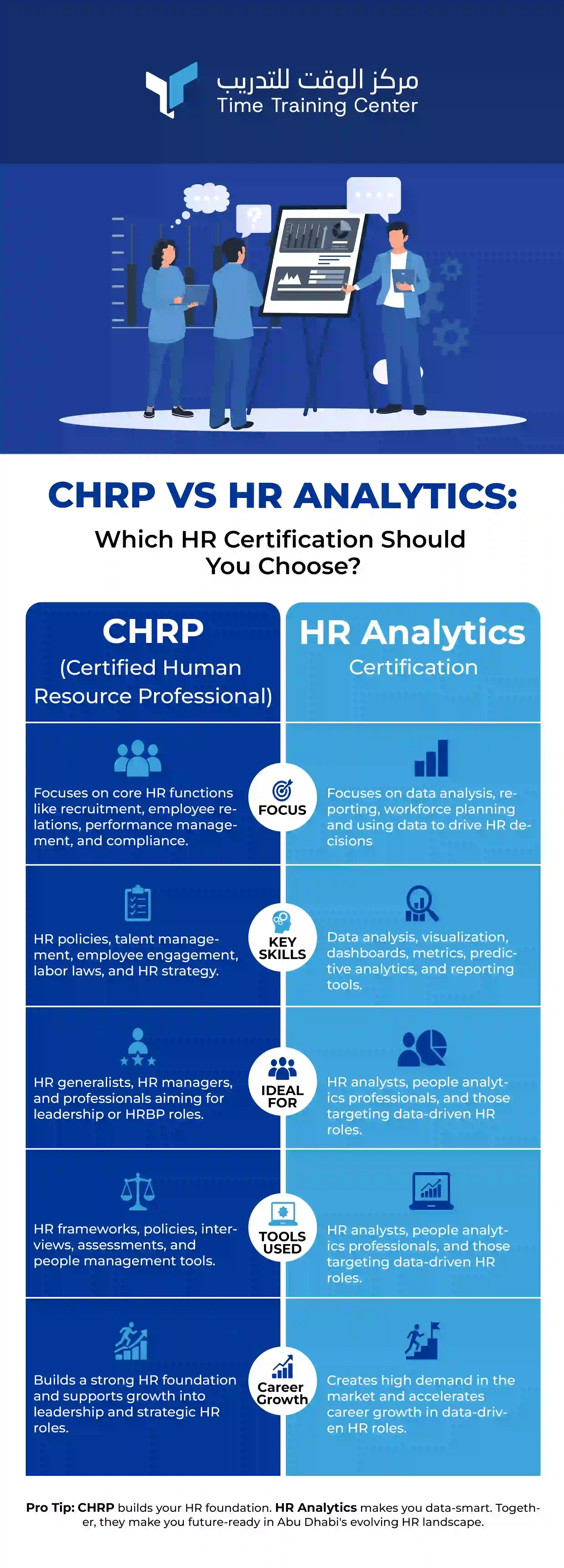
The major difference between CHRP and HR Analytics certification is illustrated in the infographic below:
What Skills Do CHRP and HR Analytics Certifications Teach?
The skills that CHRP and HR Analytics certifications teach are:
| CHRP Skills |
HR Analytics Skills
|
| Recruitment & Selection |
HR Dashboards (Power BI/Excel)
|
| Performance Management |
Workforce Analytics
|
| Employee Relations |
Attrition Analysis
|
| Compensation & Benefits |
Predictive HR Analytics
|
| UAE/GCC Labour Law |
HR Metrics & KPIs
|
| Learning & Development |
Data Visualization
|
| HR Policies & Compliance |
Workforce Planning
|
| HR Strategy |
Reporting & Business Insights
|
Why Are Abu Dhabi Employers Paying More for HR Analytics Skills?
Abu Dhabi employers pay more for HR professionals with analytics skills because data-literate talent remains in short supply.
-
HR analytics professionals can earn 20–30% higher salaries than peers in similar HR roles.
-
Data-driven HR skills are among the biggest salary differentiators across the UAE.
-
Abu Dhabi government-linked employers typically offer 10–15% higher pay plus stronger allowances than Dubai's private sector.
-
Combining HR analytics skills with government-sector roles can significantly boost earning potential.
-
Demand is growing for roles such as HR Reporting Lead, HR Data & Analytics Officer, and Workforce Planning Manager.
The salary comparison of CHRP and HR Analytics professionals in Abu Dhabi is listed in the table below:
CHRP vs HR Analytics Salary Comparison in Abu Dhabi (2026)
| Career Path |
Typical Monthly Salary (AED) |
Best Certification |
| HR Coordinator |
6,000 - 9,000 |
CHRP |
| HR Officer |
8,000 - 12,000 |
CHRP |
| HR Generalist |
10,000 - 15,000 |
CHRP |
| HR Business Partner |
16,000 - 25,000 |
CHRP + HR Analytics |
| HR Analyst |
15,000 - 22,000 |
HR Analytics |
| HR Reporting Specialist |
16,000 - 24,000 |
HR Analytics |
| Workforce Planning Specialist |
18,000 - 28,000 |
HR Analytics |
| People Analytics Manager |
25,000 - 40,000+ |
HR Analytics + Experience
|
| HR Manager |
20,000 - 35,000 |
CHRP |
| HR Director |
35,000 - 60,000+ |
CHRP + HR Analytics |
Should You Earn Both CHRP and HR Analytics Certifications?
Global research backs up the idea that this isn't an either/or forever. Deloitte's 2026 Global Human Capital Trends report projects that 70% of job roles will change in some way by 2030, requiring around 1.4 million workers to reskill.
In the UAE specifically, hiring-intent data from human capital firm Taaeen Group shows the country leading globally, with 56% of employers planning to expand headcount in 2026, but half of those organisations admit they still lack live skills assessment capability. (Khaleej Times)
That gap is exactly where certified, data-literate HR professionals get pulled to the front of the queue.
HR.com's State of People Analytics 2025–26 research adds a sobering note: despite widespread interest, few organisations are genuinely effective at people analytics yet. That's an opportunity, not a warning; it means certified professionals who can actually execute are still rare enough to be valuable.
Questions to Help You Choose the Right HR Certification
Ask yourself these questions before choosing to help you select the right HR certification in Abu Dhabi:
| If Your Goal Is... |
Recommended Certification
|
| You're new to HR or building generalist experience. |
Start with CHRP training to develop a strong foundation in core HR functions.
|
| You understand HR fundamentals but lack confidence with HR data and reporting. |
Choose HR Analytics to build practical data analysis and workforce planning skills.
|
| You aim to become an HR Director or Chief Human Resources Officer (CHRO). |
Begin with CHRP, then add HR Analytics to strengthen strategic decision-making skills.
|
| You're targeting HR Reporting, Workforce Planning, or People Analytics roles. |
HR Analytics is the faster and more specialised path for these positions.
|
| You work-or plan to work-for an Abu Dhabi government entity or a large multinational. |
Consider both certifications. Data literacy is increasingly valued, and HR Analytics can accelerate salary growth while CHRP strengthens overall HR expertise.
|
Expert Quote
Prabhu Ramachandran, founder of Facilio Inc., told Gulf News that younger employees are "changing workplace dynamics" to reflect their own priorities a trend UAE HR teams are increasingly expected to track and respond to with real data rather than guesswork.
Curious about the career impact? See how a CHRP certification can boost your HR career in Abu Dhabi.
Why Choosing the Right HR Certification Matters More in Abu Dhabi?
Choosing the right HR certification matters more as Abu Dhabi's HR landscape has shifted fast. The major factors for this change are stated below:
-
New HR regulations are changing the profession: Abu Dhabi's Human Resources Law (effective 1 January 2026) has introduced a more performance-driven approach to HR in government organisations.
-
Data-driven HR is becoming the standard: Promotions, workforce planning, and performance decisions increasingly rely on measurable HR data rather than policy knowledge alone.
-
Emiratisation is increasing demand for workforce analytics: Organisations must meet Nafis employment targets, making workforce tracking, reporting, and forecasting more important than ever.
-
HR professionals now need both compliance and analytical skills: Employers value professionals who understand HR policies and can translate workforce data into business decisions.
-
CHRP builds strong HR foundations: It prepares professionals for recruitment, employee relations, compliance, performance management, and broader HR leadership roles.
-
HR Analytics develops high-demand technical skills: It focuses on dashboards, workforce planning, HR reporting, and people analytics that support strategic decision-making.
-
Choosing the right certification depends on your career goals: CHRP is ideal for generalist and leadership careers, while HR Analytics is better suited for data-focused HR and workforce planning roles.
Ready to choose where to study? Explore the top HR analytics institutes in Abu Dhabi.
FAQ's
1. Should You Choose CHRP or HR Analytics for an HR Career in Abu Dhabi?
Choose CHRP if you want a broad HR career or leadership role. Choose HR Analytics if you're interested in workforce data, reporting, and strategic decision-making. Combining both certifications can provide a stronger competitive advantage.
2. Which certification is easier for beginners?
CHRP is generally easier for beginners because it builds a strong foundation in core HR concepts before moving into specialised topics.
3. Is CHRP recognised across the GCC?
Yes. CHRP is widely recognised across the GCC and is valued by employers hiring for generalist, HR business partner, and leadership-track roles.
4. Can HR Analytics help non-HR professionals?
Yes. HR Analytics is also useful for professionals in business analysis, operations, workforce planning, and people management who work with employee data.
5. Which certification offers better long-term career growth?
It depends on your goals. CHRP supports broader HR leadership careers, while HR Analytics provides a competitive advantage in data-driven HR roles. Combining both offers the strongest long-term prospects.
6. Do recruiters value CHRP and HR Analytics together?
Yes. Many recruiters value candidates who combine CHRP's HR expertise with HR Analytics' data skills, especially for strategic and senior HR positions.
 +971 2 6713828