Career prospects for Data Analysts in Abu Dhabi are genuinely strong right now, and they keep improving. The emirate holds 38% of the UAE's data science and analytics market, the largest share in the country, and AI-related job postings across the UAE have almost tripled since 2021. Banks, government bodies, energy giants and hospitals all need people who can turn raw numbers into decisions. This guide walks you through the roles, skills, salaries and training path that actually matter in 2026, so you know exactly where you stand and what to do next.
Quick Answer
Abu Dhabi holds the largest share of the UAE's data analytics market (38%). SQL, Excel and Power BI top the skills list; mid-level analysts typically earn AED 14,000–45,000 a month, and a recognised Data Analytics Course in Abu Dhabi is one of the fastest ways to become job-ready.
→ Explore the Data Analytics Course in Abu Dhabi
|
Table of Contents
|
|
1. Why Abu Dhabi Is Becoming a Data-First Economy
2. Which Industries in Abu Dhabi Hire Data Analysts?
3. Common Data Analyst Job Roles and the Career Path
4. Skills Employers Look for in Abu Dhabi
5. Tools Every Data Analyst Should Know
6. Qualifications and Certifications That Matter
7. How Much Does a Data Analyst Earn in Abu Dhabi?
8. Does AI Replace Data Analysts, or Change the Job?
9. How to Prepare for a Data Analyst Career in Abu Dhabi
10. Build Your Data Analytics Career with Time Training Center
11. Common Questions About Data Analyst Careers in Abu Dhabi
12. Conclusion
|
Why Abu Dhabi Is Becoming a Data-First Economy
Abu Dhabi is turning into a data-first economy because national strategy now puts data and AI at the centre of growth, not on the side. The federal Digital Economy Strategy aims to double the digital sector's share of GDP, from 9.7% in 2022 to 19.4% by 2032, and the UAE economy is projected to grow by 4.5% in 2026. Abu Dhabi captures the biggest slice of this shift, driven by ADNOC's energy operations, large infrastructure projects and government digitisation.
“Our goal is a government that is faster, smarter and always one step ahead... We are building the government of the future, one that runs on data and agentic AI, built around people, not paperwork.” His Highness Sheikh Mohammed bin Rashid Al Maktoum, UAE Prime Minister
This is not a vague ambition. ADNOC already runs its Panorama digital command centre on live data for predictive maintenance and safety monitoring, and Abu Dhabi's AI company base grew by 67% in 2025 alone. For anyone weighing up a Data Analytics Training in Abu Dhabi, this is the backdrop: real government money, real infrastructure and real hiring behind the numbers. Check if data analytics training is worth it in Abu Dhabi.
Which Industries in Abu Dhabi Hire Data Analysts?
Energy, banking, government and healthcare hire the most Data Analysts in Abu Dhabi, because these sectors handle the largest and most complex data sets. Retail, logistics and telecoms are catching up fast as digital transformation spreads across the wider economy.
Industries Hiring Data Analysts in Abu Dhabi and the Typical Job Roles
| Industry |
How Analytics Is Used |
Typical Roles |
| Energy & Oil and Gas (ADNOC) |
Predictive maintenance, reservoir modelling, safety monitoring |
Data Analyst, AI & Automation Specialist
|
| Banking & Financial Services |
Fraud detection, risk scoring, sanctions screening |
Risk Analyst, Data Analyst
|
| Government & Public Sector |
Smart government dashboards, national data standards |
Data Governance Analyst
|
| Healthcare |
Hospital operations, public health monitoring |
Digital Health Analyst
|
| Retail & Logistics |
Inventory forecasting, route optimisation |
Business Intelligence Analyst
|
These industries seek professionals equipped with essential data analytics skills. Explore the top in-demand data analytics skills that can help you succeed in this vibrant job market in Abu Dhabi.
Common Data Analyst Job Roles and the Career Path
A Data Analyst career in Abu Dhabi usually starts at junior level and moves towards specialist or leadership roles as skills and domain knowledge grow. The path is not always a straight line, and many analysts branch into Business Intelligence, analytics engineering or data science along the way.
| Career Stage |
Typical Role |
Core Focus |
| Entry level |
Junior Data Analyst |
Data cleaning, reporting, dashboards
|
| Early career |
Data Analyst |
SQL queries, Power BI/Tableau dashboards, stakeholder reports
|
| Experienced |
Senior / Lead Data Analyst |
Advanced analytics, ETL oversight, mentoring juniors
|
| Specialist |
BI Developer / Analytics Consultant |
Building BI systems, cross-team advisory
|
| Advanced |
Analytics Engineer / Data Scientist |
Predictive modelling, machine learning, automation
|
If you already work in finance, marketing or operations, the switch is realistic. Business Analyst, Product Analyst, Marketing Analyst and Financial Analyst roles all share the same technical core, so your domain experience becomes an advantage rather than a barrier. A structured Data Analytics Certification builds the missing technical layer on top of what you already know. See how you can become a data analyst in Abu Dhabi.
Which are the Data Analytics Skills Employers Look for in Abu Dhabi?
SQL, Excel and Power BI are the three skills that appear most often in Abu Dhabi Data Analyst vacancies, based on an analysis of over 500 active job postings. Employers pair these technical skills with stakeholder management and critical thinking, because a chart only matters if someone can explain what it means for the business. Here’s the chart given below:
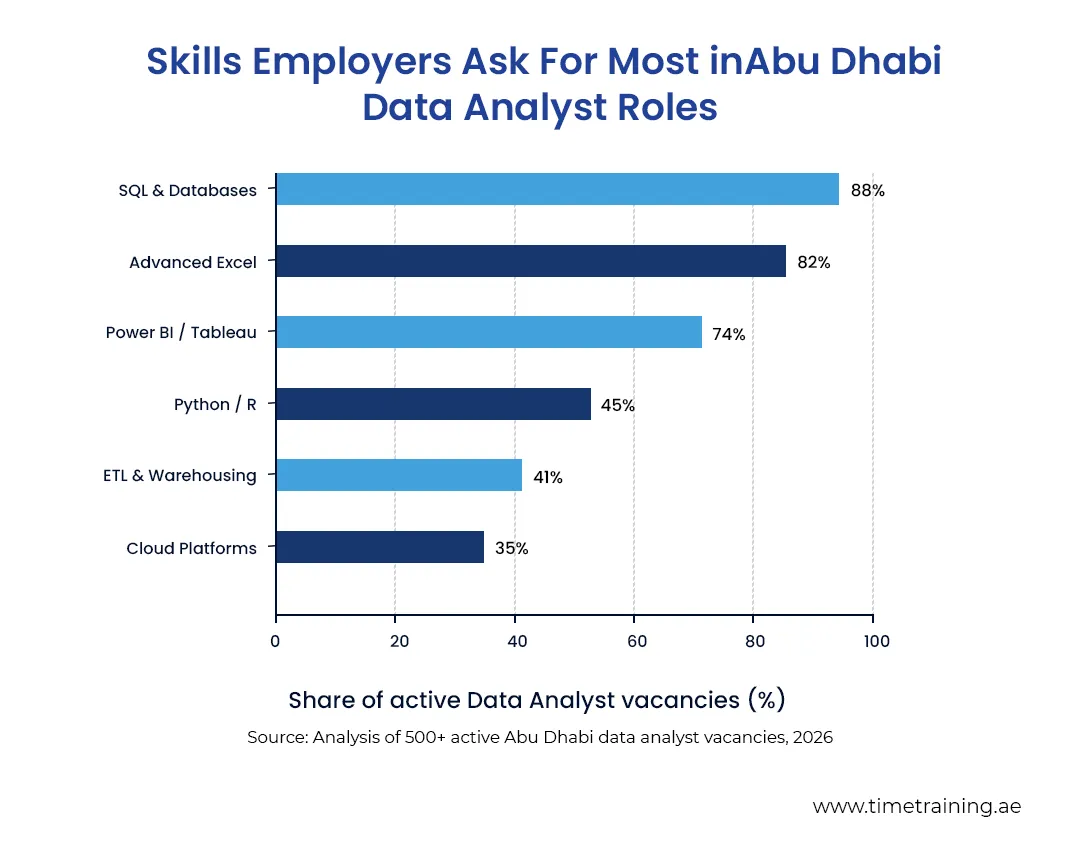
Technical skills most requested in Abu Dhabi Data Analyst vacancies,2026
Soft Skills That Complete the Package for a Data Analyst
A Data Analyst must have the following soft skills to be successful in the role. These include:
-
Stakeholder management: explaining findings to non-technical managers, needed in 78% of roles
-
Critical thinking: spotting the real cause behind a number, needed in 72% of roles
-
Business acumen: understanding the sector you work in, needed in 58% of roles
-
Communication: turning a spreadsheet into a clear, short recommendation
Tools Every Data Analyst Should Know
A data analyst must be familiar with a set of tools to make the job easier. Below are the major tools required for a Data Analyst.
-
Excel: the baseline for almost every role, especially Power Query and XLOOKUP for fast, hands-on analysis
-
SQL: the single most requested skill, used to query and model data inside large organisations such as banks and ADNOC
-
Power BI: the dominant BI tool in the UAE market, closely tied to the respected PL-300 certification
-
Tableau: a strong alternative for visualisation-heavy roles, especially in consulting and retail
-
Python: increasingly asked for automation, basic predictive modelling and handling larger datasets
You may also find these best data analytics tools helpful in your Data Analytics Career in Abu Dhabi. No single tool is essential for every job. What matters is depth in two or three of them, plus the judgement to know which one fits a given problem.
This is exactly why a guided Data Analyst Training programme works better than teaching yourself from scattered tutorials.
What Qualifications and Certifications Matter for Data Analyst?
A bachelor's degree in a numerate subject helps, but it is not the only route into Data Analytics in Abu Dhabi. Employers increasingly hire on demonstrated skill, backed by a recognised certification and a portfolio of real projects.
-
Microsoft Power BI Data Analyst Associate (PL-300): widely recognised across UAE employers and a strong signal for applicant tracking systems
-
Google or IBM Data Analytics certificates: useful for building foundational skills, especially for career changers
-
A local project portfolio: built using open datasets, such as the Statistics Centre – Abu Dhabi (SCAD) open data portal, to show Abu Dhabi-specific relevance
-
Structured classroom training: gives faster, more consistent progress than self-study alone, and adds a mentor to check your work
A certification never guarantees a job on its own, and no training provider can promise employment. What a well-designed Data Analytics Course in Abu Dhabi does offer is a structured, practical route to the skills employers keep asking for.
How Much Does a Data Analyst Earn in Abu Dhabi?
Data Analyst salaries in Abu Dhabi vary widely by experience and by how skilled the role really is, from AED 8,000 a month for a junior analyst to over AED 45,000 for a senior specialist. The UAE has no personal income tax, so the figure on your offer letter is close to your actual take-home pay.
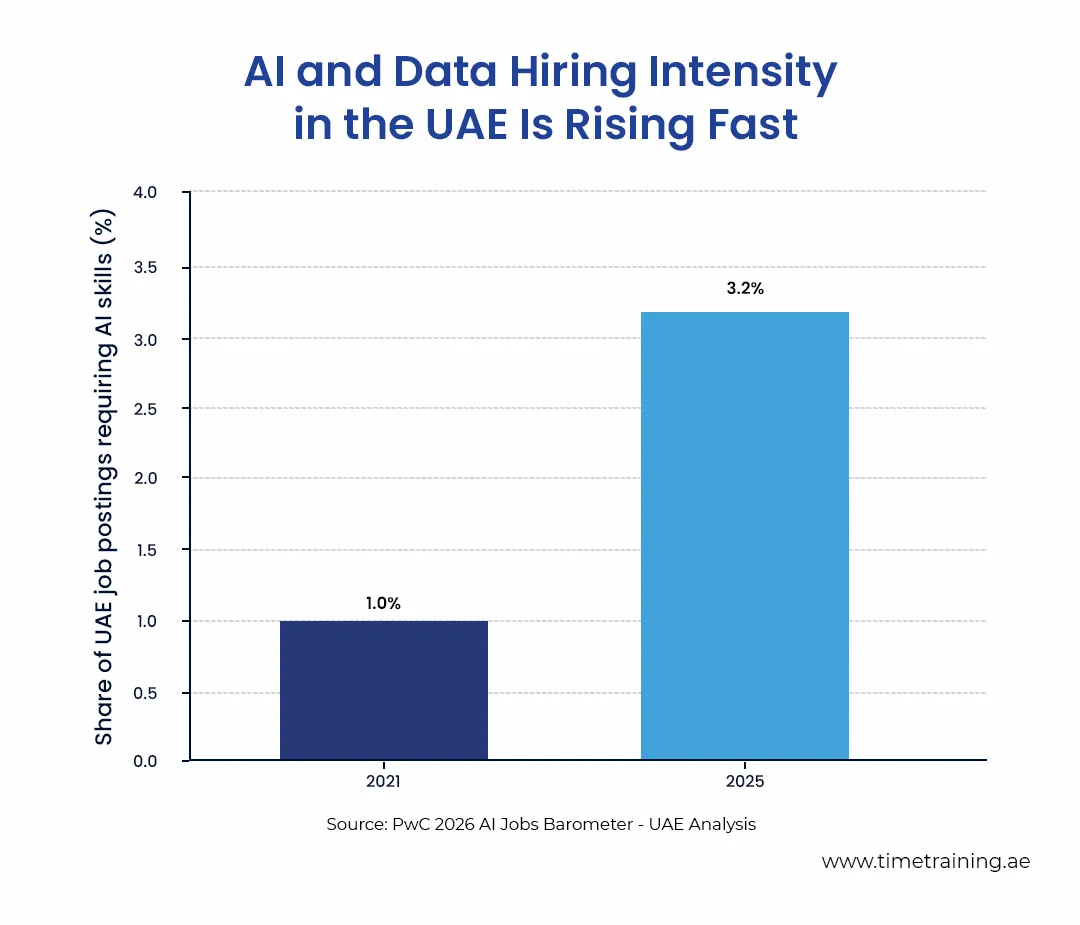
AI and data-skill hiring intensity in UAE job postings, 2021 vs 2025
Data Analyst Salary in Abu Dhabi
| Experience Level |
Monthly Salary (AED) |
Notes |
| Entry / Junior Data Analyst |
8,000 – 12,000 |
Focus on Excel, SQL basics and a starter BI tool
|
| Professional / Mid-level |
14,000 – 45,000 |
SQL, Power BI/Tableau, ETL and cloud exposure
|
| Senior / Lead Data Analyst |
25,000 – 46,000+ |
Predictive analytics, BI strategy, stakeholder leadership
|
| Administrative 'Analyst' roles |
1,300 – 2,500 |
Often data-entry work mislabelled as analytics — check the job description carefully
|
Treat any single figure with caution. Pay depends on the employer, the sector and how the role is actually defined, so always check what the job really involves before comparing offers. Find out what the average salary of a Data Analyst in Abu Dhabi is.
Does AI Replace Data Analysts, or Change the Job?
AI changes what a Data Analyst does far more than it removes the need for one. Routine reporting and basic dashboard building are increasingly automated, but someone still has to ask the right question, judge whether an answer makes sense and explain it to decision-makers.
“AI is going to beat us to the target. If you have to be hyper-specialised, AI can do that better than us. The only way you can stand a chance is if you have the breadth of knowledge.” — H.E. Omar Sultan Al Olama, UAE Minister of State for Artificial Intelligence
This idea, often called 'cognitive breadth', is why employers value analysts who understand their sector, not just their software. Research from PwC's 2026 AI Jobs Barometer also shows that the most AI-exposed roles now need a much wider set of skills than less-exposed ones, which points the same way: broader, not narrower, skill sets win.
How to Prepare for a Data Analyst Career in Abu Dhabi
The six steps given below can help you prepare for a career in Data Analytics in Abu Dhabi. Follow these steps:
-
Start with SQL and Excel: these two skills unlock the largest share of job postings, so get them solid before moving on.
-
Build a local portfolio: use Abu Dhabi or UAE datasets so your projects speak directly to local employers.
-
Earn a recognised certification: a credential such as PL-300 helps your CV pass automated screening systems.
-
Practise explaining data simply: record yourself summarising a chart in three sentences, since this is what interviews actually test.
-
Target your sector: energy, banking and government each value different contexts, so tailor your projects and CV accordingly.
-
Join structured training: a guided Data Analytics Training in Abu Dhabi keeps you accountable and closes skill gaps faster than solo study.
You may also check this ultimate career guide on Data Analyst Roadmap.
How to Build Your Data Analytics Career in Abu Dhabi?
Time Training Center's Data Analytics Course in Abu Dhabi is built around exactly the skills covered in this guide: SQL, Excel, Power BI, Tableau and Python, taught through hands-on projects rather than theory alone. The course does not promise a job. It gives you the practical, job-relevant skills that Abu Dhabi employers are actively asking for, so you walk into interviews with real evidence of what you can do.
Conclusion
Career prospects for Data Analysts in Abu Dhabi look genuinely encouraging for anyone willing to build the right skills. The emirate's economy is shifting hard towards data and AI, employers keep asking for the same core toolkit of SQL, Excel and Power BI, and salaries reward those who add sector knowledge on top. The best next step is a practical one: build your skills, build a portfolio and get in front of employers.
FAQ's
1. Are Data Analysts in demand in Abu Dhabi?
Yes. Abu Dhabi holds 38% of the UAE's data science and analytics market, and AI-related hiring across the country has almost tripled since 2021, with energy, banking and government leading demand.
2. What qualifications do I need to become a Data Analyst in the UAE?
A degree in a numerate subject helps, but a recognised certification such as PL-300, plus a strong project portfolio, matters just as much to most UAE employers.
3. Is Data Analytics a good career in Abu Dhabi?
It is a realistic, growing option, especially if you build strong SQL, Excel and Power BI skills and pair them with sector knowledge in energy, finance or government.
4. Can fresh graduates become Data Analysts in Abu Dhabi?
Yes. Entry-level roles typically pay AED 8,000–12,000 a month and focus on Excel, SQL basics and a starter BI tool such as Power BI.
5. Can non-IT professionals switch to Data Analytics?
Yes. Professionals from finance, marketing or operations often move into Data Analytics by adding SQL, Excel and Power BI skills to their existing business knowledge.
6. Which tool should I learn first, Power BI or Tableau?
Power BI is the more widely used tool in the UAE and links to the respected PL-300 certification, so most beginners start there before adding Tableau.
7. What is the difference between a Data Analyst and a Business Analyst?
A Data Analyst focuses on numbers, queries and dashboards, while a Business Analyst focuses more on processes and requirements, though the two roles overlap in many companies.
8. What is the difference between a Data Analyst and a Data Scientist?
Data Analysts mainly describe what has happened using SQL, Excel and BI tools, while Data Scientists build predictive models using more advanced statistics and machine learning.
9. Is Data Analytics a future-proof career in the UAE?
No career is guaranteed, but analysts who build broad, sector-aware skills alongside strong technical tools are well placed as AI automates routine reporting tasks.
10. How long does it take to become job-ready as a Data Analyst?
With focused study or a structured Data Analytics Course in Abu Dhabi, many learners reach an entry-level, job-ready standard within a few months of consistent practice.
 +971 2 6713828