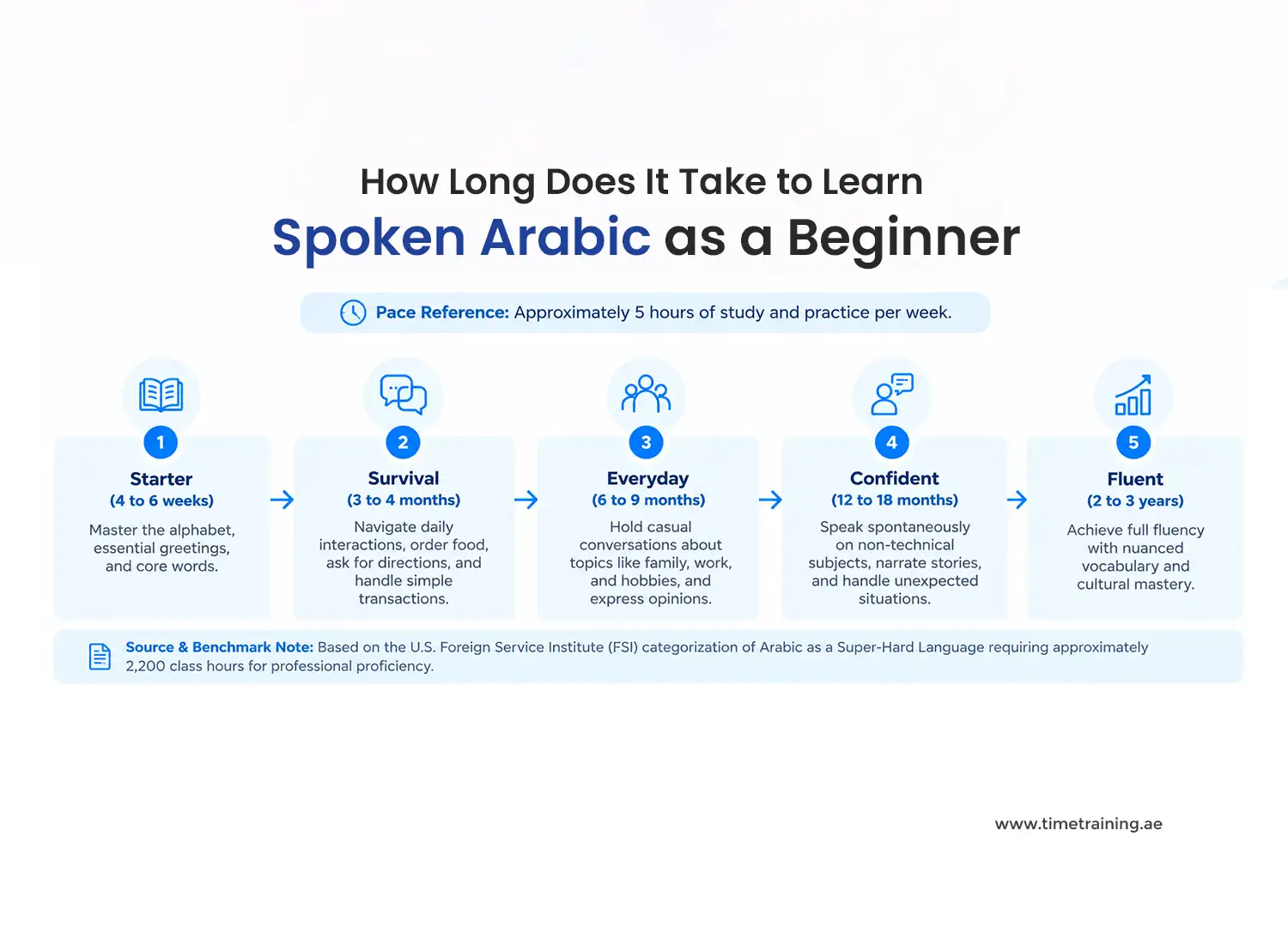
Most beginners reach the Starter stage (basic phrases) in 4 to 6 weeks, Survival (simple daily chats) in 3 to 4 months, and Everyday (comfortable conversation) in 6 to 9 months. That assumes about 5 hours of study a week.
Fluency takes two to three years. Your goal and daily habits matter most.
The lift doors open on the ninth floor. Your neighbour smiles and says, "Sabah al-khair." You smile back. Then your mind goes blank.
Many people in Abu Dhabi know this moment. You live here. You hear Arabic every day. Yet you cannot say much beyond "shukran."
So here is the big question. How long does it take to learn spoken Arabic? And how can you learn spoken Arabic as a beginner without feeling lost?
This blog gives you honest numbers, clear steps, and local tips.
|
Table of Contents
|
|
1. How Long Does It Take to Learn Spoken Arabic as a Beginner?
1.1. How Long Does It Take to Learn Basic Arabic Phrases?
1.2. Can I Learn Conversational Arabic in 6 Months?
2. What Decides How Fast You Learn Spoken Arabic?
3. Which Arabic Should You Learn in Abu Dhabi?
4. How Can You Learn Arabic Faster as a Beginner?
4.1. How Do You Practise Speaking Arabic Every Day?
5. What Should a Beginner Do Each Week?
6. Is a Classroom Course Better Than Learning Alone?
7. What Do Abu Dhabi Experts Say About Learning Arabic?
8. Key Takeaways
9. FAQs: How Long Does It Take to Learn Spoken Arabic as a Beginner?
|
How Long Does It Take to Learn Spoken Arabic as a Beginner?
The average time taken to learn spoken Arabic is about 6 to 9 months to reach the Everyday stage, where you can chat comfortably, if you study around 5 hours a week. Basic phrases come much sooner. Fluency takes two to three years.
The US Foreign Service Institute (FSI) puts Arabic in its hardest group for English speakers. It estimates about 2,200 class hours, or 88 weeks, to reach general professional proficiency in speaking and reading.
That figure assumes full-time study for good language learners. It describes a work-level goal, like running meetings in Arabic, not daily conversation.
Good Arabic classes for beginners focus on the first 130 to 200 hours, where speech starts to feel easier.
How Long Does It Take to Learn Spoken Arabic? A Beginner’s Timeline
| Stage |
Time (about 5 hours a week) |
What you can do
|
| Starter |
4 to 6 weeks |
Greet people, say your name, count
|
| Survival |
3 to 4 months |
Order food, ask prices, give taxi directions
|
| Everyday |
6 to 9 months |
Chat about work, family and plans
|
| Confident |
12 to 18 months |
Follow most talk and share opinions
|
| Fluent |
2 to 3 years |
Speak freely on many topics
|
These stages are practical guides, not fixed rules.
How Long Does It Take to Learn Basic Arabic Phrases?
About 4 to 6 weeks. Learn five new phrases a day, and you can know around 150 in a month.
Start with greetings, numbers, and polite words. Say each one out loud.
Can I Learn Conversational Arabic in 6 Months?
Yes, for simple everyday talk. Not for full fluency.
At 5 hours a week, six months gives you about 130 hours of study. That covers shops, taxis, office small talk, and introductions. You can still make mistakes. That is fine. Mistakes are how speaking skills grow.
This infographic below presents a clear, step-by-step staircase model outlining the timeline, milestones, and time commitments required to learn spoken Arabic from a beginner level to fluency.
What Decides How Fast You Learn Spoken Arabic?
The four factors that decide how fast you learn spoken Arabic are: how often you practise, your first language, your goal, and how much you actually speak.
-
Practice rhythm: Twenty minutes every day beats three hours once a week.
-
Your first language: Hindi and Urdu speakers already know many words that came from Arabic. English speakers start with fewer.
-
Your goal: Buying vegetables needs fewer words than chairing a meeting.
-
Speaking time: Reading about Arabic is not the same as saying it. Talk from week one.
Sounds matter too. A few letters, like ع and ح, feel strange at first. Listen, copy, and repeat. Arabic pronunciation for beginners gets easier with daily practice, and there are simple ways to improve your Arabic speaking skills even on a busy workday.
Which Arabic Should You Learn in Abu Dhabi?
For daily life in Abu Dhabi, start with Emirati Arabic, the local spoken variety. It belongs to the wider Gulf Arabic family. Add Modern Standard Arabic (MSA) later for reading and formal use.
Emirati Arabic vs Modern Standard Arabic: Key Differences for Beginners
| Criteria |
Emirati Arabic (Gulf family) |
Modern Standard Arabic
|
| Used for |
Chatting with neighbours, colleagues, and shopkeepers in the UAE |
News, books, speeches, forms
|
| Heard in daily life |
Often |
Rarely |
| Best for |
Beginners who want to speak |
Reading, writing, formal work
|
"Gulf Arabic" is the wider label for the spoken Arabic of the Gulf. Emirati is the version you hear around Abu Dhabi. Ask which one a course teaches.
Experts do not all agree on the order. Nasser Isleem, a senior Arabic instructor at NYU Abu Dhabi who teaches the Emirati dialect, has said that MSA alone is not enough for expats in the UAE.
He suggests about three semesters of MSA before starting the dialect, as Gulf News reported. Many short courses go the other way and teach the spoken dialect first, because the goal is speaking.
You are not alone in this.
A 2022 study by the Abu Dhabi Arabic Language Centre surveyed 6,087 residents aged 18 and over, from mid-2021 to June 2022. It found that 64% of non-Arabic speakers want to learn Arabic.
Their understanding and use of simple Arabic stood at 26.7%.
A good Arabic language course in Abu Dhabi will cover everyday Emirati phrases first and add MSA basics later. That way, you learn Gulf Arabic in Abu Dhabi in its local form, for real life
How Can You Learn Arabic Faster as a Beginner?
Practise a little every day, speak out loud from day one, and learn whole phrases instead of single words.
-
Learn the sounds first: Good pronunciation helps people understand you, even with simple words.
-
Learn phrases, not lists: "Shlonak?" (How are you?) is more useful than ten loose words.
-
Listen for 15 minutes daily: Try radio in the car or chat in the shop queue.
-
Speak with a person weekly: A teacher, classmate, or friendly colleague all count.
-
Review for 10 minutes before bed: Sleep helps new words stick.
How Do You Practise Speaking Arabic Every Day?
Set a 20-minute slot. Say phrases aloud. Then use them in real places.
Order your coffee in Arabic. Greet the security guard in Arabic. Record a 30-second voice note and play it back.
Speaking Arabic also builds the wider communication skills in Abu Dhabi that employers look for: listening well, speaking clearly, and showing respect for local culture.
What Should a Beginner Do Each Week?
Aim for about 5 hours: two lessons, three listening sessions, one speaking session, and a nightly review.
Weekly Spoken Arabic Practice Schedule for Beginners
| When |
What to do |
Time |
| Two days |
Live lesson or class |
2 x 60 minutes |
| Three days |
Listening and phrase practice |
3 x 30 minutes |
| One day |
Speak with a partner or tutor |
30 minutes |
| Every night |
Quick review of new phrases |
7 x 10 minutes |
Shift your focus as you progress. Month 1: greetings and numbers. Months 2 to 3: shops, taxis and directions. Months 4 to 6: work and family talk.
Is a Classroom Course Better Than Learning Alone?
For most beginners, yes. A teacher fixes your pronunciation early and gives you someone to talk to. Self-study works if you are disciplined.
Which Arabic Learning Method Is Best for Your Goals?
| Your situation |
Best choice |
| You want to speak within 3 months |
Live classes with a teacher
|
| Tight budget and strong self-discipline |
Self-study plus a free programme
|
| Your team speaks Arabic at work |
Course plus daily practice at work
|
| You feel shy speaking in front of others |
Small group or one-to-one lessons
|
For live speaking, a spoken Arabic course in Abu Dhabi gives you a set routine and a teacher who corrects you in the moment.
What Do Abu Dhabi Experts Say About Learning Arabic?
Local voices agree that Arabic helps you work and live here, and that regular practice matters.
-Mahmoud Bay, academic supervisor at The Mother Tongue Center, Abu Dhabi, told Khaleej Times that "70 per cent of the students learn Arabic for work." He added that expats can learn to greet and communicate after one or two two-hour lessons.
-Saeed Al Tunaiji, acting executive director of the Abu Dhabi Arabic Language Centre, said digital learning is "a major focus that provides easy accessibility to those looking to learn."
-Dr Nidal Al Tunaji, Director General of the Zayed House for Islamic Culture, said teaching Arabic to non-speakers "strengthens our Emirati identity."
What does this mean for you? Pick a clear goal, then match your study plan to it.
Key Takeaways
-
How long does it take to learn spoken Arabic? Plan on 6 to 9 months to reach the Everyday stage.
-
Starter takes 4 to 6 weeks, and Survival takes 3 to 4 months. Fluency takes two to three years.
-
Emirati Arabic, the local form of Gulf Arabic, is the quickest route to talking in Abu Dhabi.
-
Twenty minutes a day beats long, rare sessions.
-
To learn spoken Arabic as a beginner, speak early, even when it feels awkward.
FAQ's
1. How long does it take to speak Arabic fluently?
Reaching fluency in spoken Arabic may take 2-3 years or longer with consistent practice. The timeline depends on your starting level, weekly study hours, speaking practice, and definition of fluency.
2. How many months does it take to learn conversational Arabic?
Most beginners can aim for basic conversational Arabic within 6-9 months by studying around five hours a week. Progress depends on lesson quality, regular listening, and opportunities to speak with others.
3. How much Arabic can you learn in 3 months?
In three months, beginners may learn greetings, numbers, shopping phrases, food orders, and simple questions. At five hours a week, this represents approximately 60-65 hours of practice.
4. How many hours does it take to learn conversational Arabic?
A practical starting estimate is 130-200 hours of focused learning for basic conversation, although the hours required vary by learner and Arabic dialect. Regular speaking and listening practice help turn vocabulary into usable communication skills.
5. Is Arabic difficult to learn for beginners?
Arabic can be challenging for English speakers because of its unfamiliar sounds, writing system, grammar, and regional dialects. However, learning everyday spoken phrases is more achievable than reaching professional-level proficiency.
6. How long does it take to understand spoken Arabic?
Beginners may start understanding slow, familiar spoken Arabic within 6–9 months of consistent practice. Understanding fast conversations, unfamiliar accents, and informal expressions usually takes longer. Daily listening to the dialect you want to learn can improve comprehension.
7. Should I learn Emirati Arabic or Modern Standard Arabic first?
If you want to speak with people in Abu Dhabi, start with Emirati Arabic or commonly used Gulf Arabic expressions. Modern Standard Arabic (MSA) is more useful for formal writing, news, books, and speeches. You can learn MSA later if your goals require it.
8. What is the best way to learn Arabic for daily life in Abu Dhabi?
The best approach combines structured spoken Arabic lessons, 20 minutes of daily practice, listening exercises, and real conversations. Practise useful phrases in shops, cafés, taxis, and the workplace to build confidence and improve everyday communication.
 +971 2 6713828