Key Takeaways
-
Primavera P6 professionals plan, schedule, monitor, and control projects using Oracle Primavera P6, which is the industry-standard scheduling software across Abu Dhabi's construction, infrastructure, and oil and gas sectors.
-
Core responsibilities include building the Work Breakdown Structure, setting baselines, tracking progress, forecasting delays, and reporting to project managers and clients.
-
Abu Dhabi's infrastructure pipeline, worth more than AED 200 billion under ADPIC, plus a new AED 55 billion PPP programme for 2026 to 2027, is driving sustained demand for these professionals.
-
Salaries in the UAE range from around AED 10,000 a month for junior schedulers to AED 50,000 or more for planning directors, with certified professionals commanding a clear premium.
-
A career in Primavera P6 typically progresses from Project Coordinator to Planning Engineer, Senior Planning Engineer, Project Controls Engineer, and eventually Project Manager or Planning Director.
-
Structured training, such as Time Training Center's Primavera P6 Course in Abu Dhabi, shortens the learning curve and builds the practical, job-ready skills that UAE employers look for.
Who Is a Primavera P6 Professional?
A Primavera P6 professional is anyone who uses Oracle Primavera P6 to plan, schedule, monitor, and control a project from start to finish. Rather than simply operating a piece of software, they translate a construction or engineering scope of work into a realistic timeline, then keep that timeline honest as the project unfolds.
In Abu Dhabi and across the wider UAE, this title covers several closely related roles: planning engineers, project schedulers, project planners, and project controls engineers. Each one sits inside the same discipline, project controls, and each one is judged on the same outcome: does the project finish on time, on budget, and with a defensible record of why anything changed along the way?
Primavera P6 itself is an enterprise-level project scheduling platform used on construction, infrastructure, engineering, oil and gas, and EPC projects. If you would like a structured route into this career, Time Training Center's Primavera P6 Course in Abu Dhabi is designed to build exactly these practical skills. If you are choosing a certification training program in Primavera P6, Discover: Classroom or Online Primavera P6 Training in Abu Dhabi: Which Is Better?
What are the Core Roles and Responsibilities of Primavera P6 Professionals
Primavera P6 professionals are responsible for building the schedule, tracking progress against it, and reporting variance to stakeholders. Their day-to-day work follows the project lifecycle, from initial planning through to close-out.
1. Building the Work Breakdown Structure (WBS)
Every schedule starts by breaking the total scope of work into manageable sections. Planning engineers organise activities, milestones, and deliverables into a logical WBS that mirrors how the project will actually be delivered on site.
2. Setting the Baseline Schedule
Once activities are sequenced and durations agreed, the professional locks a baseline schedule. This becomes the reference point that every future update is measured against, so any slippage is visible and explainable.
3. Monitoring Progress and the Data Date
At each reporting cycle, the professional updates the schedule against a fixed Data Date, capturing what has genuinely been achieved on site versus what was planned.
4. Forecasting and Reporting
Using the updated schedule, professionals forecast the likely completion date, flag at-risk activities, and prepare progress reports, look-ahead programmes, and recovery plans for project managers, consultants, and clients.
5. Resource and Cost Loading
Labour, equipment, and material resources are assigned to activities, allowing the schedule to support cost forecasting and Earned Value Management rather than acting as a simple time-only bar chart.
6. Risk, Delay, and Claims Support
On complex UAE projects governed by FIDIC contracts, professionals also support Time Impact Analysis and Extension of Time claims, using the schedule as evidence that a delay was genuinely outside the contractor's control.
Check Out: Why Primavera P6 Is the Industry Standard for EPC Projects in the UAE
What are Primavera P6 Professional Roles: A Responsibility Matrix
The table below summarises how responsibility typically shifts as professionals move up the career ladder.
| Role |
Responsibility |
Reports To |
| Project Coordinator |
Data entry, document control, basic schedule support |
Planning Engineer |
| Planning Engineer |
WBS creation, baseline updates, progress tracking |
Senior Planning Engineer |
| Senior Planning Engineer |
Multi-package scheduling, forecasting, reporting |
Project Controls Manager |
| Project Controls Engineer |
EVM, cost-schedule integration, risk analysis |
Project Controls Manager |
| Planning Director |
Portfolio-level oversight, governance, client strategy |
Project Manager / Client |
Primavera P6 Professional vs Project Manager: What Is the Difference?
A common point of confusion for newcomers is how a Primavera P6 professional differs from a Project Manager. The two roles are complementary, not competing. Let’s identify these key differences from the table below:
| Aspect |
Primavera P6 Professional |
Project Manager |
| Primary focus |
Schedule accuracy, logic, and forecasting |
Overall project delivery and stakeholders
|
| Main tool |
Primavera P6 schedule and reports |
Budgets, contracts, and team leadership
|
| Decision scope |
Advises on timeline and delay impact |
Makes final delivery and commercial decisions
|
| Typical output |
Updated programme, S-curves, forecasts |
Status reports, approvals, client sign-off
|
You may also check it out: Can Primavera P6 help you start a career as a Project Coordinator in Abu Dhabi?
Where Do Primavera P6 Professionals Work? Industries Hiring in the UAE
Primavera P6 professionals work across construction, infrastructure, oil and gas, EPC, manufacturing, and utilities projects throughout Abu Dhabi and the UAE. Demand is strongest wherever project schedules are tied to contractual milestones and capital investment.
-
Construction and building: residential, commercial, and mixed-use developments across Abu Dhabi and Al Reem Island.
-
Infrastructure and transport: roads, bridges, and rail projects linked to Etihad Rail and the Department of Municipalities and Transport.
-
Oil and gas and energy: ADNOC-linked EPC projects requiring rigorous, contractually mandated scheduling.
-
Utilities and industrial: projects connected to KEZAD and Abu Dhabi's industrial expansion.
-
Consultancy and PMC firms: supporting multiple clients with independent schedule review and audit.
-
Manufacturing and healthcare infrastructure: increasingly requiring project controls support as Abu Dhabi diversifies beyond oil.
Abu Dhabi and UAE Demand: Why the Primavera P6 Career Is Growing?
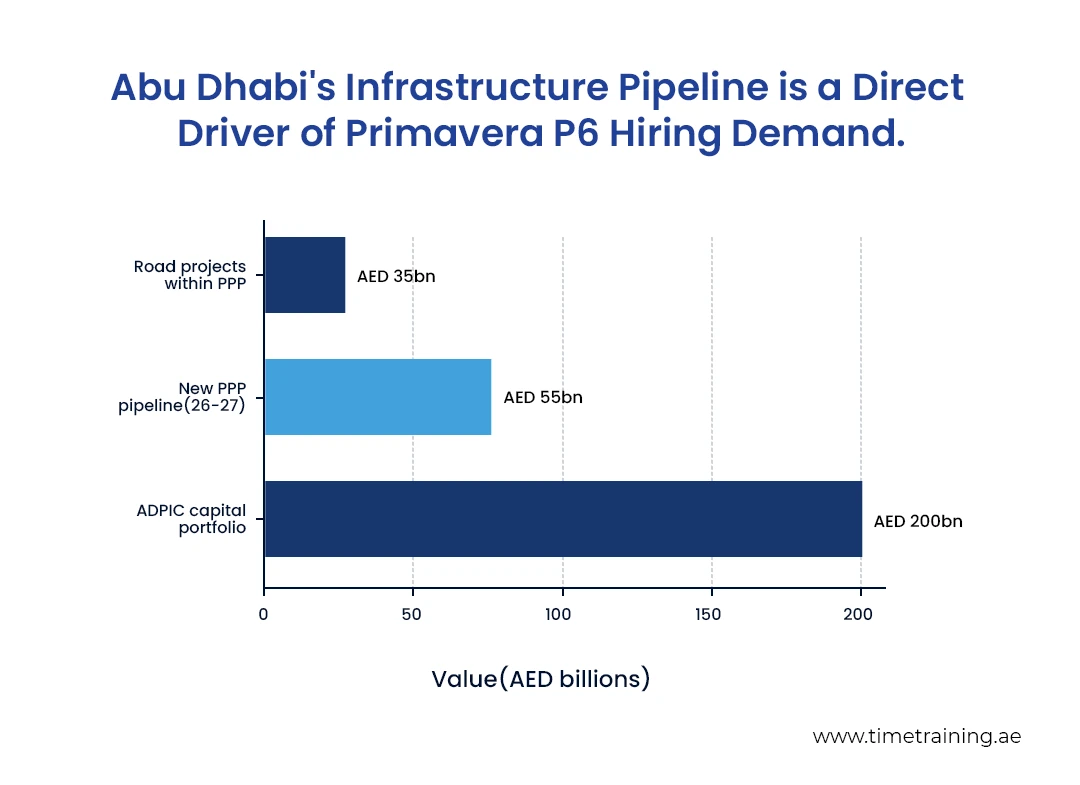
Demand for Primavera P6 professionals in Abu Dhabi is rising because the emirate's infrastructure pipeline is expanding faster than the pool of experienced planners. The Abu Dhabi Projects and Infrastructure Centre (ADPIC) oversees a capital portfolio exceeding AED 200 billion across more than 600 projects in housing, transport, and energy.
In 2026, the Abu Dhabi Investment Office and ADPIC jointly launched a further AED 55 billion public-private partnership pipeline covering 24 projects for 2026 and 2027, including 11 major road developments worth AED 35 billion. Major project owners such as ADNOC, DEWA, and the RTA now treat Primavera P6 proficiency as a contractual requirement rather than a preference, which keeps hiring demand consistently high across every level of experience.
What are the Skills Employers Expect from Primavera P6 Professionals?
Employers in Abu Dhabi in the UAE expect Primavera P6 professionals to have a blend of technical and soft skills, and software knowledge alone rarely secures a role. The table below lists these top skills that employers in Abu Dhabi look for:
| Skill Area |
What Employers Look For
|
| Scheduling logic |
Clean WBS, minimal open ends, sound Finish-to-Start logic
|
| Analytical thinking |
Ability to read Critical Path Method output and explain delays
|
| Reporting |
Clear progress reports, look-aheads, and S-curves for non-technical stakeholders
|
| Contract awareness |
Familiarity with FIDIC clauses relevant to time and claims
|
| Communication |
Coordinating with site engineers, consultants, and subcontractors
|
| Attention to detail |
Accurate Data Date updates and resource loading
|
Plans are only good intentions unless they immediately degenerate into hard work.
— Peter Drucker, management consultant and author
For Primavera P6 professionals, this is the job in one sentence: a plan is only useful once it is tracked, tested against reality, and updated honestly.
How to Progress the Primavera P6 Career from Coordinator to Planning Director?
Most Primavera P6 careers in the UAE follow a clear, five-stage path. Progression depends less on tenure and more on how much responsibility for forecasting, cost integration, and client reporting a professional can demonstrably handle.
| Stage |
Typical Experience |
Focus |
| Project Coordinator |
0–1 years |
Learning the software, supporting senior planners
|
| Planning Engineer |
1–4 years |
Independent scheduling and progress updates
|
| Senior Planning Engineer |
4–8 years |
Multi-discipline programmes, forecasting
|
| Project Controls Engineer / Manager |
8–12 years |
Cost-schedule integration, EVM, governance
|
| Planning Director |
12+ years |
Portfolio strategy and client relationships
|
How Much Do Primavera P6 Professionals Earn in Abu Dhabi?
Primavera P6 professionals in Abu Dhabi and the wider UAE typically earn between AED 10,000 and AED 50,000 or more a month, depending on experience and seniority. Entry-level schedulers sit at the lower end, while planning directors overseeing large portfolios command the highest salaries.
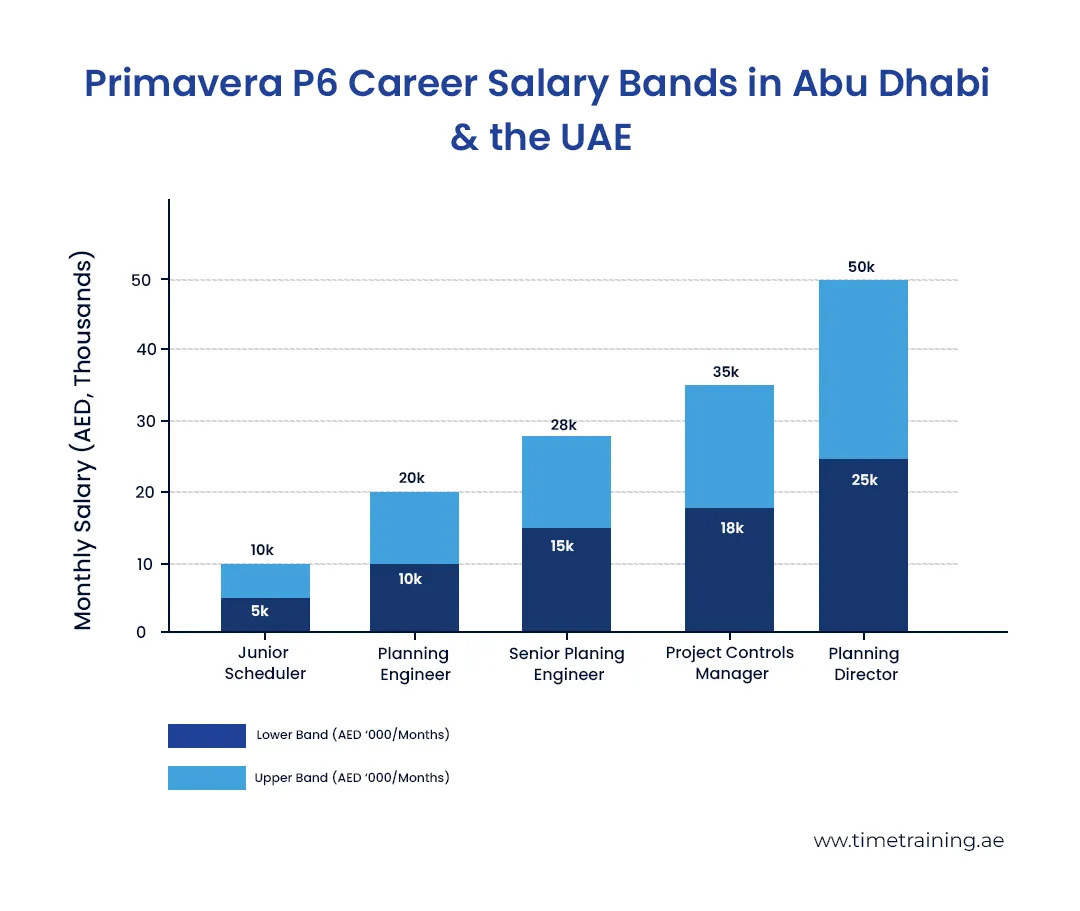
Professionals with a Primavera P6 certification and hands-on project experience often earn higher salaries. Employers value people who can manage schedules, apply Earned Value Management (EVM), analyse delays, and confidently defend project timelines under pressure. Find Out: Why Companies in Abu Dhabi Invest in Primavera P6 Training for Project Teams.
A Real-World Example: Planning on an Abu Dhabi Infrastructure Project
Consider a mid-sized road upgrade forming part of Abu Dhabi's wider PPP transport programme. The planning engineer builds a WBS split by road section, sets a baseline aligned to the contractual completion date, and updates progress weekly against the Data Date.
When utility diversion works run late, the schedule flags the knock-on effect on paving activities within days rather than weeks, giving the project manager enough lead time to reallocate crews and protect the overall finish date. This is the practical value a Primavera P6 professional brings: early warning, not just record-keeping.
Final Thoughts: Building a Career Around Primavera P6
Primavera P6 professionals sit at the centre of every successful Abu Dhabi construction and infrastructure project. Their roles and responsibilities- building schedules, tracking progress, forecasting risk, and reporting clearly- make the difference between a project that drifts and one that finishes on time. With Abu Dhabi's infrastructure pipeline continuing to expand, the demand for capable, well-trained planning professionals shows no sign of slowing down.
Frequently Asked Questions
What does a Primavera P6 professional do daily?
They update schedules against the Data Date, monitor progress, prepare look-ahead programmes, and report variance to project managers and clients, adjusting forecasts as site conditions change.
Is Primavera P6 in demand in Abu Dhabi?
Yes. With ADPIC managing over AED 200 billion in capital projects and a new AED 55 billion PPP pipeline for 2026 to 2027, demand for qualified planning engineers and schedulers remains strong across Abu Dhabi.
What is the difference between a Planning Engineer and a Project Controls Engineer?
A Planning Engineer focuses primarily on schedule creation and updates, while a Project Controls Engineer integrates cost, risk, and Earned Value Management alongside the schedule for a fuller performance picture.
How long does it take to become job-ready in Primavera P6?
Basic navigation can be learned within one to two weeks, but most UAE employers expect two to three months of applied practice on realistic project files before a candidate is considered job-ready. Get your answer clear by checking how long it takes to learn Primavera.
Do Primavera P6 professionals need a civil engineering degree?
Not always. While many planning engineers hold engineering degrees, project coordinators and schedulers can enter the field from related backgrounds, provided they build strong practical scheduling skills. But, Civil Engineers need a Primavera P6 Certification. Here are the reasons why Primavera P6 is essential for Civil Engineers in Abu Dhabi.
What salary can a Primavera P6 professional expect in the UAE?
Salaries typically range from AED 10,000 a month for junior schedulers to AED 50,000 or more for planning directors, with certified, experienced professionals earning at the higher end of each band.
 +971 2 6713828

1.jpeg)
.webp)