HR Analytics is the practice of collecting, analysing, and interpreting workforce data to make informed HR decisions that improve hiring, performance, and employee retention. In Abu Dhabi, it commonly involves skills such as data analysis & HR metrics, advanced Excel and Power BI, HRIS platforms like Workday and SAP SuccessFactors, predictive analytics, and strong business communication to support data-driven workforce strategies.
Employers in Abu Dhabi are increasingly looking for HR professionals who can turn workforce data into strategic insights. According to industry insights, 56% of HR teams now have dedicated analytics specialists, highlighting how data-driven HR has become a core business function rather than a support role.
This shift creates a strong opportunity for professionals aiming to build a career in HR analytics. As organisations adopt predictive tools and smarter workforce planning, skills such as data analysis, HR metrics, HRIS platforms, and data visualisation are becoming essential to stay competitive in the job market.
In this blog, we explore the most in-demand HR analytics skills in Abu Dhabi, why they matter, and how they can help you build a successful and future-ready HR career.
Table of Contents
-
Top 5 HR Analytics Skills in Demand in Abu Dhabi
-
1.1 Data Analysis & HR Metrics
-
1.2 Advanced Excel & Data Visualisation Tools
-
1.3 HRIS & HR Technology Knowledge
-
1.4 Statistical & Predictive Analytics
-
1.5 Business & Communication Skills
-
Salary & Compensation Benchmarks for HR Analytics Roles in Abu Dhabi
-
Recommended Certifications for HR Analytics in the UAE
-
Industries in Abu Dhabi Actively Hiring HR Analytics Professionals
-
Conclusion: Why Do HR Analytics Skills Matter in Abu Dhabi's Job Market?
-
FAQs
Top 5 HR Analytics Skills in Demand in Abu Dhabi
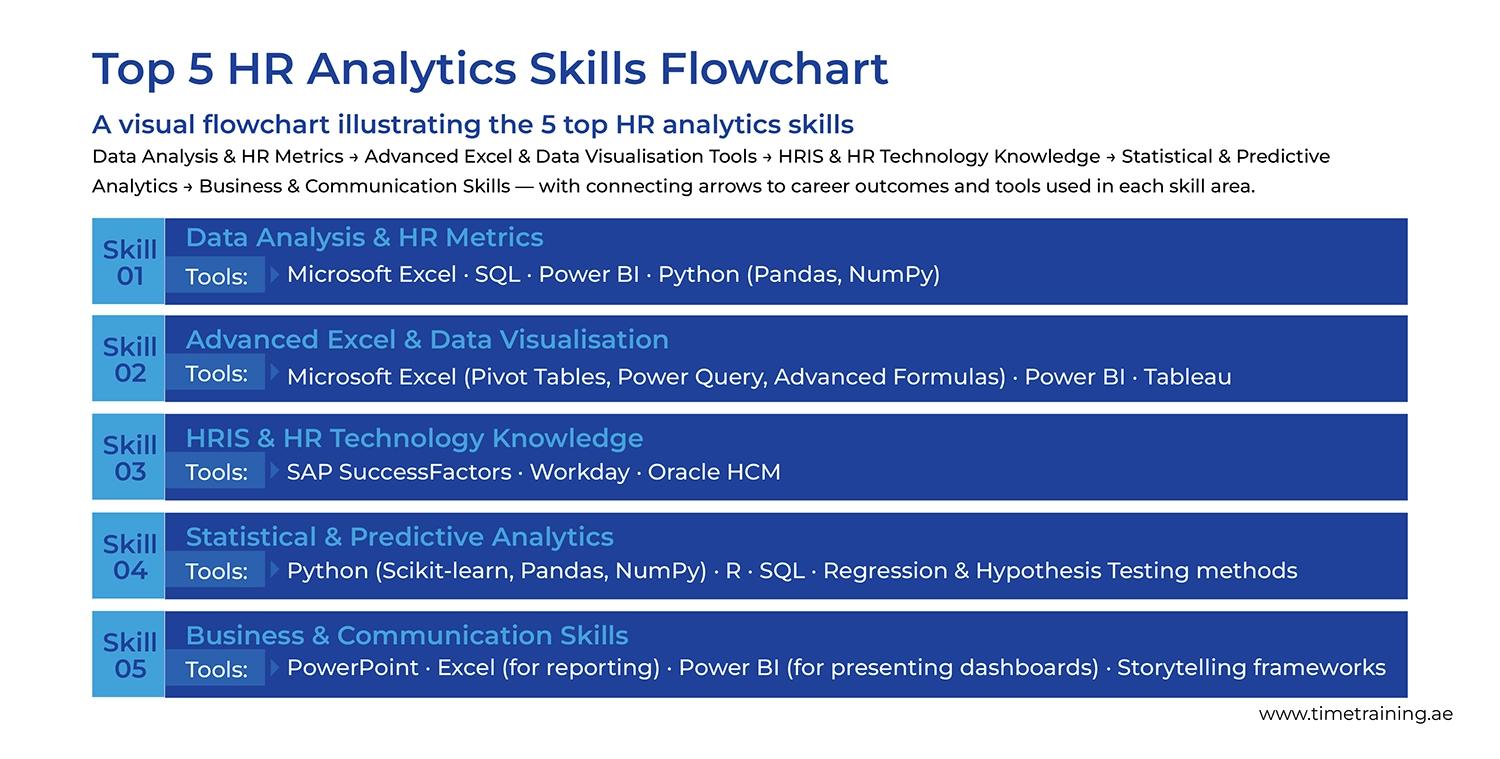
The table below shows the 5 major HR analytics skills and why they are in demand in Abu Dhabi.
| Skill |
Why It Matters in Abu Dhabi |
| Data Analysis & HR Metrics |
Supports evidence-based hiring, workforce planning, and Emiratisation targets
|
| Advanced Excel & Data Visualisation Tools |
Power BI is the dominant tool in the UAE due to Microsoft ecosystem integration
|
| HRIS & HR Technology Knowledge |
SAP SuccessFactors, Workday, and Oracle HCM are standard in enterprise hiring
|
| Statistical & Predictive Analytics |
Employers need forecasting skills, not just historical tracking |
| Business & Communication Skills |
Bridges technical data insights with non-technical stakeholders and leadership |
Let us explore the details of these major HR analytics skills below.
1. Data Analysis & HR Metrics
Data analysis and HR metrics refer to the process of collecting and interpreting employee data to measure HR performance and improve decision-making. It helps organisations track key workforce indicators and turn data into actionable insights.
-
Measures KPIs like turnover, cost-per-hire, time-to-fill, and engagement
-
Converts raw HR data into meaningful insights
-
Supports evidence-based HR strategies
It enables HR teams to move beyond basic reporting and make proactive, data-driven decisions that improve workforce outcomes and business performance. It helps;
-
Optimise hiring and workforce planning
-
Identifies trends, gaps, and performance issues
-
Improves employee retention and engagement
HR professionals use data analysis and metrics to guide recruitment, performance management, and overall workforce strategy. It is used for;
-
Analysing hiring data to improve recruitment efficiency
-
Monitoring employee performance and engagement levels
-
Supporting strategic decisions with real-time workforce insights
Market Reality: With 45% of UAE employers reporting difficulty finding qualified talent and organisations actively competing to meet Emiratisation quotas, HR analysts who can translate raw workforce data into strategic recommendations are among the most sought-after professionals in Abu Dhabi.
2. Advanced Excel & Data Visualisation Tools
An HR must be proficient in tools like Excel, creating pivot tables and using advanced formulas. HR is the one who is responsible for transforming unfiltered data into interactive dashboards and reports that are easily understandable for the business people. To perform these kinds of inevitable tasks, an HR must gain expertise in using visualisation platforms such as Power BI and Tableau.
What are the Key Advanced Excel & Data Visualisation Tools to Master
The table below shows the major tools used in HR Analytics and the demand for the technical expertise of those tools in the UAE market.
| Tool |
Level |
Used Cases |
| Microsoft Power BI |
Intermediate–Advanced |
Dominant tool in the UAE; exceptional market value (Microsoft ecosystem) |
| Advanced Excel (Power Query, Pivot Tables) |
Foundational–Advanced |
Remains essential across all industries and organisation sizes |
| Tableau |
Intermediate |
Widely used in multinational companies and large enterprises |
Taking a professional training in the key tools listed above can help you enhance your skills and strengthen your employability.
|
Pro Tip: Microsoft Power BI holds exceptional market value in the UAE due to its deep integration with existing Microsoft ecosystems widely adopted by organisations across Abu Dhabi.
|
3. HRIS & HR Technology Knowledge
HRIS & HR technology knowledge refers to the ability to use digital HR platforms to manage, analyse, and report workforce data for strategic decision-making. In-depth knowledge of human resource information systems (HRIS) is crucial. These systems include SAP SuccessFactors, Workday, Oracle HCM, or other similar platforms.
What are the Key HRIS & HR Technology Tools Used in HR Analytics
The following table provides a quick overview of the most widely used HRIS and HR technology platforms in Abu Dhabi. It highlights their core functions, practical examples, and real-world use cases to help you understand how each tool supports HR analytics and workforce management.
| Tool |
Function |
Example |
Use Case |
| SAP SuccessFactors |
Cloud-based HR system for talent, performance, and learning management |
Managing employee lifecycle, performance reviews, and training programs |
Used by large enterprises in Abu Dhabi to align employee performance with business goals
|
| Workday |
Unified platform for HR, finance, and workforce planning |
Real-time workforce analytics, payroll, and financial integration |
Used for data-driven workforce planning and integrating HR with finance functions
|
| Oracle HCM |
End-to-end HR solution covering recruitment, payroll, and analytics |
Automating hiring workflows and compensation management |
Used to streamline recruitment processes and ensure compliance with labour laws
|
4. Statistical & Predictive Analytics
Predictive analytics in HR uses statistical models and historical workforce data to forecast future outcomes such as employee turnover, hiring success, and workforce trends. In Abu Dhabi’s data analytics-driven job market, organisations rely on predictive analytics to make proactive decisions, reduce hiring risks, and improve workforce planning. It is widely used for
-
Predicts employee attrition and hiring outcomes
-
Supports workforce planning and talent forecasting
-
Reduces hiring risks and improves decision-making
-
Shifts HR from reactive reporting to proactive strategy
To apply it effectively, HR professionals need skills like regression analysis, hypothesis testing, and predictive modelling, along with tools such as Python (Pandas, NumPy, Scikit-learn), SQL, and Power BI. The shift from descriptive analytics (what happened) to predictive analytics (what will happen) enables HR teams to move from reactive reporting to strategic decision-making.
Predictive Analytics in HR – Key Concepts, Skills, and Tools
The table below provides a structured overview of predictive analytics in HR, including its definition, importance in Abu Dhabi, practical use cases, core skills required, commonly used tools, and how it differs from traditional descriptive analytics.
| Category |
Details |
| Definition |
Uses statistical models and historical data to predict future HR outcomes
|
| Importance in Abu Dhabi |
Enables proactive workforce planning, reduces hiring risks, supports Emiratisation goals
|
| Key Use Cases |
Predicting attrition, forecasting hiring needs, identifying top candidates, and workforce planning
|
| Core Skills |
Regression analysis, hypothesis testing, predictive modelling, analytical thinking
|
| Tools |
Python (Pandas, NumPy, Scikit-learn), SQL, Power BI, Excel
|
| Descriptive vs Predictive |
Descriptive = past data insights; Predictive = future forecasting and decision-making
|
5. Business & Communication Skills
As an HR analyst, it is crucial to be an expert in business and communication skills. There may be stakeholders who have zero technical knowledge involved in the businesses. An HR with strong communication skills who can effectively communicate the insights clearly to them is significant for the growth of the business. Communication skills are also essential to align the HR analytics with wider business goals.
An HR analyst must be proficient in storytelling data, collaborating with various teams and departments, translating HR metrics for business impact, etc. These are crucial skills needed for organisational growth. HR analysts should also work proactively to influence the strategic decisions of the business. To achieve this, an HR analyst must have strong business knowledge and presentation skills.
Taking a professional training in HR analytics can help you strengthen your skills and enhance job opportunities.
Top 5 HR Analytics Skills Flowchart
Salary & Compensation Benchmarks for HR Analytics Roles in Abu Dhabi
The table below helps you understand the HR Analytics compensation landscape in Abu Dhabi. This helps you benchmark your career goals and negotiate effectively.
| Role / Level |
Salary Range |
Notes |
| HR Analyst (Average) – Abu Dhabi |
AED 219,056/year |
Across all experience levels |
| HR Analyst (Entry Level) – Abu Dhabi |
AED 157,440/year |
0–2 years experience |
| Data Analyst (UAE-wide Average) |
AED 79,500/year |
General data analytics roles |
| Senior Data Analyst – Abu Dhabi |
AED 18,000–28,000/month |
5+ years, specialised skills |
| AI/ML Specialist – UAE |
AED 240,000–720,000/year |
Premium segment, rare skill set |
Note: UAE salary growth is projected at an average of 4% for 2025. Professionals with certifications in Power BI, CIPD, or Python analytics command significantly above-average compensation.
Recommended Certifications for HR Analytics in the UAE
Earning recognised certifications can significantly enhance your competitiveness in Abu Dhabi's HR analytics job market. The following tables show the credentials that are highly valued by UAE employers:
| Certification |
Provider |
Why It Matters |
| Microsoft Certified: Power BI Data Analyst Associate |
Microsoft |
Exceptional market value in the UAE — dominant BI tool |
| CIPD (Chartered Institute of Personnel and Development) |
CIPD |
Considered the gold standard for HR professional excellence |
| CHRM / CHRP |
HRCI / equivalent |
Required for managerial and operational HR roles |
| Google / IBM Data Analyst Professional Certificate |
Google / IBM |
Valued for entry-level roles and career changers |
| Python for Data Analysis (Pandas, NumPy, Scikit-learn) |
Multiple platforms |
Increasingly non-negotiable for senior analytics roles |
Industries in Abu Dhabi Actively Hiring HR Analytics Professionals
HR analytics professionals are in demand across a broad spectrum of industries. The following sectors are particularly active in hiring:
-
Government & Public Sector – driving Emiratisation tracking and workforce planning
-
Oil & Gas – complex workforce modelling and compliance reporting
-
Healthcare – DoH Abu Dhabi targets 5,000 new UAE national roles by the end of 2025
-
Banking & Financial Services – compensation analytics, talent retention, regulatory compliance
-
Aviation & Transport – a rapid growth sector with +64% global hiring outlook
-
Education – faculty planning, student engagement data, and HR reporting
-
Large Corporate Groups – enterprise HRIS implementation and analytics
Ready to Start Your HR Analytics Career?
If you want to become a Certified HR Professional, check out our Step-by-Step Career Guide to start your HR career in Abu Dhabi.
Why These HR Analytics Skills Matter in Abu Dhabi's Job Market
The organisations across Abu Dhabi focus on improved workforce planning, employee performance, and retention strategies. The organisations are mainly relying on data for improving the above-mentioned factors. In such a context, the demand for HR analysts with strong technical knowledge and soft skills is increasing in Abu Dhabi. A workforce of HR analysts who have these skills can be capable of:
-
Enabling data-driven hiring, workforce planning, and talent retention strategies and decisions.
-
Supporting compliance with UAE labour laws and Emiratisation initiatives.
-
Helping organisations to identify skill gaps and optimise training investments.
-
Improving employee performance, engagement, and productivity through insights.
-
Aligning HR strategies with overall business goals and growth plans.
-
Navigating data privacy obligations under Federal Decree-Law No. 45 of 2021, which governs personal data handling, a compliance challenge for 45% of organisations using advanced analytics.
Abu Dhabi's job market is evolving fast, and HR analytics is no longer a specialised function; it is a core business requirement. Organisations that invest in HR analysts with the right blend of technical and communication skills will be better positioned to meet Emiratisation targets, retain top talent, and make smarter workforce decisions. For professionals looking to build a future-proof HR career in Abu Dhabi, developing these five skills is the clearest path forward.
FAQs
Q1: Which HR analytics skills are most valued by employers in Abu Dhabi?
HR metrics and data analysis, advanced Excel and data visualisation (especially Power BI), HRIS knowledge, statistical and predictive analytics, and strong business communication skills are the most valued HR analytics skills in Abu Dhabi. Employers increasingly value Python and SQL for senior roles.
Q2: Is a technical background necessary for learning HR analytics?
No, a technical background is not mandatory. You can learn HR analytics with basic computer skills. Most tools are designed to be user-friendly for non-technical users. That said, professionals who develop intermediate Python or SQL skills will have a clear advantage for senior positions.
Q3: What are the commonly used tools in HR analytics?
Microsoft Excel, Power BI (the dominant tool in the UAE), HRIS platforms (SAP SuccessFactors, Workday, Oracle HCM), Tableau, and increasingly Python and SQL for advanced analytics roles.
Q4: How can HR analytics help in Emiratisation and workforce planning?
HR analytics helps track nationalisation targets, workforce demographics, and talent gaps, enabling organisations to plan Emiratisation initiatives. With penalties of up to AED 6,000 per month per unfilled Emirati role (for companies with 50+ workers), analytics-driven compliance tracking is now a business-critical function.
Q5: Which industries in Abu Dhabi have a higher demand for skilled HR analysts?
Government, healthcare, oil and gas, aviation, education, banking, and large corporate groups actively hire HR analytics professionals. The healthcare sector alone has a target of 5,000 new UAE national roles by the end of 2025.
Q6: How long does it take to learn HR analytics skills?
Basic HR analytics skills can be learned within a few weeks, while advanced analytics and strategic applications may take a few months of structured training and hands-on practice. Certifications such as Microsoft's Power BI Data Analyst Associate can be earned in 2–3 months with dedicated study.
Q7: What is the average HR analyst salary in Abu Dhabi?
The average HR analyst salary in Abu Dhabi is approximately AED 219,056 per year. Entry-level analysts earn around AED 157,440 per year. Salary growth of 4% is projected for 2025, and professionals with advanced certifications or AI/ML skills command significantly higher compensation. (Source: UAE Workforce Briefing 2025–2026)
 +971 2 6713828