Every great achievement, from the pyramids of Egypt to the Burj Khalifa, started with someone, somewhere, asking a deceptively simple question: How do we get this done? That question is the heartbeat of project management.
Whether you are a seasoned project professional in Abu Dhabi’s booming construction sector, a tech lead navigating digital transformation, or someone stepping into your first Project Manager (PM) role, this guide gives you everything you need to understand project management from the ground up and what it takes to advance.
We cover the definition, history, frameworks, career paths, PMP certification (including costs in AED), and the specific landscape in Abu Dhabi and the UAE. Read it in full or jump to the section that matters most to you right now.
| Table of Contents |
1. What is Project Management?
2. A Brief History of Project Management
3. What are the Core Knowledge Areas of Project Management?
4. What are Project Management Methodologies?
5. Project Management by the Numbers: 2025-2026
6. What is PMP Certification?
7. What are the PMP Eligibility Requirements?
8. What is the PMP Exam Structure and Content?
9. What is the cost of PMP Certification?
10. What is the PMP Certification Cost in Abu Dhabi?
11. How to Get PMP Certified?
12. How to Prepare for the PMP Exam?
13. PMP vs Other Project Management Certifications
14. What is the Salary of PMP Professionals in the UAE and Abu Dhabi?
15. Why Project Management Matters: The Business Case
16. How To Maintain Your PMP Certification?
17. Project Management in Abu Dhabi: What is the Local Landscape?
18. Frequently Asked Questions on Project Management |
1. What is Project Management?
Project management is the application of knowledge, skills, tools, and techniques to project activities to meet project requirements. In plain terms, it is the structured practice of planning, executing, monitoring, and closing a defined piece of work, delivering specific results within agreed constraints of time, budget, and scope.
The Project Management Institute (PMI) defines it as “the use of specific knowledge, skills, tools, and techniques to deliver something of value to people.” That “something of value” is the key: project management is ultimately about outcomes that matter to people and organisations, not just completing tasks.
1.1. What Makes Something a ‘Project’?
Not every work is a project. A project has three defining characteristics:
• It is temporary: It has a clear start and end date.
• It produces a unique result: A product, service, or change not produced before in exactly this way.
• It is progressively elaborated: Details are developed and refined as the team learns more.
Running a hotel reception desk is an operation. Building a new wing of that hotel is a project. Maintaining a software platform is an operation. Migrating it to the cloud is a project.
1.2. The Triple Constraint in Project: Scope, Time, and Cost
Every project exists within what practitioners call the Triple Constraint or the Iron Triangle. If change happens on one side, the others are affected. Here is what they mean in a project:
• Scope → What needs to be done?
• Time → When it needs to be done?
• Cost → How much can it cost?
Quality is often cited as the fourth dimension that all three sides support. A skilled project manager navigates these trade-offs deliberately, keeping stakeholders aligned along the way.
2. A Brief History of Project Management
Project management as a formal discipline is surprisingly young. Barely 70 years old as a defined profession!
But its roots stretch back thousands of years. Let’s get down the history lane.
A. Ancient Foundations
Around 2560 BCE, the Great Pyramid of Giza was constructed over approximately 20 years, requiring the coordination of tens of thousands of workers, massive supply chains of stone and food, and sophisticated scheduling. This was project management before it had a name.
Medieval cathedral builders across Europe operated under a ‘Master Builder’ model, which is one person overseeing design, engineering, and construction over decades. The principles of scope, time, and resources were already central.
B. The Industrial Revolution and Early Tools
The Industrial Revolution brought complex manufacturing projects that demanded coordination at scale. Henry Gantt developed the Gantt chart in the early 20th century. It is still one of the most widely used project planning tools today. Frederick Taylor’s scientific management principles laid further groundwork for structured work execution.
C. Post-War Professionalisation
Modern project management was forged in the crucible of post-World War II ambition. The 1950s and 1960s saw the development of two foundational scheduling techniques: the Critical Path Method (CPM), developed by DuPont, and the Program Evaluation and Review Technique (PERT), developed for the U.S. Navy’s Polaris missile program. NASA’s Apollo programme further embedded project management disciplines such as work breakdown structures, risk management, and earned value analysis into professional practice.
In 1969, the Project Management Institute (PMI) was founded in the United States, creating the first professional body dedicated to the discipline. The first PMBOK® Guide was published in 1987, establishing a common global language for project managers.
D. The Agile Revolution
The 2001 Agile Manifesto transformed how software, and soon every other industry, approached projects. Rather than planning everything up front, Agile introduced iterative, adaptive delivery in short cycles.
Today, hybrid approaches that blend predictive (waterfall) and Agile methods are the norm: 58% of organisations anticipate increasing their use of hybrid project management over the next five years.
E. AI and the Future of PM
In 2025 and beyond, artificial intelligence is reshaping project management again. AI-driven tools now assist with predictive scheduling, risk identification, resource optimisation, and scenario modelling.
The role of the project manager is evolving from task administrator to strategic orchestrator, combining technology fluency with the distinctly human skills of leadership, empathy, and judgment.
Read More : PMP vs Lean Six Sigma in 2026:
3. What are the Core Knowledge Areas of Project Management?
The core knowledge areas of project management include management of Scope, Schedule, Cost, Risk, Stakeholder, Communication, Quality and Resource.
Whether you use PMI’s PMBOK® framework, PRINCE2, or an Agile approach, effective project management requires competence across these interconnected domains, as explained in detail below:
1. Scope Management
The scope defines what the project will and will not deliver. This includes creating a Work Breakdown Structure (WBS), managing change requests, and preventing scope creep- the gradual expansion of deliverables without corresponding changes to time or budget.
2. Schedule Management
Schedule management involves planning the sequence and duration of activities, identifying the critical path (the longest chain of dependent tasks), and tracking progress against the baseline plan. The tools involved in Schedule Management range from Gantt charts to sophisticated project management software.
3. Cost Management
Cost Management in project management involves estimating, budgeting, and controlling expenditure. Techniques like Earned Value Management (EVM) give project managers a quantitative view of cost and schedule performance in real time.
4. Risk Management
Risk Management is all about identifying, assessing, and responding to uncertainties that could affect project outcomes. Strong risk management is one of the clearest differentiators between projects that succeed and those that don’t. You can become a Risk Management Professional (RMP) by taking RMP training in Abu Dhabi from a PMI Authorised Training Centre.
5. Stakeholder and Communication Management
Projects are human endeavours. Identifying everyone with a stake in the project, understanding their expectations, and communicating clearly and consistently are often the single most important factors in project success.
6. Quality Management
Quality Management is about ensuring the project delivers what was agreed upon to the standard required. Quality management is proactive, building quality in through processes rather than reactive inspection at the end. Learn Quality Management to maintain the quality standards in projects you handle.
7. Resource Management
Resource Management is about planning and optimising the use of people, equipment, and materials. As hybrid and remote work models become the norm, resource management has grown more complex and more critical.
Read More : Which Methodologies Are Highly Used in Project Management
4. What are Project Management Methodologies?
There is no single ‘right’ methodology. The best approach depends on the nature of your project, your organisation, and your team. Here are the most widely used project management frameworks:
I. Waterfall (Predictive)
Waterfall is the traditional, sequential approach used in project management. In this method, the requirements are defined fully at the start. The work flows in one direction through phases starting from;
Initiation → Planning → Execution → Monitoring → Closure.
The Watrefall Method is best suited to construction, engineering, and other projects where requirements are stable and the sequence of work is fixed.
Abu Dhabi’s major infrastructure programmes, such as Etihad Rail and Masdar City, depend on a rigorous predictive project management method.
II. Agile
Agile is an iterative approach delivering value in short cycles (sprints, typically 1–4 weeks). The team adapts plans as they learn more.
Agile is widely used in software, digital product development, and any environment where requirements evolve. Over 71% of organisations globally report using Agile in some capacity.
III. PRINCE2 (Projects in Controlled Environments)
PRINCE2 is a process-driven framework developed in the UK, widely adopted in Europe, the Middle East, and Commonwealth countries. PRINCE2 is highly structured and scalable, with defined roles, responsibilities, and management stages. PRINCE2 is particularly prevalent in UK-related government projects and organisations with formal governance requirements.
IV. Hybrid Approaches
Hybrid is the modern reality. Most organisations, including those managing large infrastructure projects in Abu Dhabi, blend predictive planning for overall structure with Agile techniques for team-level execution.
58% of organisations anticipate increasing hybrid usage over the next five years.
V. Lean and Six Sigma
Borrowed from manufacturing, Lean focuses on eliminating waste in a project and maximising value flow. Six Sigma targets process quality through statistical analysis. Both are widely applied in operational improvement projects and are increasingly integrated with project management practice.
5. Project Management by the Numbers: 2025-2026
87.7 Million
PM roles needed globally by 2027 (PMI)
|
64%
Projected growth in PM talent demand, 2025-2035 (PMI)
|
17%
Higher median salary for PMP holders vs non-certified professionals (PMI Salary Survey)
|
88%
High-performing organisations prioritise PM as critical (PMI Pulse of the Profession)
|
-
The World Economic Forum’s Future of Jobs Report 2025 ranks project manager as the 12th fastest-growing job role globally. It has been identified as a key driver of net employment growth through 2030.
-
The MENA region, including the UAE and Abu Dhabi, is among the fastest-growing markets for project talent, fuelled by infrastructure investment and economic diversification.
6. What is PMP Certification?
The Project Management Professional (PMP)® is the world’s leading project management certification, issued by the Project Management Institute (PMI). It certifies that a professional has the knowledge, skill, and experience to lead and direct projects across any industry and methodology.
As of 2025, there are over 1.7 million PMP holders worldwide. These include project management professionals in construction, IT, healthcare, government, energy, finance, and more. The PMP credential is recognised and requested by employers in over 180 countries.
PMI describes the PMP as demonstrating your ability to manage the “people, processes, and business priorities” of professional projects, a definition that captures its breadth. Unlike certifications that focus on a single methodology, PMP spans predictive, Agile, and hybrid approaches, making it universally applicable. Check out these five amazing benefits of PMP Certification.
PMP Certification vs. Project Management as a Concept
It’s worth being clear: ‘project management’ is a discipline. ‘PMP’ is a professional credential within that discipline. You can practise project management without a PMP certification. But holding a PMP demonstrates to employers, clients, and teams that your skills meet a rigorous, internationally validated standard. Read this: PMI Accreditation – What It Means and Why It Matters
7. What are the PMP Eligibility Requirements?
Before you can apply for the PMP exam, you must meet PMI’s experience and education requirements. Let’s identify what these requirements are mandated by PMI:
| With a 4-Year Degree |
With a High-School / Associate Degree |
3 years (36 months) of project leadership experience
+
35 contact hours of formal PM education |
5 years (60 months) of project leadership experience
+
35 contact hours of formal PM education |
The 35 contact hours must be formal project management education. This includes classroom, online, or bootcamp training from an accredited provider. PMI Authorized Training Partners (ATPs) are the most reliable route.
Pro Tip: If you’re based in Abu Dhabi, look for
PMI Authorized Training Partners who offer PMP bootcamps covering all 35 required contact hours in an intensive 3–4 day format. This is especially popular with working professionals who cannot commit to long part-time programmes.
8. What is the PMP Exam Structure and Content?
The PMP Exam Structure and content are as given in the table below:
PMP Exam Format
| Number of Questions |
180 |
| Time Allowed |
230 minutes (3 hours 50 minutes) |
| Question Types |
Multiple choice, drag-and-drop, matching, hotspot, fill-in-the-blank |
| Breaks |
Two optional 10-minute breaks |
| Testing Mode |
Computer-based: test centre or online proctored |
| Passing Score |
Not published; PMI uses a qualitative scale (Above Target, Target, Below Target, Needs Improvement)
|
8.1. The Three Exam Domains in PMP
The PMP Exam Content Outline organises all exam questions across three domains. These domains are:
-
People (42%) → The people domain covers questions on leading teams, managing conflict, building collaborative environments, emotional intelligence, and servant leadership.
-
Process (50%) → The Process domain involves planning and executing projects using predictive, Agile, and hybrid approaches. It’s the process of managing scope, schedule, costs, quality, and risk.
-
Business Environment (8%) → This domain covers areas that align projects to organisational strategy, benefits realisation, compliance, and supporting change management.
The exam currently reflects a roughly 50/50 split between predictive/waterfall and Agile/hybrid scenarios, meaning you need to be fluent in both worlds.
8.2. What’s New in the 2025–2026 PMP Exam?
PMI regularly updates the PMP exam to stay current. The updated exam introduces topics that reflect how project management is evolving. This involves:
-
Artificial intelligence and machine learning in project delivery
-
Sustainability and ESG considerations in project planning
-
Remote and distributed team leadership
-
Increased emphasis on business value and benefits realisation
9. What is the cost of PMP Certification?
The total cost of PMP certification involves several components. Here is a comprehensive breakdown, including approximate AED equivalents for professionals in Abu Dhabi and the UAE:
| Fee Component |
PMI Member (USD) |
Non-Member (USD) |
Approx. AED (Non-Member)
|
| PMI Membership (optional) |
$174 |
N/A |
AED 639 |
| PMP Exam Fee |
$405 (member) / $555 (non-member) |
$555 |
AED 2,038 |
| Training (35 contact hours) |
$200 – $2,500 |
$200 – $2,500 |
AED 735 – 9,185 |
| Study Materials / Books |
$50 – $200 |
$50 – $200 |
AED 184 – 735 |
| Re-exam Fee (if needed) |
$275 (member) / $375 (non-member) |
$375 |
AED 1,378 |
| Total Estimate |
$830 – $3,279 |
$980 – $3,455 |
AED 3,600 – 12,690 |
PMI membership ($174/year) is generally worth it. It reduces the exam fee by $150, saving you money overall if you plan to sit the exam. PMI Membership also gives you access to PMI’s extensive library of standards, templates, and research.
9.1. What is the PMP Certification Cost in Abu Dhabi?
The PMP Certification cost in Abu Dhabi is $405 for PMI members and $555 for non-members, plus applicable taxes. Membership costs 139. Additional training courses range from 1,000 to $1,500, depending on the provider. The exam fee is only payable after your application is approved. Some providers offer 'buy now, pay later' options with Tabby. Total costs can reach $1,500–$2,000 when including training and fees.
If you have plans to take PMP Training in Abu Dhabi, the local training providers offer PMP preparation courses ranging from approximately AED 3,500 to AED 9,000. This fee is for an intensive bootcamp covering all 35 required contact hours. The exam itself is proctored online, so you do not need to travel.
Some employers in Abu Dhabi’s government and construction sectors sponsor their employees’ PMP training and examination fees. Therefore, it is worth checking with your HR department.
Abu Dhabi Tip: Exam fees must be paid in USD to PMI. Given current AED/USD peg rates (3.67 AED per USD), a non-member exam fee of $555 is approximately AED 2,038. Factor in this conversion when budgeting.
10. How to Get PMP Certified?
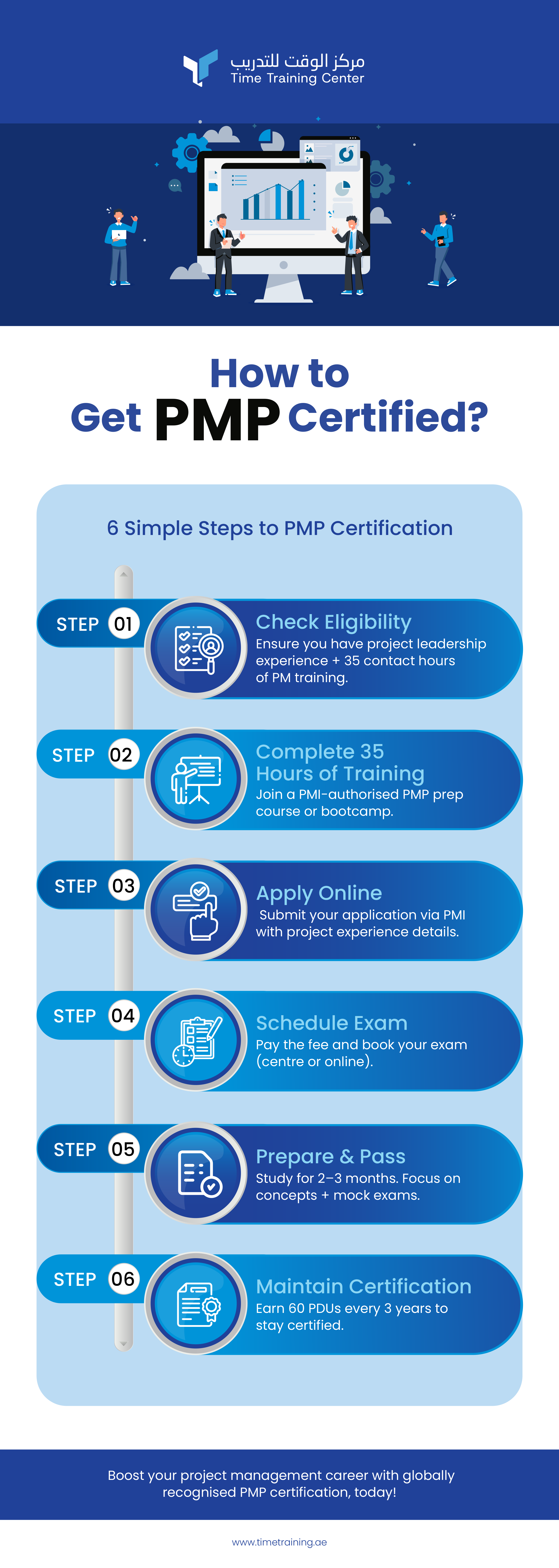
Six Steps To Get PMP Certified
Here is your six-step guide to getting PMP Certified, wherever you are in the world.
Review the requirements above. You need documented project leadership experience, not just involvement, and 35 contact hours of formal PM education.
Enrol in a PMP prep course from a PMI Authorized Training Partner. In Abu Dhabi, look for accredited providers offering intensive bootcamps. These bootcamps usually run over 3–4 days and cover the full Exam Content Outline.
Create a PMI account at pmi.org and complete the online application. Document your project experience by providing a brief description of your roles and responsibilities on each project. PMI audits approximately 15–20% of applications. If audited, you will need supporting documentation, such as a letter from a supervisor.
Once approved (typically within 5–10 business days), pay your exam fee and schedule your exam through Pearson VUE, either at a test centre or online. You have one year from application approval to pass the exam, with up to three attempts.
Most candidates spend 2–3 months preparing. Focus on understanding the reasoning behind PM decisions rather than memorising process names. Practice with full-length mock exams under timed conditions.
PMP certification must be renewed every three years by earning 60 Professional Development Units (PDUs). This includes a combination of learning activities, giving back to the profession, and working as a practitioner.
11. How to Prepare for the PMP Exam?
To prepare for the PMP Exam, we have got ready a study plan that ranges from 30 days to 90 days. Let’s check these plans by each one’s time plan.
PMP Study Plans by Timeline
| 30-Day Intensive Plan |
60-Day Part-Time Plan |
60-Day Part-Time Plan |
| Suited to full-time students or professionals taking leave to study. |
The most common approach for working professionals. |
For those managing demanding work schedules.
|
| Complete your 35-hour training first, then devote 4–5 hours daily to content review and practice exams. |
2. Study 2–3 hours per day on weekdays and 4–5 hours on weekends. |
2. Study 1–2 hours per evening and use weekends for longer practice sessions and mock exams.
|
| In the final week, focus exclusively on full mock exams and reviewing weak areas. |
3. Cover one domain per week in the first three weeks, then spend weeks four to eight on integration, practice exams, and review. |
3. This gentler pace allows deeper processing of the material but requires discipline to stay on track.
|
11.1. What are the Recommended Study Resources for PMP?
While preparing for your PMP exam and moving towards becoming a successful PMP professional, the following study resources can be used. These include:
• PMI’s Exam Content Outline (free on pmi.org): It’s the definitive guide to what’s tested.
• PMBOK® Guide 7th Edition: Helpful in understanding the principles, not just the processes.
• Agile Practice Guide: Essential for the exam’s strong Agile component.
• Full-length mock exams: This covers a minimum of 3 complete simulated exams before test day
• PMI-authorised prep courses: These are structured content aligned to the current exam and provided by training providers
Study Tip: The PMP is not a memorisation exam. Questions test how you would lead a team, respond to a stakeholder, or handle a project crisis.
Read each question carefully and think: what would a skilled, ethical project manager do here?
12. PMP vs Other Project Management Certifications
The PMP is the most widely recognised PM certification globally, but it is not the only one. Here’s how it compares to the other major credentials:
| Project Management Certifications |
Best For |
Experience Req. |
Methodology Focus |
Global Recognition |
| PMP |
Experienced PMs across all industries |
3-5 years |
Predictive, Agile, Hybrid |
Very High (180+ countries)
|
| CAPM |
Entry-level/aspiring PMs |
0 years |
Predictive / Waterfall |
High |
| PRINCE2 |
Government & UK/EU markets |
2+ years |
Process-driven |
High in the UK/Europe |
| PMI-ACP |
Agile practitioners |
1 year Agile |
Agile / Scrum |
High globally |
| Scrum Master (CSM) |
Agile team leads |
0 years |
Scrum framework only |
Moderate |
| PgMP |
Program managers |
4+ years PM |
Strategic / Portfolio |
High – senior level |
Check these top ten project management certifications to advance your career. For most working project managers looking to advance their career globally, including in Abu Dhabi’s international project environment, the PMP offers the best combination of recognition, versatility, and return on investment.
13. What Impact and ROI can a PMP Career create?
If you’re looking to invest in your career as a Project Management Professional (PMP), here is the impact and Return On Investment (ROI) you can expect.
A Higher Global Salary Premium
The data is clear: PMP certification pays. PMI’s Project Management Salary Survey (14th Edition) found that PMP holders earn a median salary approximately 17% higher than non-certified project managers globally.
In the United States, the median total compensation for a project manager is around $136,000 per year. In high-demand markets like the Middle East, the premium can be even greater.
14. What is the Salary of PMP Professionals in the UAE and Abu Dhabi?
The UAE is one of the world’s strongest markets for certified project managers, driven by its $66.89 billion construction sector, government infrastructure programmes, and the push for economic diversification under Abu Dhabi Vision 2030. Let’s look into their salary details earned in a month by role or level.
| Role / Level |
Monthly Range (AED) |
Notes |
| Junior / Entry-Level PM |
AED 8,000 – 15,000 |
Typically pre-PMP; may be pursuing certification
|
| Mid-Level PM (PMP Certified) |
AED 20,000 – 28,000 |
Strong demand in construction, IT, and government
|
| Senior PM / Project Director (PMP) |
AED 28,000 – 47,500 |
The construction sector pays the highest at the senior level
|
| IT Project Manager (PMP + Agile) |
AED 18,000 – 60,000 |
Government digital transformation driving demand
|
| Programme Manager (PMP/PgMP) |
AED 40,000 – 70,000+ |
Oil & gas, infrastructure megaprojects |
UAE salaries are tax-free, significantly enhancing the real value of earnings compared to equivalent roles in many other countries. PMP-certified professionals in Abu Dhabi also typically receive additional benefits, including housing allowance, transport allowance, and annual flights home.
14.1. Major Industries Hiring PMP-Certified Professionals in Abu Dhabi
Listed below are the major industries hiring PMP Certified Professionals in Abu Dhabi.
| Major Industries |
Organisations Hiring |
| Construction and Infrastructure |
ADNOC, Mubadala, Aldar, Turner & Townsend
|
| Government and smart city projects |
DoT, ADDC, Department of Municipalities
|
| Oil, gas and energy |
ADNOC, TAQA, Masdar, Barakah Nuclear Energy Plant
|
| IT and digital transformation |
Government entities, banks, telecoms
|
| Healthcare |
SEHA, Cleveland Clinic Abu Dhabi
|
| Aviation and transport |
Etihad, Abu Dhabi International Airport expansion
|
14.2. Is PMP Worth It in Abu Dhabi?
Given Abu Dhabi’s construction market projected to grow at 6% CAGR through 2030, its ambitious Vision 2030 diversification agenda, and the consistent salary premium for certified professionals, the answer for most project management practitioners is clearly yes. The total investment in PMP, including training, exam, and study time, is typically recovered within months through higher earnings.
For expat professionals in Abu Dhabi, the PMP also functions as a portable global credential. It signals competence to employers worldwide, supporting career mobility across the MENA region and beyond.
15. Why Project Management Matters: The Business Case
Projects fail at a startling rate. According to PMI’s research, without enough skilled project managers, the global economy could face a GDP loss of up to $345.5 billion by 2030. Poor project management costs organisations billions every year in overruns, delays, and failed initiatives.
The flip side: Organisations that invest in strong project management consistently outperform those that don’t. 88% of high-performing organisations rate project management as critical to their success. They complete more projects on time, within budget, and with better outcomes.
In Abu Dhabi, where megaprojects can run to billions of dirhams and involve thousands of workers across dozens of contractors, the stakes of poor project management are immediately visible. A qualified project manager, with the frameworks, tools, and judgment to navigate complexity, is not a cost; they are a risk management strategy.
Are you a Project Planner searching for a strong tool for your Project Management?
Primavera is the answer. Check the reasons why you should choose Primavera for Project Management.
16. How To Maintain Your PMP Certification?
PMP certification is valid for three years. To renew, you must earn 60 Professional Development Units (PDUs) across the following categories:
-
Education (minimum 35 PDUs): courses, webinars, conferences, self-directed learning in project management topics
-
Giving Back (maximum 25 PDUs): volunteering, creating content, working as a project management practitioner, mentoring
PDUs can be earned through PMI chapters (there is a PMI UAE Chapter), online PMI courses, professional conferences, and formal training. Many employers in Abu Dhabi support continuing education. While budget cycles and annual training plans are good times to plan your PDU activities.
Renewal Tip: Track your PDUs in PMI’s CCRS (Continuing Certification Requirements System) as you earn them. Don’t leave it until the last quarter of your certification cycle to scramble for 60 PDUs.
17. Project Management in Abu Dhabi: What is the Local Landscape?
Let’s find this out in detail.
17.1. Why Abu Dhabi Is a PM Hotspot?
Abu Dhabi is not simply keeping pace with global project management trends; it is setting them. The UAE’s construction market was valued at approximately $66.89 billion in 2024 and is projected to reach $96.06 billion by 2030. Major initiatives driving demand for project management professionals include:
• Etihad Rail: A transformative $11 billion regional rail network connecting Abu Dhabi to Dubai and beyond
• Masdar City: The world’s most sustainable urban development, requiring sophisticated multi-contractor programme management
• Barakah Nuclear Energy Plant: The Arab world’s first civilian nuclear power station, a landmark in large-scale project delivery
• Abu Dhabi International Airport expansion: The Midfield Terminal Building project, one of the largest airport developments globally
• ADNOC’s capital projects programme: A multi-billion-dollar oil, gas, and clean energy infrastructure
• Government digital transformation: Abu Dhabi’s smart government agenda is driving significant IT project activity
17.2. Abu Dhabi Economic Vision 2030 and the Need for Certified Project Managers
Abu Dhabi’s Economic Vision 2030 commits the emirate to diversifying its economy away from oil dependency, building world-class infrastructure, and developing a knowledge-based economy.
Every strand of that vision, from renewable energy to healthcare, education, and tourism, requires large-scale project delivery.
The demand for certified project managers who understand both global best practice and the local regulatory and cultural environment is structural, not cyclical.
17.3. How is UAE Emiratisation Creating Opportunities for Project Management?
Emiratisation initiatives are creating new opportunities for UAE nationals to enter and advance in project management careers. Government entities and large infrastructure developers are actively developing Emirati project management talent, with PMP certification increasingly required for senior roles in both public and private sectors.
18. Conclusion
Project management is one of the most valuable and transferable skill sets in today’s professional world. Whether you are managing a construction megaproject in Abu Dhabi, leading a digital transformation programme, or delivering a new product launch, the fundamentals are the same: define clearly, plan deliberately, lead well, adapt when reality changes, and deliver results that matter.
The PMP certification remains the gold standard for validating those skills globally. With over 1.7 million holders worldwide, a 17% salary premium, and growing demand in Abu Dhabi’s thriving project economy, it is an investment that pays for itself quickly. The PMP Certification keeps paying you throughout your career.
Your next step is the one that matters most. Whether that is researching eligibility, enrolling in a prep course, or simply learning more about the discipline, you are already on the right path.
19. Frequently Asked Questions on Project Management
1. What does PMP stand for?
PMP stands for Project Management Professional. It is a certification issued by the Project Management Institute (PMI) that validates a professional’s ability to lead and direct projects.
2. What is the difference between PMP and PRINCE2?
PMP is a globally recognised certification based on a broad framework covering predictive, Agile, and hybrid approaches. PRINCE2 is a process-driven methodology more prevalent in the UK, Europe, and Commonwealth countries. In Abu Dhabi and the broader MENA region, PMP tends to be more widely recognised, though PRINCE2 is valued in organisations with UK connections.
3. How long does it take to prepare for the PMP exam?
Most candidates spend 2–3 months preparing, studying 10–15 hours per week. Experienced project managers who have recently been immersed in PM practice may need less time; those returning to study after a long break may need more.
4. Can I take the PMP exam online?
Yes. PMI offers online proctored exams through Pearson VUE, allowing you to take the PMP from your home or office. You will need a reliable internet connection, a webcam, and a quiet, uncluttered space. Testing centres are also available in Abu Dhabi.
5. What is the PMP passing score?
PMI does not publish a specific passing score. Instead, performance is reported across the three domains on a scale of Needs Improvement, Below Target, Target, and Above Target. PMI uses psychometric analysis to set the passing standard, and it varies slightly between exam versions.
6. How much does a project manager earn in Abu Dhabi?
Project manager salaries in Abu Dhabi typically range from AED 20,000 to AED 47,500 per month at the mid to senior level, with PMP-certified professionals generally commanding the higher end of that range. Oil and gas and large infrastructure projects offer the highest compensation. Salaries are tax-free.
7. Is PMP certification recognised in Abu Dhabi?
Yes. PMP is one of the most widely recognised and requested certifications in the UAE job market. Major employers in construction, government, IT, energy, and healthcare actively seek PMP-certified candidates and often require it for senior project leadership roles.
8. How do I maintain my PMP certification?
You must earn 60 Professional Development Units (PDUs) every three years to renew your PMP. PDUs are earned through education, giving back to the profession, and working as a practitioner. PMI’s CCRS portal tracks your progress.
9. What is a Gantt chart?
A Gantt chart is a bar chart that visualises a project schedule, showing tasks, durations, dependencies, and milestones on a timeline. Developed by Henry Gantt in the early 20th century, it remains one of the most widely used project planning tools today.
10. What is the PMI Talent Triangle?
PMI’s Talent Triangle describes the three skill areas required for modern project professionals: Ways of Working (technical PM knowledge, methodologies), Power Skills (leadership, communication, emotional intelligence), and Business Acumen (strategic thinking, commercial awareness). PDU activities are mapped to these three areas.
 +971 2 6713828
1.jpeg)
.webp)