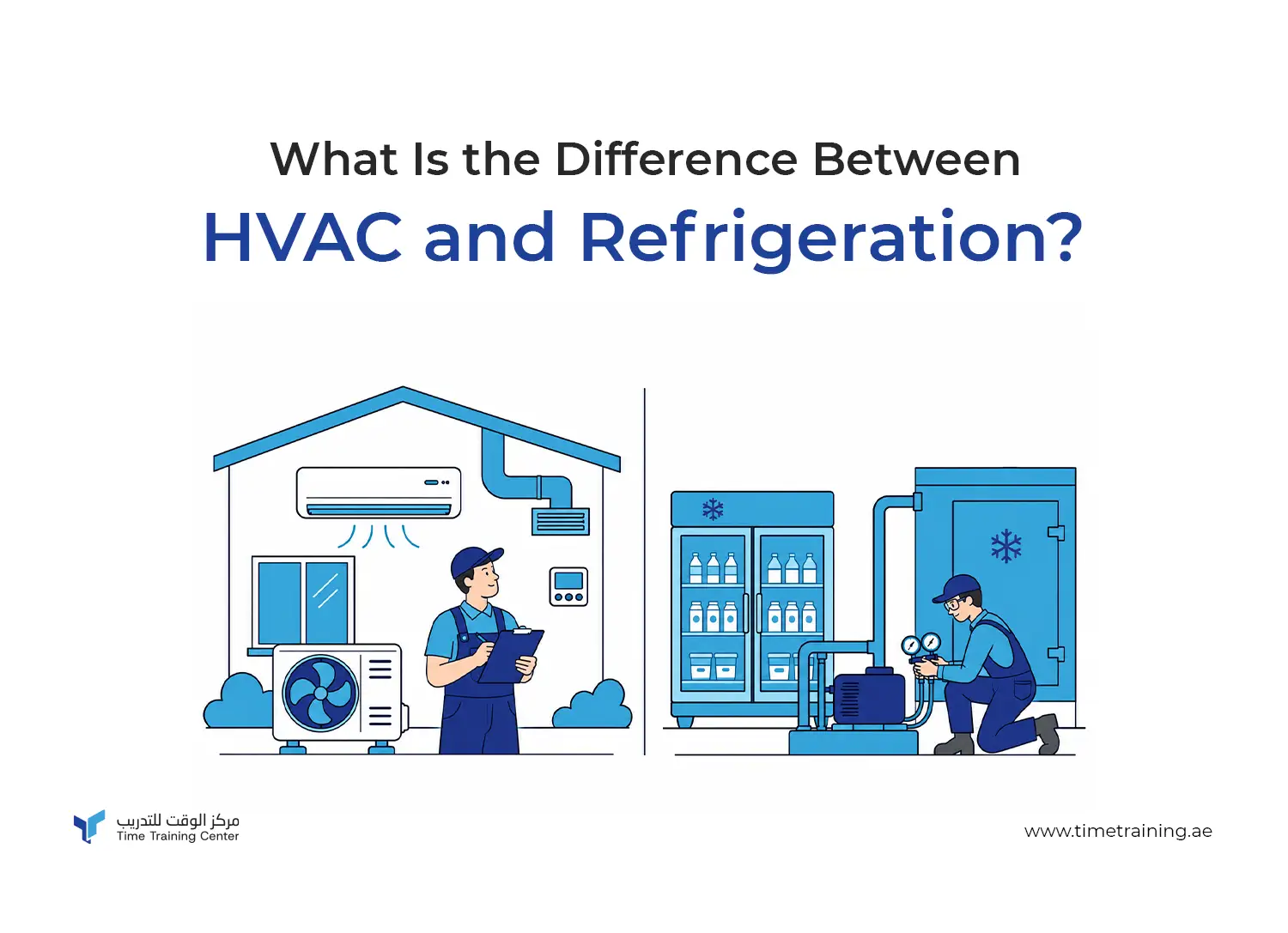
HVAC manages a building's indoor environment, including temperature, humidity, ventilation, and air quality. Refrigeration removes heat from a space, product, or process to keep it cold. Both rely on heat transfer, and air conditioning is where the two overlap.
This article explains their key differences, shared components, applications, and technician responsibilities. It also covers the skills and training options to consider when pursuing HVAC or refrigeration training in Abu Dhabi.
|
Table of Contents
|
|
1. What Is HVAC?
2. What Is Refrigeration?
3. What Is the Difference Between HVAC and Refrigeration?
4. Is Refrigeration Part of HVAC?
4.1. What Is the Difference Between HVAC, Air Conditioning and Refrigeration?
5. What Are the Common Components of HVAC and Refrigeration Systems?
6. Where Are HVAC and Refrigeration Systems Used?
6.1. What Are the Latest HVAC and Refrigeration Industry Trends in Abu Dhabi?
7. HVAC Technician vs Refrigeration Technician: Responsibilities and Skills
8. Which Is Better to Learn, and Is It a Good Career in Abu Dhabi?
9. How Can You Start Learning HVAC in Abu Dhabi?
10. Frequently Asked Questions About HVAC and Refrigeration
|
What Is HVAC?
HVAC stands for heating, ventilation, and air conditioning: an integrated system that regulates temperature, humidity, fresh air, and air quality inside buildings.
The main functions of HVAC are:
-
Heating: warming indoor air where needed.
-
Ventilation: exchanging stale indoor air for filtered outdoor air.
-
Air conditioning: cooling and dehumidifying indoor air.
-
Air quality control: filtering dust and particles.
Systems range from residential split units to large central plants. They normally use air handling units (AHUs), ductwork, chillers, and variable refrigerant flow (VRF) systems.
In simple terms, an HVAC system senses conditions through thermostats or controllers, then conditions and circulates air to maintain the settings.
For beginners interested in developing these technical skills, an HVAC Course in Abu Dhabi can provide foundational knowledge of heating, ventilation, air conditioning, and system operation.
What Is Refrigeration?
Refrigeration is the process of moving heat out of a space, substance, or product so that it stays below the surrounding temperature.
It does not "add cold". Instead, a refrigerant circulates in a closed loop, absorbing heat in one place and releasing it in another. This is the vapour-compression cycle, which has four stages:
1. Compression: the compressor raises the refrigerant vapour's pressure and temperature.
2. Condensation: the condenser releases heat, turning the vapour into a liquid.
3. Expansion: the expansion device drops the pressure, cooling the refrigerant.
4. Evaporation: the evaporator absorbs heat from the space or product, and the refrigerant boils back into vapour.
Refrigeration powers supermarket display cabinets, walk-in cold rooms, pharmaceutical storage, and industrial cold storage.
Operating much colder than comfort cooling, these systems require extra features like defrost controls and oil management.
Understanding how refrigeration systems operate also provides a useful foundation for HVAC design and maintenance training in Abu Dhabi, particularly when working with integrated cooling systems.
What Is the Difference Between HVAC and Refrigeration?
HVAC and refrigeration both involve temperature control; they differ in their primary purposes, operating conditions, equipment, and maintenance requirements.
Understanding these differences is also useful for anyone considering an HVAC Technician Course to develop the technical knowledge required for installation and servicing.
The following table highlights the key differences between the two systems.
HVAC vs Refrigeration: Key Differences at a Glance
| Feature |
HVAC |
Refrigeration |
| Main purpose |
Human comfort, health, and air quality |
Preserving products and controlling process temperatures
|
| What it treats |
Air in occupied spaces |
Air, liquids, or products in enclosed units
|
| Temperature target |
Comfortable room conditions |
Much lower, often chilled or frozen
|
| Scope |
Heating, cooling, ventilation, filtration, humidity |
Heat removal and temperature holding
|
| Common equipment |
AHUs, ducts, dampers, chillers, VRF |
Rack systems, cold rooms, display cases, unit coolers
|
| Maintenance focus |
Airflow, filters, controls |
Defrost, low-temperature diagnostics, oil return
|
The key difference is scope. HVAC controls an entire indoor environment. Refrigeration concentrates on holding a specific load at a low temperature.
Is Refrigeration Part of HVAC?
Yes, Partly. Air conditioning is a refrigeration-based application within HVAC, but refrigeration is also a distinct field that extends well beyond buildings.
Many industry bodies and training providers use the term HVACR to cover both, which is why the two trades are so closely linked.
What Is the Difference Between HVAC, Air Conditioning and Refrigeration?
Think of it as a relationship, not three separate things:
-
HVAC is the broad discipline of environmental control. Much of it, such as ventilation, heating, and filtration, involves no refrigeration at all.
-
Air conditioning is the cooling and dehumidifying part of HVAC. It uses the refrigeration cycle.
-
Refrigeration uses the same cycle for preservation and process cooling, including in supermarkets, cold chains, and industry, where there is no building comfort goal.
So the fields are closely related but not identical.
If you are considering entering this field, knowing how to choose the best HVAC certification course can help you identify suitable training for your career goals.
What Are the Common Components of HVAC and Refrigeration Systems?
HVAC and refrigeration systems share key components, including compressors, condensers, and evaporators. An HVAC Design and Maintenance Course helps learners understand their operation and maintenance.
Both rely on the same four core components, arranged in the same loop:
-
Compressor: circulates the refrigerant and raises its pressure.
-
Condenser: rejects heat to the outdoor air or water.
-
Expansion device: lowers pressure to cool the refrigerant before it enters the evaporator.
-
Evaporator: absorbs heat from the air or product.
What changes is the configuration. HVAC adds large airflow equipment such as fans, ducts, and dampers. Refrigeration adds low-temperature controls, defrost systems, and, in larger plants, multiple compressors working together.
Where Are HVAC and Refrigeration Systems Used?
HVAC and refrigeration systems are used for different purposes across residential, commercial, and industrial settings, depending on their cooling and temperature-control requirements.
-
Residential: split air conditioners and ducted systems keep homes comfortable. Domestic refrigerators and freezers are the household form of refrigeration.
-
Commercial: offices, malls, and hospitals depend on chilled water systems, AHUs, and VRF. Supermarkets and restaurants add commercial refrigeration for food.
-
Industrial: food processing, cold storage, and pharmaceutical facilities rely on industrial refrigeration.
What Are the Latest HVAC and Refrigeration Industry Trends in Abu Dhabi?
Abu Dhabi's climate makes cooling infrastructure central to its buildings. This demand for cooling infrastructure makes HVAC Training in Abu Dhabi relevant for individuals interested in developing practical skills for the local building services sector.
According to the Abu Dhabi Department of Energy's July 2026 announcement on the Cooling Load Manual, air-conditioning systems account for approximately 60-70% of electricity consumption in UAE buildings. The initiative also aims to improve cooling-load calculations and energy efficiency.
The scale of this infrastructure is also reflected in Abu Dhabi's district cooling capacity, which the Department of Energy estimated at approximately 600,000 refrigeration tons (RT), supported by substantial water requirements for plant operations.
Refrigerant regulations are changing too.
The UAE accepted the Kigali Amendment to the Montreal Protocol on 19 April 2024. Under its Article 5 Group 2 schedule, the country must freeze HFC production and consumption at baseline levels from 2028 and achieve an 85% reduction by 2047, compared with its defined baseline.
These changes make knowledge of newer refrigerants, environmental requirements, and safe handling practices increasingly relevant for HVAC and refrigeration technicians.
What Is the Difference Between an HVAC Technician and a Refrigeration Technician?
Technicians work with cooling systems, but their responsibilities, equipment, and working environments differ. Understanding these roles can also help you assess whether HVAC technicians are in demand in the UAE.
The following table highlights the key differences between the two roles.
Key Differences Between HVAC Technicians and Refrigeration Technicians
| Criteria |
HVAC technician |
Refrigeration technician
|
| Regular work |
Installing and maintaining split units, AHUs, ductwork, and controls |
Servicing cold rooms, display cases, rack systems, and chillers
|
| Normal environments |
Offices, residential towers, hospitals, malls |
Supermarkets, food plants, cold stores, commercial kitchens
|
| Specific tasks |
Airflow balancing, filter servicing, thermostat and building controls |
Defrost systems, low-temperature diagnostics, oil return
|
Skills both need:
-
Electrical fundamentals and reading wiring diagrams
-
Brazing and pipework
-
Pressure testing and leak detection
-
Refrigerant recovery and safe handling
-
System diagnostics and troubleshooting
-
Workplace safety practices
HVAC-leaning skills include airflow and ventilation, duct systems, and controls integration. Refrigeration-leaning skills include low-temperature operation and defrost management.
Which Is Better to Learn, and Is It a Good Career in Abu Dhabi?
Neither is universally better. The right choice depends on your interests:
-
If you prefer building-wide systems, airflow and controls, HVAC is the closer fit.
-
If you prefer cold storage, food and process equipment, refrigeration may suit you better.
Many beginners start with HVAC fundamentals, because the same cycle, tools and safety knowledge carry over, and then specialise.
Cooling is essential to Abu Dhabi's buildings and logistics, making HVAC skills relevant to the local market.
Requirements for HVAC certification and career opportunities in the UAE vary by employer and role. A course builds practical skills and knowledge but does not guarantee employment, a licence, or a particular salary.
Requirements for HVAC certification and career opportunities in the UAE vary by employer and role.
How Can You Start Learning HVAC in Abu Dhabi?
You can start learning HVAC in Abu Dhabi by choosing a structured training programme that combines basic concepts with practical design, troubleshooting, and maintenance skills.
Beginners should look for a course that covers:
-
Hands-on training: Practical exposure to HVAC equipment, components, and maintenance procedures.
-
Core technical concepts: HVAC system design, air distribution, cooling systems, and basic diagnostics.
-
Beginner-friendly learning: A structured curriculum that introduces fundamental concepts before progressing to technical applications.
-
Industry relevance: Knowledge of HVAC systems commonly used in residential, commercial, and industrial buildings.
Key Takeaways
-
Understanding the time required to learn HVAC from scratch helps beginners set realistic expectations.
-
HVAC focuses on indoor comfort, while refrigeration focuses on keeping products and spaces cold.
-
Both systems use compressors, condensers, and evaporators.
-
The refrigeration cycle connects both fields through air-conditioning systems.
-
Technician roles, equipment, and specialisations differ.
-
Both require practical skills in electrical systems, refrigerant handling and troubleshooting.
-
HVAC and refrigeration skills are valuable across UAE buildings, including hospitals, commercial and industrial facilities, particularly in Abu Dhabi.
FAQ's
1. Is refrigeration part of HVAC?
Yes, partly. Air conditioning is an application of refrigeration within HVAC, but refrigeration also includes independent applications such as cold storage, food preservation, and industrial cooling.
2. What is the difference between air conditioning and refrigeration?
Air conditioning regulates indoor temperature and humidity for comfort, while refrigeration maintains low temperatures for product preservation and industrial processes.
3. Can an HVAC technician work on refrigeration systems?
Yes, but additional training may be needed. Commercial refrigeration involves specialised components, low-temperature controls, and defrost systems beyond standard HVAC servicing.
4. Is HVAC or refrigeration easier for beginners to learn?
HVAC fundamentals can provide a useful starting point because they introduce electrical, mechanical, and cooling principles. Refrigeration builds on some of these concepts and introduces specialised low-temperature applications.
5. Can beginners learn HVAC without prior experience?
Yes. Beginners can start with basic electrical and mechanical concepts before learning about HVAC components, installation, troubleshooting, and maintenance. Practical training helps develop these foundational skills.
6. What is the difference between HVAC and refrigeration technician training?
HVAC technician training focuses on air conditioning, ventilation, heating, and building climate control, while refrigeration technician training covers cooling cycles, cold rooms, commercial refrigeration, and low-temperature systems. Both include electrical fundamentals, refrigerant handling, maintenance, and troubleshooting.
 +971 2 6713828