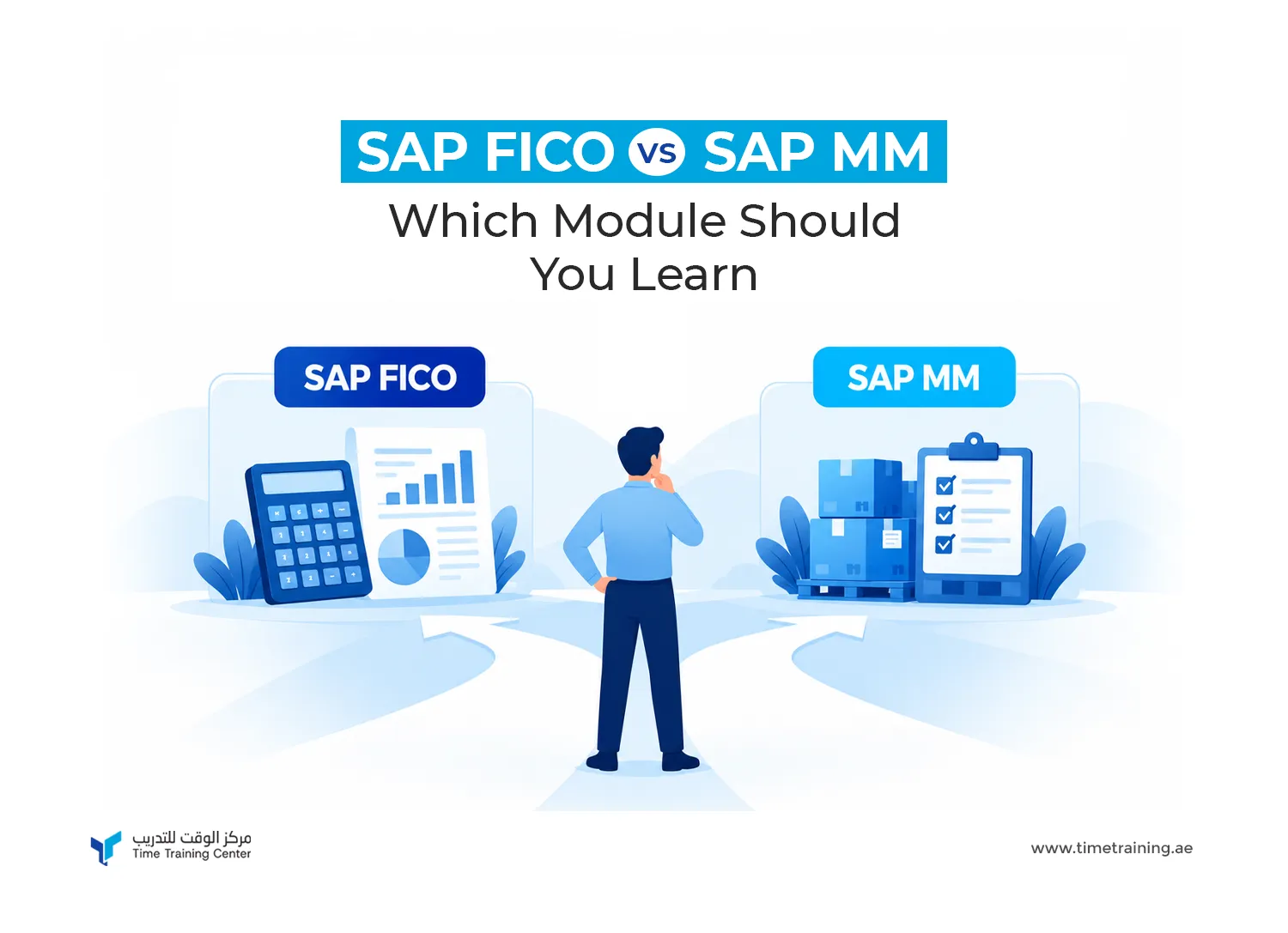
Learn SAP FICO if you enjoy accounts, costs and financial reports. Learn SAP MM if you enjoy buying, stock and supplier work. Neither module is better for everyone. The right choice depends on your background, your interests and the job you want.
SAP FICO (Financial Accounting and Controlling) records money and controls costs. SAP MM (Materials Management) buys goods and keeps stock right. Both run inside SAP, business software that many large companies use. In Abu Dhabi and across the UAE, more firms are digitising finance and procurement, so choose with clear eyes.
Key Takeaways
-
Different jobs: SAP FICO covers accounting and controlling. SAP MM covers materials, buying and inventory.
-
One shared journey: The two meet in purchase-to-pay, where a purchase turns into a payment.
-
Background first: Accountants often find FICO familiar. Buyers often find MM familiar.
-
No guarantees: No course can promise a job or salary.
In this guide, let’s see what the major areas covered are:
|
TABLE OF CONTENTS
|
|
1. SAP FICO vs SAP MM: Quick Comparison
2. What Is SAP FICO?
3. What Is SAP MM?
4. How Do SAP FICO and SAP MM Work Together?
5. Who Should Learn SAP FICO?
6. Who Should Learn SAP MM?
7. SAP FICO and SAP MM in SAP S/4HANA
8. SAP Certification: What to Know First
9. SAP FICO and SAP MM Careers in Abu Dhabi and the UAE
10. Which Module Fits Your Background?
11. SAP FICO vs SAP MM: FAQs
|
SAP FICO vs SAP MM: A Quick Comparison
Let’s first find out the major differences between SAP FICO (Financial Accounting and Controlling) and SAP MM (Materials Management).
| Factor |
SAP FICO |
SAP MM |
| Main purpose |
Records money and reports results |
Manages buying and stock
|
| Business area |
Finance and accounting |
Procurement and inventory
|
| Core processes |
General ledger, payables, receivables, assets, cost tracking |
Requisitions, purchase orders, goods receipts, invoice checks
|
| Typical users |
Accountants, finance controllers, auditors |
Buyers, stores teams, procurement managers
|
| Key skills |
Accounting basics, reporting, care with numbers |
Purchasing basics, stock control, supplier handling
|
| Simple example |
Paying a supplier and posting the cost |
Ordering 100 chairs and receiving them
|
| Works closely with |
Purchasing, sales, assets |
Finance, sales, production
|
| Exam (SAP S/4HANA Cloud Private Edition) |
Financial Accounting associate (C_TS4FI) |
Sourcing and Procurement associate (C_TS452)
|
Exam versions change often, so check SAP Learning for the current code.
What Is SAP FICO?
SAP FICO is the SAP finance module. It joins Financial Accounting (FI) and Controlling (CO). FI records what happened. CO explains where the costs sit and how to control them.
Here are major terms that represent the core submodules of the Financial Accounting (FI) component in SAP FICO:
-
General ledger: the main book of the company's accounts.
-
Accounts payable: money the company owes to suppliers.
-
Accounts receivable: money customers owe the company.
-
Asset accounting: tracks buildings, vehicles and equipment, including depreciation.
Controlling (CO) adds cost centres and profit reports. A cost centre is just a department, such as HR or Marketing, whose spending you track.
For Example, an Abu Dhabi retailer pays rent and salaries. FICO records each payment and shows the manager what every department spent this month.
Is SAP FICO the same as SAP Finance? Not exactly. FICO is the familiar name. SAP S/4HANA Finance covers more than FI and CO. Here, you may learn in detail what SAP FICO is and its core modules.
What Is SAP MM?
SAP MM is the SAP module for materials and buying. It helps a company order goods, receive them and keep stock accurate. It is one part of supply chain work, not the whole.
Here are the major components of SAP MM (Materials Management). SAP MM uses these four core components to run the complete Procure-to-Pay cycle from sourcing to payment.
-
Material master: one record for every item, holding its details.
-
Purchasing: requisitions and purchase orders sent to suppliers.
-
Inventory management: goods receipts, goods issues and stock counts.
-
Invoice verification: checking the supplier invoice against the order and the delivery.
For Example, a hospital orders gloves. MM records the order, the delivery and the boxes on the shelf.
Is SAP MM the same as procurement? They overlap. MM covers buying and stock inside SAP. Procurement as a career also includes sourcing strategy and supplier talks outside the system.
How Do SAP FICO and SAP MM Work Together?
They meet in purchase-to-pay. MM handles the ordering and receiving. FICO handles the postings and payments. SAP Learning describes this as a three-step process: order, goods receipt, invoice.
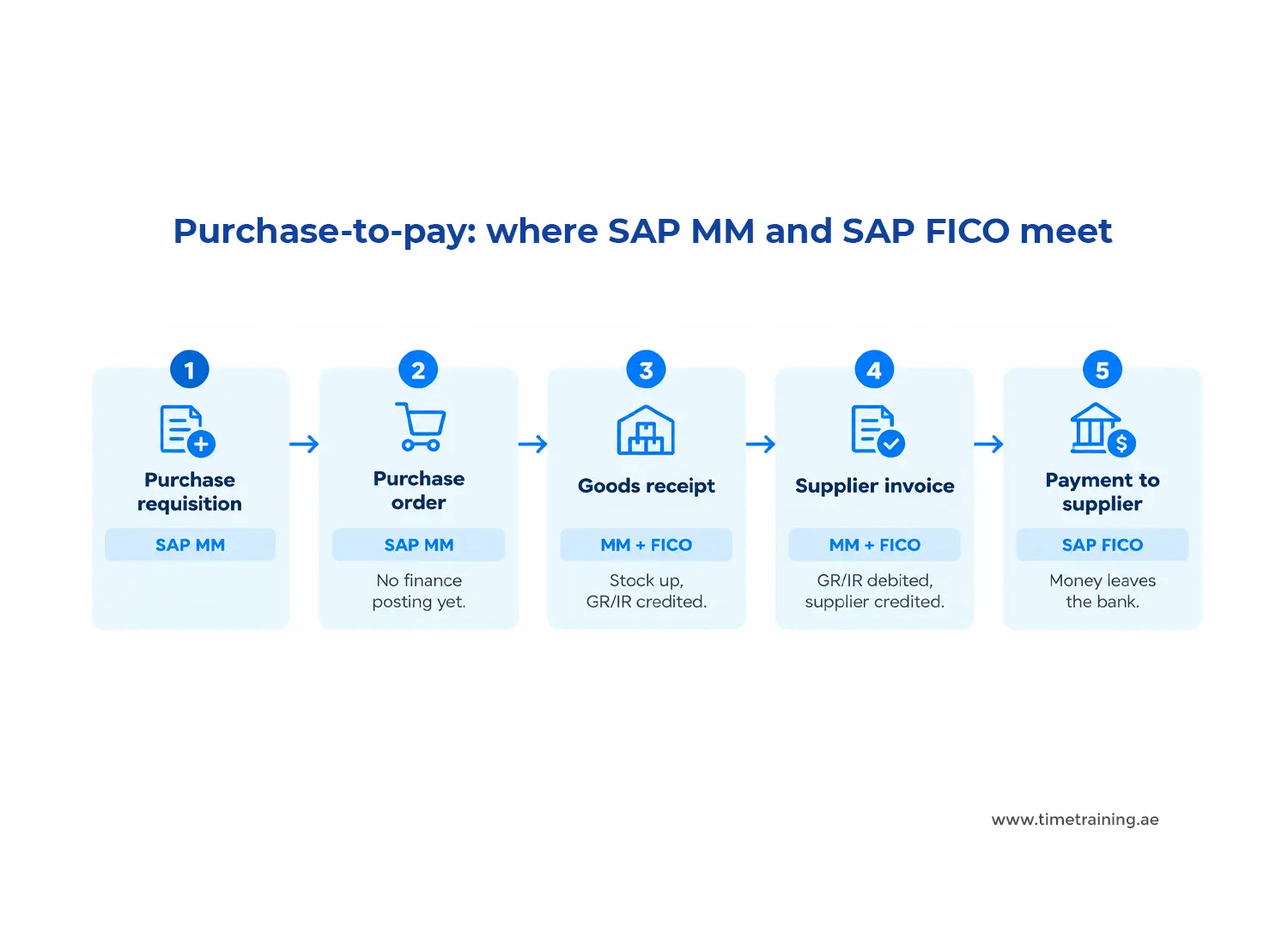
Purchase-to-pay in simple steps. Source: adapted from SAP Learning.
Here is what happens when SAP FICO and SAP MM meet:
-
Purchase order: this stays in MM. Nothing is posted to finance yet.
-
Goods receipt: stock goes up, and finance records the value in a holding account called GR/IR.
-
Supplier invoice: GR/IR is cleared, and the supplier is recorded as owed.
-
Payment: FICO pays the supplier and closes the item.
For example, you order 100 chairs at AED 200 each. On arrival, stock rises by AED 20,000 and finance notes the company owes for them. When the invoice comes, FICO moves it into amounts payable. (Illustration only.)
Who Should Learn SAP FICO?
SAP FICO may align naturally with your background if you like numbers, accounts and reports.
-
Accountants and finance staff: you know ledgers, payables and closing the books.
-
Commerce graduates: debits and credits feel familiar from your studies.
-
Finance managers: you learn how the system produces your reports.
-
ERP professionals: you add finance depth to your skills.
You bring accounting knowledge. SAP adds the system skills: setting up accounts, posting documents and running reports. Need a refresher? Read our guides on the top skills for an accounting career and in-demand accounting careers.
Who Should Learn SAP MM?
SAP MM may suit you if you enjoy buying, stock and supplier work.
-
Procurement and purchasing staff: you already raise orders and deal with suppliers.
-
Stores and inventory teams: you know receipts and stock counts.
-
Supply chain and logistics staff: you see how materials move through the business.
-
Operations-minded graduates: you like practical process work.
You bring knowledge of how buying works. SAP adds the system steps: creating orders, posting receipts and checking invoices.
Is SAP MM easier than SAP FICO? We cannot say either is easier. It depends on where you start. Accountants find FICO familiar, and buyers find MM familiar. Check out this guide to learn the scope of SAP FICO for freshers.
SAP FICO and SAP MM in SAP S/4HANA
Both modules continue in SAP S/4HANA, but the names have shifted. Older SAP ERP used FI, CO and MM. In S/4HANA, finance sits under SAP S/4HANA Finance, and MM work sits under Sourcing and Procurement. Many people still say FICO and MM as shorthand.
S/4HANA also keeps finance postings together in the Universal Journal, so learning on S/4HANA keeps your skills current.
SAP Certification: What to Know First?
Training teaches you. Certification tests you. SAP offers associate exams for both paths: C_TS4FI for financial accounting and C_TS452 for sourcing and procurement. Confirm the latest version on SAP Learning.
Hands-on practice matters as much as the exam. Compare the finance exam topics with our SAP FICO certification course details. A certificate alone does not guarantee a job. However, certifications have their benefits. See the benefits of SAP FICO Certification and the benefits of SAP MM certification.
SAP FICO and SAP MM Careers in Abu Dhabi and the UAE
Both modules matter in the UAE because companies here are digitising finance and procurement. We cannot give a demand figure for each module, so we do not guess. Here is what the evidence shows.
-
Abu Dhabi government: the Abu Dhabi Government Digital Strategy 2025 to 2027 carries AED 13 billion of investment and includes a unified digital ERP platform.
-
UAE e-invoicing: the Ministry of Finance moved the deadline for large businesses to appoint a service provider to 30 October 2026. Their go-live date remains 1 January 2027.
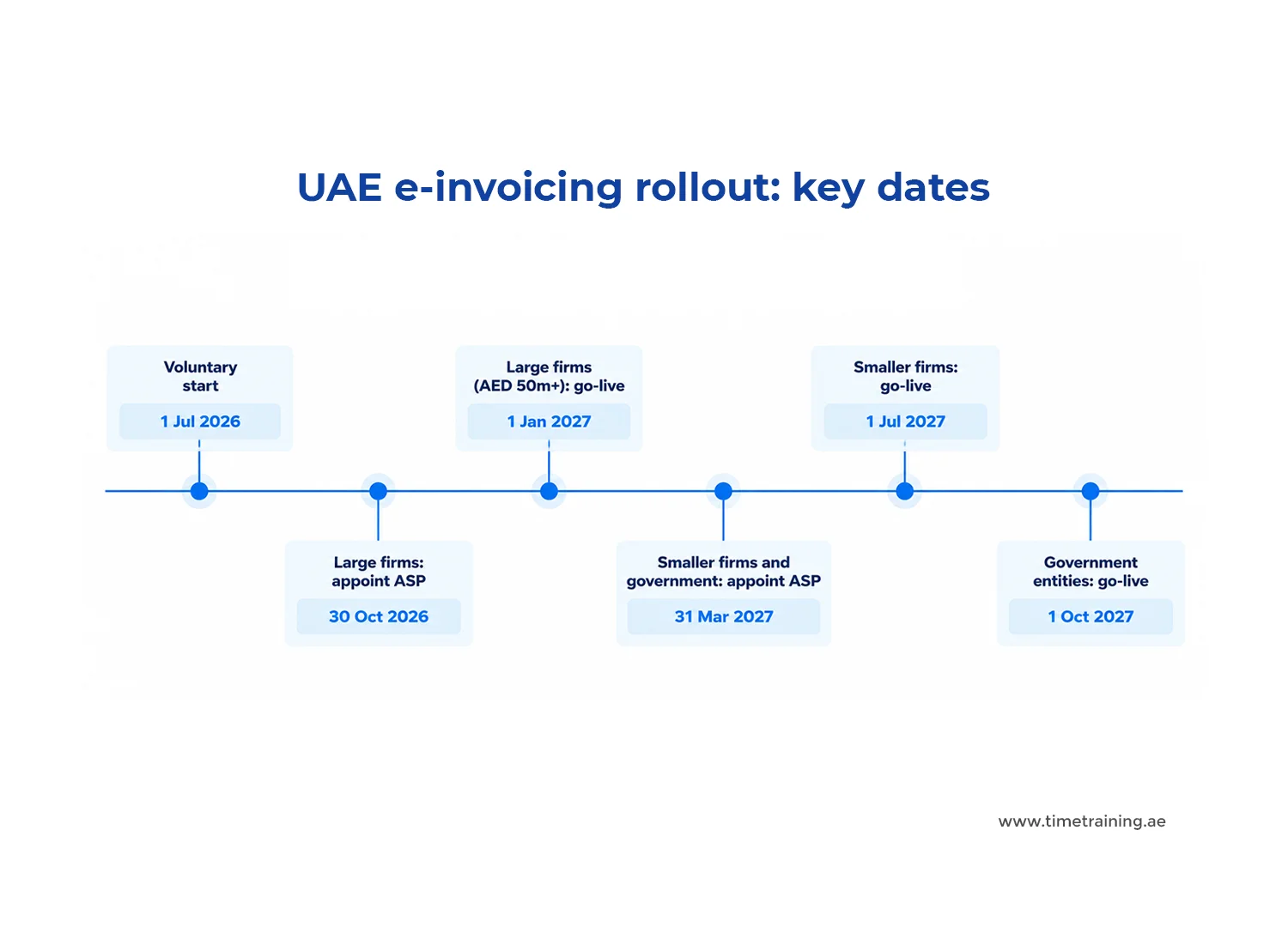
UAE e-invoicing key dates. Businesses with revenue of AED 50 million or more go first.
Invoices carry supplier details, tax data and payment records, so finance and procurement teams both feel the change. That is our reading, not a government statement about jobs.
Accuracy matters in both fields. SAP CEO Christian Klein told Sapphire 2026 that for mission-critical processes, "almost right" is not good enough.
What about salary? We do not quote one. Published UAE figures for SAP consultants vary widely, and no reliable public source splits FICO from MM. Check this SAP Professional salary guide.
Which Module Fits Your Background?
There is no winner here, only fit. Start with where you are now.
SAP FICO may align with you if:
-
Interest: you enjoy accounts, costs and financial reports.
-
Background: you have studied or worked in finance or accounting.
-
Work style: you like accuracy and checking numbers.
-
Direction: you want to work on financial systems.
Learn how to become a SAP FICO Consultant in Abu Dhabi.
SAP MM may align with you if:
-
Interest: you enjoy buying, suppliers and stock.
-
Background: you have worked in procurement, stores or logistics.
-
Work style: you like practical process work.
-
Direction: you want to work on procurement or supply chain systems.
You may also find this guide on top SAP Modules for software engineers helpful.
A beginner with no clear background? Try these steps:
-
Check your studies: note whether accounting or operations feels more familiar.
-
Notice what you enjoy: pick the process you could explain to a friend.
-
Read real job adverts: see which duties interest you most.
-
Ask a trainer: a short chat can settle doubts.
FAQ's
What is the difference between SAP FICO and SAP MM?
SAP FICO handles financial accounting and controlling. SAP MM handles materials, purchasing and inventory. One tracks money, the other tracks goods.
Which is better, SAP FICO or SAP MM?
Neither is better for everyone. Choose by background, interest and career goal.
Can beginners learn SAP FICO or SAP MM?
Yes. Basic accounting helps for FICO, and basic purchasing helps for MM. A good course teaches the rest.
Do SAP FICO and SAP MM work together?
Yes. In purchase-to-pay, MM handles ordering and receiving, and FICO handles postings and payment.
Are SAP FICO and SAP MM part of SAP S/4HANA?
Yes, though S/4HANA uses newer names, such as SAP S/4HANA Finance.
Is SAP training available in Abu Dhabi?
Yes. Time Training Center offers SAP FICO and SAP MM courses in Abu Dhabi.
Does SAP certification guarantee a job?
No. It shows tested knowledge, but employers also look at practical skills.
Should I learn both modules?
Start with the one that fits your background. Many people add the other later.
 +971 2 6713828