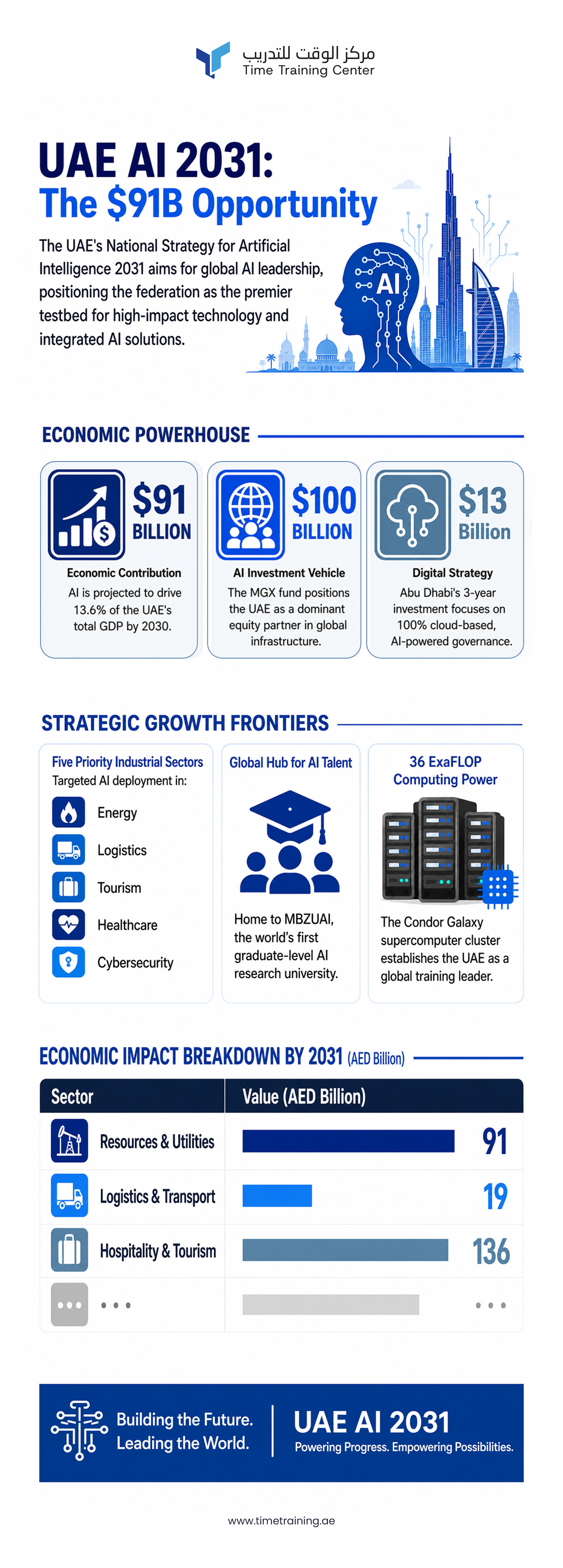
Quick Answer: The UAE National Strategy for Artificial Intelligence 2031 is the government's roadmap to make the UAE a global AI leader by 2031, targeting AED 335 billion (about $91 billion) in added economic value and 20% of non-oil GDP from AI.
It prioritises sectors like energy, logistics, tourism, healthcare, and cybersecurity, and is backed by talent programs such as the 1 Million AI Talents Initiative, creating strong demand for AI-skilled professionals across Dubai and Abu Dhabi.
The UAE AI Strategy 2031 is shaping the future of business, innovation, and careers across the Emirates.
Designed to position the UAE as a global leader in artificial intelligence, the strategy focuses on high-growth sectors, stronger digital infrastructure, smarter government services, and future-ready talent development.
From healthcare and logistics to tourism, energy, and cybersecurity, AI is expected to create major economic opportunities while transforming the skills employers demand.
Here in our blog, we talk about the UAE AI Strategy 2031, the key objectives and focus areas of this strategy, and its impact on developing talents and job opportunities in the UAE.
Table of Contents
|
|
1. What is the UAE AI Strategy 2031?
2. Which Industries Are Prioritised Under the UAE AI Strategy 2031?
3. Career Impact: What This Means for Job Seekers in the UAE
4. Key Takeaways
5. FAQs: UAE AI Strategy 2031
|
What is the UAE AI Strategy 2031?
The National Strategy for Artificial Intelligence 2031 is the UAE's plan to position itself as a global AI leader and hub, built around integrating emerging AI technology into government, attracting top AI talent and partnerships, and developing an AI export base.
It was made clear that the UAE’s intention was strong from the outset by naming Omar Al Olama as the world’s first Minister of State for Artificial Intelligence in 2017.
AI is stated as a pillar of the UAE Centennial 2071, as a way to create opportunities in the fields of economics, education, and society for the people, government, and companies. This is not a standalone policy paper; rather, it is part of a larger ecosystem that includes free zones, sovereign AI funds, and training programs.
What Are the Eight Strategic Objectives of the UAE AI Strategy 2031?
The strategy is centred around eight important goals. The first one is to make sure that the UAE becomes an attractive destination for AI technologies.
The strategy helps introduce AI into priority sectors and public services. Also, there is an attempt to create an environment where skilled talent will be attracted.
The eight strategic objectives of the UAE AI Strategy 2031 are discussed in the table below, with what each strategy means in practice.
The Eight Strategic Objectives
| Strategic Objective |
What It Means in Practice |
| Build a reputation as an AI destination |
Branding, awards, and a "UAI seal" for ethical AI firms |
| Increase competitive assets in priority sectors. |
Sector-specific AI deployment in energy, retail, and finance |
| Develop a fertile AI ecosystem. |
Startup funding, mentoring, free-zone incentives |
| Adopt AI across government services. |
Smart government platforms, citizen-facing AI tools |
| Attract and train future-ready talent. |
National training programs, university partnerships |
| Bring world-leading research to target industri.es |
National Virtual AI Institute, Key Thinkers Program |
| Build data and infrastructure as an AI test bed |
Secure data-sharing frameworks, sovereign cloud |
| Ensure strong governance and regulation. |
AI ethics guidelines, the UAE AI Charter |
Which Industries Are Prioritised Under the UAE AI Strategy 2031?
The strategy focuses on mature sectors such as finance, resources, construction, and retail trade, while also targeting newer growth areas, including healthcare, cybersecurity, and tourism, for AI-led innovation.
The UAE plans proof-of-concept projects in these industries, such as predictive systems for tourism demand and advanced diagnostic tools for healthcare.
| Industry |
AI Use Cases Being Prioritised |
| Healthcare |
AI diagnostics, predictive care, robotic-assisted surgery
|
| Energy |
Predictive maintenance, smart grid optimisation |
| Logistics |
Route optimization, automated warehousing |
| Tourism |
Demand forecasting, AI-personalised guest experiences
|
| Cybersecurity |
Threat detection, automated incident response |
| Finance |
Fraud detection, algorithmic risk assessment |
| Government services |
Citizen-facing chatbots, automated case processing
|
This sector spread matters for training providers and professionals alike: it signals where certification demand will concentrate first, healthcare informatics, cybersecurity, data analytics, and project or operations roles that increasingly require AI literacy.
“We want the UAE to become the world's most prepared country for artificial intelligence.”
What Are the Economic Goals and Investment Priorities of the UAE AI Strategy 2031?
UAE strategists have stated they are aiming for 20 per cent of non-oil GDP to come from AI by 2031, with the strategy projecting roughly $91 billion (AED 335 billion) added to the economy within six years.
There is also a strong belief among some UAE leadership figures in the near-term transformative potential of advanced AI, including artificial general intelligence.
Capital is following the ambition. MGX, a $100 billion AI investment vehicle launched by sovereign wealth fund Mubadala, is investing in datacentress, energy infrastructure, and stakes in major AI players such as OpenAI.
Microsoft has also committed $1.5 billion to Emirati AI company G42, partnering on sovereign cloud offerings and advanced AI solutions for public sector and enterprise clients.
| Metric |
Figure |
| Target non-oil GDP share from AI by 2031 |
20% |
| Projected economic contribution |
~$91B / AED 335B |
| Mubadala's MGX AI investment vehicle |
$100B |
| Microsoft–G42 sovereign cloud investment |
$1.5B |
| AI talent training target |
1,000,000 people |
Source: GulfNews
What Is the 1 Million AI Talents Initiative and Why Does It Matter?
-
A UAE Government initiative to train one million people in Artificial Intelligence, supporting the country's AI Strategy 2031.
-
Includes AI literacy programs for all professionals and advanced training in:
-
Focuses on upskilling STEM students, government officials, and professionals through partnerships with global AI experts.
-
Plans to establish a National Virtual AI Institute and attract leading researchers through the Key Thinkers Program.
-
Expected to boost demand for AI training and increase enrollments in AI courses across Dubai, Abu Dhabi, and the wider UAE.
“Artificial intelligence is not a technology of the future; it is a tool that is transforming economies and societies today. Countries that invest in AI talent and innovation will lead the future.”
-
Omar Sultan Al Olama, Minister of State for Artificial Intelligence, Digital Economy, and Remote Work Applications, UAE
How Is the UAE Regulating Artificial Intelligence and Ensuring Responsible AI Use?
The UAE has adopted a phased approach to AI governance, combining data protection laws, ethical guidelines, and national frameworks to promote responsible AI adoption.
-
Personal Data Protection Law (2021): Federal Decree-Law No. 45 of 2021 establishes rules for data privacy, transparency, informed consent, and the prevention of data misuse and leakage in the UAE.
-
AI Ethics Guidelines (2022): The UAE introduced non-binding AI ethics guidelines based on eight core principles to encourage fairness, accountability, transparency, and responsible AI development.
-
UAE AI Charter (2024): Announced in June 2024, the UAE Charter for the Development and Use of Artificial Intelligence outlines key principles for ethical, inclusive, and human-centric AI deployment.
-
Balanced Innovation and Governance: The UAE's regulatory framework is designed to accelerate AI innovation while ensuring strong governance, public trust, data security, and ethical implementation.
-
Focus on Responsible AI Adoption: By integrating legal protections, ethical standards, and national guidance, the UAE aims to create a secure and sustainable environment for AI growth across industries.
Expert Opinion
What makes the UAE AI Strategy 2031 particularly significant is its comprehensive approach. It combines investment, talent development, regulatory innovation, and sector-wide adoption to accelerate economic diversification and establish the UAE as a global hub for artificial intelligence.
- Dr Ray O. Johnson, former CEO, Technology Innovation Institute (TII), UAE
Career Impact: What This Means for Job Seekers in the UAE
The strategy's industry focus and talent programs are reshaping hiring patterns across the UAE and wider GCC. A few clear shifts are emerging:
-
Cybersecurity and data roles are in high demand as the government and finance sectors digitise under the strategy's mandate to adopt AI services securely.
-
Healthcare and logistics professionals with AI literacy have an edge, since these are explicit pilot sectors for AI deployment.
-
Government and semi-government employers are actively upskilling staff through subsidised AI training rather than hiring externally for every new AI-related function.
-
Free zones such as ADGM, DIFC, Dubai Internet City, and Masdar City continue to attract AI and deep-tech employers, widening the private-sector job pool for AI-skilled talent.
-
Certifications carry real weight. With government-subsidised training covering a large share of program costs, professionals who complete recognised AI, data, or cybersecurity certifications are positioned to move into these roles faster than those relying on on-the-job exposure alone.
| Career Path |
Why Demand Is Rising |
| AI/ML Engineer |
Direct hiring needs from sector pilots and G42/MGX-backed projects |
| Cybersecurity Analyst |
Listed as a national AI priority sector |
| Data Analyst/Scientist |
Core to AI-ready government and enterprise data initiatives |
| AI Governance/Ethics Specialist |
Driven by the UAE AI Charter and ethics guidelines |
| Healthcare Informatics Specialist |
Healthcare is flagged as a proof-of-concept priority sector |
Key Takeaways
-
The strategy was launched in October 2017 and aligns with the long-term UAE Centennial 2071 vision.
-
It is built around eight strategic objectives, from building an "AI destination" brand to ensuring strong governance.
-
Priority sectors include energy, logistics, tourism, healthcare, and cybersecurity, with proof-of-concept projects planned in each.
-
Officials are targeting 20 per cent of non-oil GDP from AI by 2031, alongside an estimated $91 billion (AED 335 billion) economic contribution within six years.
-
The UAE has launched a program to train 1 million people in AI skills, intended to make the country a regional AI talent hub.
-
The shift is creating new, well-paid career paths in AI, data, cybersecurity, and governance across both government and private sectors.
Ready to build AI-relevant skills for the UAE job market? Explore certification programs designed around the sectors driving the UAE's AI economy and get ahead of where hiring is heading.
FAQs
What is the goal of the UAE AI Strategy 2031?
The strategy aims to establish the UAE as a global AI leader by 2031, aligned with the UAE Centennial 2071 vision, while generating an estimated AED 335 billion in economic growth.
Which industries does the UAE AI Strategy prioritise?
Energy, logistics, tourism, healthcare, and cybersecurity are the named priority sectors, with proof-of-concept AI projects planned in each.
How much economic value is the strategy expected to generate?
The strategy projects around $91 billion (AED 335 billion) in added economic value, with a target of 20 per cent of non-oil GDP coming from AI by 2031.
What is the 1 Million AI Talents Initiative?
It is a national program to train one million people in AI skills, positioned as the largest coordinated AI skills development effort in the Middle East and a key pillar supporting the AI Strategy 2031.
Is there a regulatory framework for AI in the UAE?
Yes, it includes the 2021 Personal Data Protection law, 2022 AI Ethics guidelines, and the 2024 UAE Charter for the Development and Use of AI.
What does this mean for my career in the UAE?
Professionals in cybersecurity, data, healthcare technology, and government digital services are best positioned, particularly those who complete recognised AI or data certifications that align with the strategy's priority sectors.
 +971 2 6713828