The salary of most Data Analytics professionals in Abu Dhabi is between AED 10,000 and AED 30,000 a month.
Junior roles mostly start around AED 8,000, while senior or specialised positions like Data Scientist can climb past AED 30,000–40,000. Experience, industry, and technical skill set are what really move the needle.
Ask five people what a Data Analyst makes in Abu Dhabi, and you'll likely get five different answers, one quoting a modest monthly figure, another throwing around a number that sounds almost too good to be true.
Both can be right at once. A fresh graduate cleaning spreadsheets and a senior analyst building predictive models for a bank technically share a job title, but they're nowhere near the same pay bracket.
This article unpacks what's actually behind those numbers: realistic ranges by experience and role, the factors that genuinely move your pay, and how roles like Business Intelligence Analyst, Business Analyst and Data Scientist compare.
Treat every figure here as a market estimate, not a promise. What you're eventually paid comes down to your employer, your portfolio, and how well you negotiate.
How Much Do Data Analysts Earn in Abu Dhabi Based On Experience?
Data Analysts earn in Abu Dhabi an average between AED 10,000 and AED 30,000 a month, with the bulk of professionals falling in the AED 12,000–29,000 range.
Where you land in that band depends almost entirely on experience and employer type; a junior analyst at a mid-sized firm and a senior analyst inside a bank or oil and gas company can be worlds apart.
The average salary of a data analyst in Abu Dhabi based on experience level is given in the table below:
Data Analyst Salary in Abu Dhabi Based on Experience Level
| Experience Level |
Average Monthly Salary Range (AED) |
What You'd Be Doing
|
| Junior Data Analyst (0–2 yrs) |
8,000 – 14,000 |
Cleaning data, building reports, and basic dashboards
|
| Mid-Level Data Analyst (2–5 yrs) |
14,000 – 22,000 |
Independent analysis, stakeholder reporting, SQL, or Power BI work
|
| Senior Data Analyst (5+ yrs) |
22,000 – 32,000+ |
Leading projects, predictive analysis, mentoring juniors
|
| Data Scientist / Specialist |
25,000 – 40,000+ |
Machine learning models, advanced statistical work
|
According to reporting on the World Economic Forum's Future of Jobs Report 2025, 56% of current jobs in the UAE are expected to undergo substantial change over the next five years.
Among them, 28% of employees are able to be upskilled into their existing roles, and 18% require retraining into new ones.
The same report lists big data professionals among the fastest-growing career categories globally.
“Data analytics that provide insight into organisational performance, customer needs, and the organisation’s ecosystem.”
Abu Dhabi Award for Excellence in Government Performance (ADAEP) Guide
What Factors Determine a Data Analyst's Salary in Abu Dhabi?
Here are the key factors that determine a data analyst’s salary in Abu Dhabi:
-
Experience: Years on the job still matter more than almost anything else, especially once you cross the 3–5 year mark.
-
Industry: Banking, oil and gas, and real estate in Abu Dhabi generally pay more for analytics talent than retail or hospitality.
-
Technical skill depth: Comfort with SQL, Power BI, Tableau, and Python opens doors to higher-paying, more technical roles.
-
Qualifications and certifications: A recognised certification doesn't guarantee a raise, but it can strengthen your case in interviews and appraisals.
-
Company size: Multinationals and large local corporations typically have wider pay bands than small businesses.
-
Specialisation: Analysts who move into Business Intelligence, predictive analytics, or machine learning tend to out-earn generalist analysts over time.
None of these factors work in isolation; a certification without practical projects, for instance, rarely moves a salary conversation on its own.
Learn the right tools and techniques to become a data analyst in Abu Dhabi and advance your career.
“Data skills are essential to manage risks, provide better business solutions, perform predictive analytics, detect fraud, and create fast trading algorithms.”
- Dr Arif Sultan Al Hammadi, Executive Vice President, Khalifa University
How Do Salaries Compare Across Different Data Analytics Roles?
To compare the salaries of different data analytics roles, you have to understand that "Data Analyst" is really an umbrella term. Depending on your specialisation, your title and your paycheck can look quite different.
Average Monthly Salary by Data Analytics Roles in the UAE
| Role |
Focus Area |
Average Monthly Range (AED)
|
| Business Analyst |
Business processes, requirements gathering |
12,000 – 24,000 |
| Data Analyst |
Reporting, dashboards, data cleaning |
10,000 – 30,000 |
| Business Intelligence Analyst |
BI tools, dashboards, KPI tracking |
14,000 – 28,000 |
| Senior Data Analyst |
Advanced analysis, project leadership |
22,000 – 32,000+
|
| Data Scientist |
Statistical modelling, machine learning |
25,000 – 40,000+
|
If you're weighing career paths, it's worth noting that Business Intelligence and Data Science roles generally sit at the higher end, but they also demand a steeper technical learning curve.
Which Skills Help You Earn More as a Data Analyst?
Salary and skill set are closely linked in Data Analytics, more so than in many other professions. Employers in Abu Dhabi consistently look for a mix of the following top in-demand data analytics skills in Abu Dhabi:
Data Analytics Skills Needed and Why It Matters
| Skill/Tool |
Why It Matters |
| Excel |
Still the baseline for reporting and quick analysis in most companies
|
| SQL |
Core skill for querying and managing large datasets
|
| Power BI |
Widely used across UAE companies for dashboards and visual reporting
|
| Tableau |
Preferred in industries with heavy data visualisation needs
|
| Python |
Opens doors to predictive analytics and more technical roles
|
No single tool guarantees a higher salary on its own. What tends to make the difference is being able to combine two or three of these skills and show real projects, not just certificates that prove you can use them.
Building this kind of practical, tool-based skill set is exactly what a structured Data Analytics course in Abu Dhabi is designed for, working through Excel, SQL, Power BI and Python in a hands-on setting rather than piecing it together alone.
PwC's 2026 AI Jobs Barometer for the UAE found that the share of UAE job postings requiring AI-related skills rose from roughly 1.0% in 2021 to about 3.2% in 2025, more than tripling in four years.
That pace of growth is contributing to rising demand and, by extension, pay pressure across UAE data and analytics roles.
Which Industries in Abu Dhabi Hire Data Analytics Professionals?
The major industries in Abu Dhabi hiring data analytics professionals are:
-
Banking and finance: Risk analysis, fraud detection, reporting
-
Oil and gas /energy: Operational data, forecasting, efficiency analysis
-
Government and semi-government entities: Policy and performance analytics
-
Healthcare: Patient data, operational reporting
-
Retail and logistics: Demand forecasting, customer analytics
-
Real estate: Market trend and pricing analysis
Average Data Analyst Salary in Abu Dhabi Based on Industry
| Industry |
Average Monthly Salary (AED)
|
| Banking & Financial Services |
AED 12,000–25,000
|
| Oil & Gas / Energy |
AED 12,000–28,000
|
| Technology & AI |
AED 10,000–25,000
|
| Government & Public Sector |
AED 10,000–24,000
|
| Telecommunications |
AED 10,000–22,000
|
| Healthcare & Life Sciences |
AED 9,000–20,000
|
| Consulting & Professional Services |
AED 9,000–22,000
|
| Retail & E-commerce |
AED 8,000–18,000
|
| Real Estate & Property |
AED 8,000–18,000
|
| Logistics & Supply Chain |
AED 8,000–18,000
|
Source: Indeed
Because many sectors in Abu Dhabi rely on data for decision-making, analysts aren't limited to traditional “tech jobs.” A finance or healthcare background paired with analytics skills can be just as valuable as a computer science degree.
How Can You Grow From Junior to Senior Data Analyst?
Career progression in Data Analytics tends to follow a fairly predictable path, even if the timeline varies from person to person:
-
Junior Data Analyst: Focused on data cleaning, basic reporting, and learning the best data analytics tools.
-
Data Analyst: Handling end-to-end analysis and presenting findings to stakeholders.
-
Senior Data Analyst: Leading projects, mentoring, and working with more complex datasets.
-
Specialist roles (Business Intelligence Analyst, Data Scientist, Analytics Manager) are built on top of a strong analyst foundation, often after developing deeper statistical or machine learning skills.
Moving up this ladder usually comes down to a mix of experience, demonstrated project work, and continuous upskilling, rarely just time served.
Follow a practical data analyst roadmap to build the skills needed for analytics roles in Abu Dhabi.
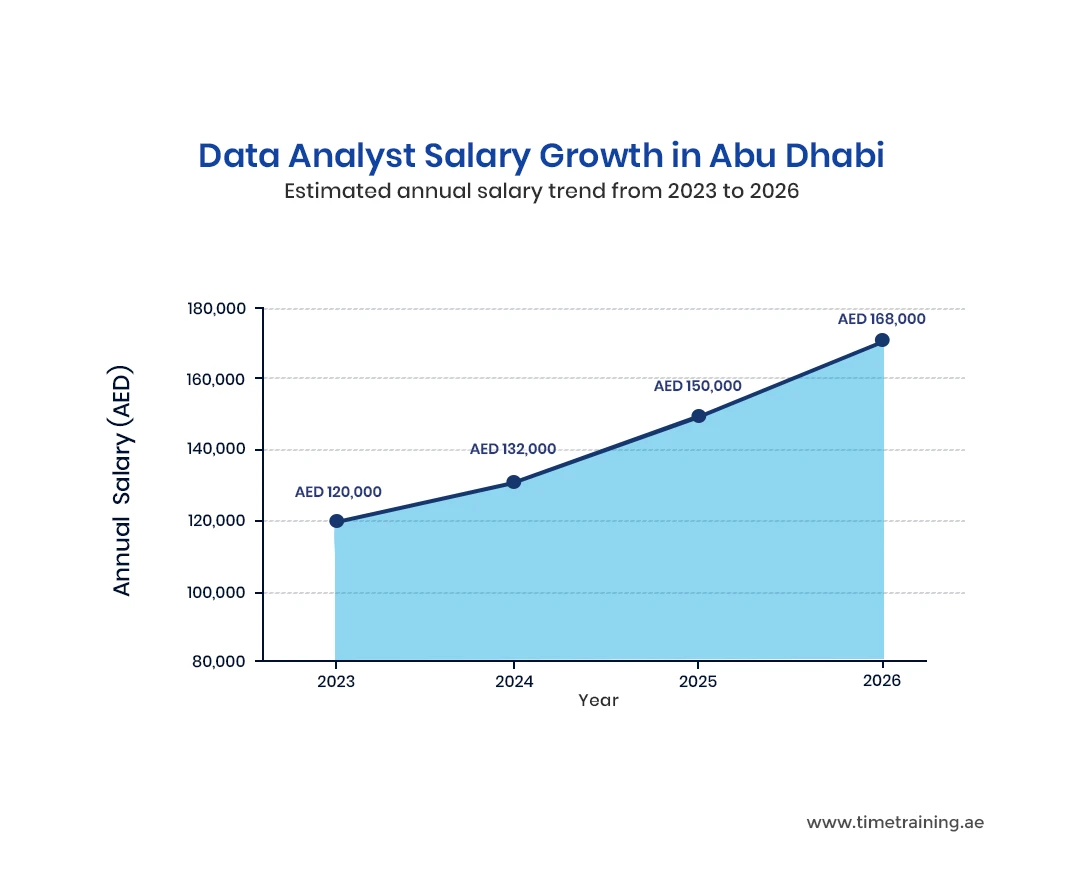
The salary growth of data analysts in Abu Dhabi over a period of 4 years is illustrated in the graph below:
How Can You Improve Your Data Analytics Salary Prospects in Abu Dhabi?
The practical, realistic steps to improve your data analytics salary prospects in Abu Dhabi are:
-
Build a portfolio of real (or realistic) projects using SQL, Power BI, Tableau, or Python, not just certificates.
-
Get comfortable presenting findings to non-technical stakeholders, since that skill is often underrated.
-
Pursue a recognised Data Analytics certification in Abu Dhabi alongside practical training, rather than instead of it.
-
Specialise gradually; pick one advanced area (BI, predictive analytics, or machine learning) once your fundamentals are solid.
-
Keep an eye on which industries in Abu Dhabi are actively hiring, and tailor your CV and skill set accordingly.
If you're starting from scratch or looking to formalise scattered self-taught skills, enrolling in a Data Analytics training programme can help you build this foundation faster and more systematically than learning tool-by-tool on your own.
Key Takeaways
-
Data Analytics salaries in Abu Dhabi vary widely based on experience, role, industry, and skill set.
-
Junior, mid-level, and senior roles typically fall into distinct earning bands.
-
SQL, Excel, Power BI, Tableau, and Python remain the core skills employers look for.
-
Industry choice can meaningfully shift earning potential, even at the same experience level.
-
Certifications and practical projects work best together, not as substitutes for one another.
-
Treat all salary figures as market estimates that can shift over time, not fixed guarantees.
-
The worth of data analytics training in Abu Dhabi can be significant for professionals seeking to build in-demand skills, improve career opportunities, and support data-driven business decisions.
FAQ's
1. What is the average Data Analyst salary in Abu Dhabi?
Most data analysts in Abu Dhabi earn between AED 8,500 and AED 14,000 a month, with senior specialists earning considerably more.
2. What is the starting salary for a Junior Data Analyst in Abu Dhabi?
Entry-level data analysts mostly start between AED 6,000 and AED 6,500 a month.
3. How much does a Senior Data Analyst earn in the UAE?
Senior data analyst salaries in the UAE generally range from AED 20,000 to AED 35,000 a month, sometimes higher with leadership responsibilities.
4. Is a Data Analyst paid more in Dubai or Abu Dhabi?
Dubai often advertises a higher base salary, while Abu Dhabi employers more frequently add allowances on top of base pay; ask each employer what's included before comparing offers directly.
5. What is the Data Analyst salary per month in Abu Dhabi?
On a monthly basis, entry-level pay is roughly AED 6,000–6,500, mid-level AED 10,000–18,000, and senior AED 20,000–35,000.
6. What is the salary of a Data Analyst with 5 years of experience in Abu Dhabi?
Around the five-year mark, analysts typically move into the senior band, commonly AED 20,000–30,000 a month, depending on industry and scope.
7. Which Data Analyst skills are most in demand in Abu Dhabi?
SQL, Power BI, Tableau, Excel, and increasingly Python are the most consistently requested skills, alongside strong communication for presenting findings to stakeholders.
8. How does a Business Analyst salary in Abu Dhabi compare to a Data Analyst's?
The two overlap significantly. UAE-wide, Business Analyst pay averages around AED 8,500 a month and can reach AED 22,000, similar to the Data Analyst range.
 +971 2 6713828