Yes, for most people it is. SQL shows up in the majority of data analyst job postings in Abu Dhabi, right alongside Excel and Power BI. It's not included in every job description, and it won't guarantee you an offer on its own.
But if you can only learn one technical skill before applying for data analyst roles, SQL is usually the one worth prioritising.
If you've spent any time browsing data analyst vacancies in Abu Dhabi, you've probably noticed the same three letters popping up again and again: SQL.
It sits there next to Excel and Power BI like just another line item, which makes it easy to skim past. In practice, it's usually skill that determines whether an analyst waits for someone else to pull the data or goes and gets it themselves.
This guide breaks down why SQL matters, what you'd actually use it for day-to-day, which parts to learn first, and where it fits alongside Excel, Power BI and Python, so you're not left guessing.
|
Table of Contents
|
|
1. What is SQL Used for in Data Analyst Jobs in Abu Dhabi?
2. What Does a Data Analyst Do With SQL Day-to-Day?
3. Which SQL Skills Should Beginners Learn First?
3.1. SQL vs Excel vs Power BI vs Python: Where Does It Fit?
3.2. Do All Data Analyst Roles in Abu Dhabi Require SQL?
4. What Does the Data Say About SQL Demand?
5. How Can Beginners Start Learning SQL Step by Step?
5.1. Is a Data Analyst Career in Abu Dhabi Worth Pursuing?
6. Key Takeaways
7. FAQs: Is Learning SQL Worth It for Data Analyst Jobs in Abu Dhabi?
|
What is SQL Used for in Data Analyst Jobs in Abu Dhabi?
Data analysts use SQL to talk to databases directly, instead of waiting for someone else to export the numbers they need. Most business data (sales records, customer information, transaction logs) lives in relational databases, not neat spreadsheets.
SQL is the language that lets you ask the database a question and get a specific answer back. Without it, an analyst is stuck relying on pre-built reports or asking IT for a data pull every time a manager wants something new.
That's the practical reason SQL keeps showing up in data analyst technical skills lists across almost every industry.
A few things SQL lets a data analyst do that Excel alone struggles with:
-
Pull exactly the rows and columns needed from millions of records, not thousands.
-
Combine data from several tables at once, instead of copying and pasting between files.
-
Filter and summarise information before it ever touches a spreadsheet.
-
Rerun the same query reliably, rather than rebuilding a manual process each time.
According to PwC's 2026 AI Jobs Barometer, the number of UAE job postings requiring AI skills increased by around 2,700 between 2024 and 2025, signalling accelerating demand for technical data and AI capabilities.
“The ability to build and scale securely and at speed depends on trusted, unified infrastructure.”
- H.E. Wesam Lootah, Director General, Department of Government Enablement – Abu Dhabi
What Does a Data Analyst Do With SQL Day-to-Day?
On a typical day, a data analyst might use SQL to pull last month's regional sales figures, check which customers haven't ordered in 90 days, or build the dataset behind a dashboard someone else will present.
None of this is glamorous. It's closer to plumbing than magic, and that's exactly why it matters.
Say a manager asks for total revenue by branch for the last quarter, split by product category. With SQL, an analyst writes one query that joins the sales table to the branch and product tables, filters by date, and groups the results.
It runs in seconds, and it can be rerun next quarter without redoing the legwork. That's the kind of task that separates "I can read a dashboard" from "I can build one from scratch," even if a job ad never spells it out that way.
Which SQL Skills Should Beginners Learn First?
Beginners don't need to master every corner of SQL before applying. A working grasp of the basics gets you further than you'd expect.
Top SQL Skills Beginners Should Learn First
| SQL Skill |
What It Does |
Where You'd Use It
|
| SELECT & WHERE |
Pulls specific columns and filters rows |
Getting only the data you actually need
|
| GROUP BY & aggregates |
Summarises data (totals, averages, counts) |
Monthly sales totals, average order value
|
| JOIN |
Combines two or more tables |
Linking customer records to their orders
|
| ORDER BY & LIMIT |
Sorts and trims results |
Finding the top 10 performing products
|
| Subqueries |
A query inside another query |
Comparing a value against a calculated benchmark
|
Most beginner SQL courses follow roughly this order: basic queries first, then filtering and sorting, then joins.
Joins tend to be the sticking point for new learners, but they're also where SQL starts to feel genuinely useful, because that's when you stop working with one table and start working with a real database.
Once these are comfortable, a few skills tend to come later rather than first: CASE WHEN for conditional logic, window functions for running totals or rankings, and CTEs for breaking complex queries into readable steps.
Beginners don't need these to start job-hunting, but they're worth knowing next once the basics feel automatic.
A Data Analyst Certification Course in Abu Dhabi can help learners build these SQL fundamentals progressively while developing practical skills for real-world data analysis.
SQL vs Excel vs Power BI vs Python: Where Does It Fit?
SQL isn't a replacement for Excel, Power BI, or Python. It's usually the first step in the pipeline, not the last one. The best data analytics tools and where they fit are given in the table below:
How SQL, Excel, Power BI, and Python Work Together in Data Analysis
| Tool |
Best For |
Common Role in the Workflow
|
| SQL |
Extracting and filtering raw data from databases |
Step 1: Get the right data out
|
| Excel |
Quick calculations, ad hoc analysis, simple reporting |
Step 2: Shape and check the numbers
|
| Power BI |
Interactive dashboards and visual reporting |
Step 3: Present findings to stakeholders
|
| Python |
Automation, statistics, larger or messier datasets |
Used alongside SQL for deeper analysis
|
In practice, a lot of analysts pull data with SQL, check it in Excel, then build the dashboard in Power BI. Python tends to come in once the workload grows or gets more statistical.
SQL and Power BI are often listed together in Abu Dhabi job postings because they cover both ends of the process: getting the data, then showing it.
The "SQL vs Python" debate online is a bit of a false choice for most entry-level roles, since SQL is usually needed just to access the data in the first place.
Do All Data Analyst Roles in Abu Dhabi Require SQL?
No, not every data analyst role in Abu Dhabi lists SQL as a strict requirement, but a large share of them do, especially in banking, government-linked entities, retail and logistics, where data volumes are high and systems are database-driven.
A quick look at live job boards backs this up.
GulfTalent alone lists dozens of open database and data-analyst roles across Abu Dhabi at any given time, with employers spanning oil & gas, hospitality, retail and banking, including names like ADNOC, Etihad Airways and Abu Dhabi Commercial Bank.
That spread reflects how central database and SQL skills have become outside of pure IT roles, showing up in finance, operations and reporting functions as much as in tech teams.
How important SQL is tends to shift with the role itself, not just the industry, as shown in the table below:
When is SQL Required for Different Data Analyst Roles?
| Role Type |
SQL Likely Required? |
Notes |
| Entry-level analyst, small business |
Sometimes |
May rely more on Excel initially
|
| Analyst at a bank, telecom, or government entity |
Usually |
Large, database-heavy systems
|
| Business Intelligence (BI) analyst |
Almost always |
SQL is core to the role
|
| Marketing or reporting analyst |
Often |
Especially where CRM data is involved
|
| Analyst using mostly vendor dashboards |
Sometimes |
Depends on how much raw access is given
|
SQL requirements for data analyst jobs vary by employer, so it's worth checking individual postings rather than assuming one rule applies everywhere.
What doesn't vary much is how often SQL improves your odds, even when it isn't listed as mandatory.
What Does the Data Say About SQL Demand?
Broader workforce data supports SQL's staying power, even though most reports track data skills as a category rather than naming SQL specifically.
According to the World Economic Forum's Future of Jobs Report 2025, big data and AI-related skills rank among the fastest-growing skill categories globally, with analytical thinking named the single most valued core skill by the employers surveyed.
That survey drew on responses from over a thousand employers worldwide, which gives it more weight than a single-market opinion piece.
SQL is where that broader trend becomes concrete for a data analyst, since it's the technical skill that turns "we need someone data-literate" into "someone who can actually query the database."
Local job listings, as above, reflect the same pattern at a market level: SQL and database skills sit inside a wide range of job titles, not just dedicated data roles.
None of this means SQL is mandatory everywhere, and it's worth being wary of any claim promising a job purely on the strength of one certificate.
What the data does support is that SQL and adjacent data skills are becoming a more consistent baseline, not a niche add-on.
For those looking to build these skills systematically, a Data Analyst Course in Abu Dhabi can provide structured training in SQL alongside Excel, Power BI, Python, and practical data analysis.
“By incorporating AI, cloud technologies, and data-driven insights into our government’s DNA, we will transform public service delivery, optimise government operations, and drive sustainable economic growth.”
- H.E. Ahmed Hisham Al Kuttab, Chairman, Department of Government Enablement – Abu Dhabi
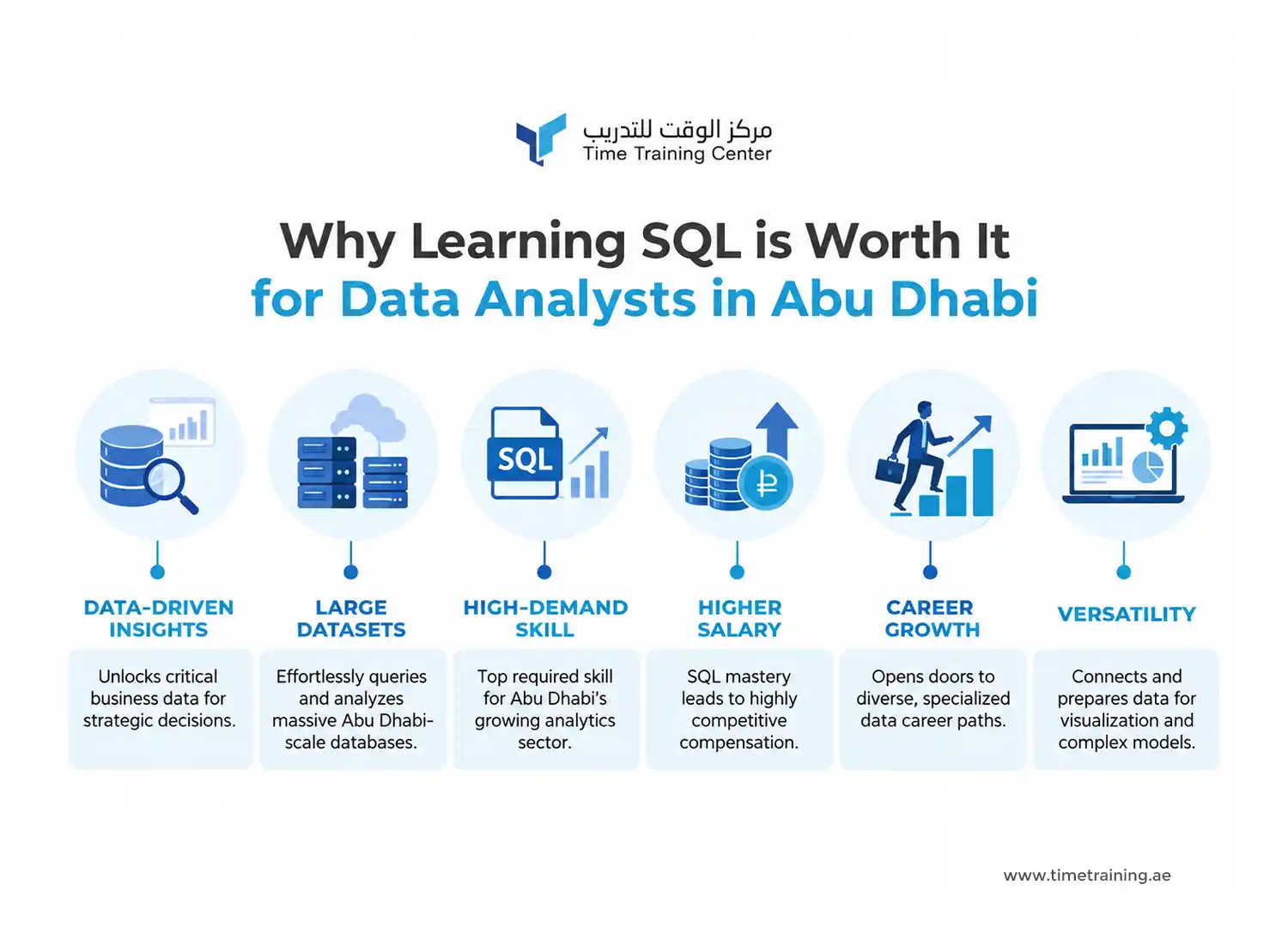
The six major 6 reasons why learning SQL is worth it for data analyst jobs in Abu Dhabi are illustrated in the infographics below:
How Can Beginners Start Learning SQL Step by Step?
Beginners generally get the most out of SQL by learning it in short, applied stages rather than absorbing the whole language at once. The steps to learn SQL to become a data analyst in Abu Dhabi are:
-
Start with SELECT statements on a small dataset to get comfortable with syntax.
-
Practise filtering with WHERE and sorting with ORDER BY.
-
Move on to GROUP BY and aggregate functions like SUM, COUNT, and AVG.
-
Learn JOINs using two related tables, such as customers and orders.
-
Work on small real-world exercises, like ranking sales by region.
-
Pair SQL with a visualisation tool, such as Power BI, so the output becomes something you can present.
-
Add two or three finished SQL projects to your CV or portfolio, since employers generally want to see applied work, not just a completion certificate.
Self-study works for some people, but a lot of beginners find it easier to stay consistent inside a structured course, where the exercises build in a logical order, and questions get answered instead of getting stuck.
If that sounds like your situation, Time Training's Data Analytics course in Abu Dhabi covers SQL alongside Excel and Power BI, so you're not learning it in isolation from the rest of the job.
Is a Data Analyst Career in Abu Dhabi Worth Pursuing?
Yes, broadly speaking, a data analyst career is worth pursuing in Abu Dhabi given the emirate's ongoing push toward data-driven government services, banking, and logistics.
That said, nobody can promise a specific salary or guaranteed placement, and results depend on the individual, the employer, and the wider job market.
LinkedIn's UAE listings currently show 482 Data Analyst jobs, including Abu Dhabi roles such as Data & Reporting Analyst, Data Modeler, and Data Analyst positions.
What tends to hold true is that analysts who combine SQL, Excel, Power BI, and a working understanding of business context are more adaptable across sectors and less dependent on someone else handing them data.
Whether you build these skills solo or through structured data analytics training, treating SQL as one part of a broader skill set, not a standalone certificate, is the more realistic approach.
Key Takeaways
-
SQL is one of the most consistently requested skills for data analyst roles, though it isn't listed as mandatory in every posting.
-
SQL helps analysts retrieve, filter, and combine data directly from databases, rather than waiting on manual reports.
-
Beginners can start with basic queries (SELECT, WHERE, GROUP BY) and build up to JOINs at a manageable pace.
-
SQL works alongside Excel, Power BI, and Python, not instead of them.
-
SQL requirements for data analyst roles in Abu Dhabi vary by industry, seniority, and employer, so it's worth checking individual listings.
FAQ's
1. Is SQL necessary for every data analyst job in Abu Dhabi?
No. SQL is common but not universal. Some entry-level or small-business roles rely mainly on Excel and dashboards, while database-heavy sectors like banking and telecom expect SQL more often.
2. Do data analysts need SQL if they already know Excel?
Excel handles smaller datasets well, but SQL becomes useful once data sits in a database or grows too large for a spreadsheet to manage efficiently. Most analysts eventually need both.
3. How long does it take a beginner to learn basic SQL?
Enough SQL to handle simple queries, filtering, and joins can mostly be learned within a few weeks of consistent, hands-on practice, though comfort with more complex queries takes longer.
4. What SQL skills do employers in Abu Dhabi look for most?
Common expectations include writing SELECT queries, filtering with WHERE, using JOINs across tables, and summarising data with GROUP BY. Advanced query writing is usually valued at more senior levels.
5. Can I become a data analyst without learning SQL first?
It's possible, particularly for roles centred on Excel and Power BI. However, skipping SQL entirely tends to limit which roles and industries stay open to you later on.
6. Does SQL guarantee a data analyst job in Abu Dhabi?
No single skill guarantees employment. SQL improves your candidacy and day-to-day capability, but employers also weigh experience, communication skills, and familiarity with tools like Power BI.
 +971 2 6713828


.webp)