Primavera P6 is an enterprise project, portfolio, and resource management software developed by Oracle. It helps organisations plan, schedule, execute, and monitor complex projects using the Critical Path Method, giving planners a single system to manage activities, resources, costs, and risks across an entire project portfolio.
For professionals working in project scheduling, construction, engineering, and project controls, understanding Oracle Primavera P6 has become an essential skill.
This article breaks down what Primavera P6 is, how Primavera P6 work in practice, and why it remains the backbone of large-scale project delivery across construction, oil and gas, infrastructure, and engineering sectors in the UAE and beyond.
Table of Contents
|
|
1. What is Primavera P6?
2. How Does Primavera P6 Work?
3. What Are the Key Features of Primavera P6?
3.1 What Are the Benefits of Primavera P6?
4. What Is the Primavera P6 Workflow?
4.1 How Is Primavera P6 Used for Construction Projects in Abu Dhabi?
4.2 What Makes Primavera P6 Different from Microsoft Excel?
4.3 Why Do Project Managers and Engineers Use Primavera P6 in Abu Dhabi?
5. Key Takeaways
6. FAQs: What is Primavera P6 and How does it Work?
|
What Is Primavera P6?
Primavera P6 is a project management and scheduling software platform originally developed by Primavera Systems and acquired by Oracle in 2008.
Today, it is officially known as Oracle Primavera P6, and it is considered the global standard for planning and controlling large, complex, multi-year projects.
Unlike simpler scheduling tools designed for small teams, Primavera P6 software is built for organisations managing thousands of activities across multiple sites, contractors, and disciplines at once.
It is the tool of choice wherever project delays translate into real financial and safety consequences think airports, metro lines, refineries, hospitals, and high-rise developments.
At its core, Primavera P6 project management revolves around three things:
-
Time
-
Cost
-
Resources
Oracle continues to actively develop the platform. The most recent on-premise release, version 25.12, arrived in January 2026, while Primavera P6 Cloud users receive monthly updates.
Recent versions have introduced AI-assisted scheduling suggestions, improved data-import controls, and predictive risk analysis tools, reflecting a broader shift toward smarter, more automated project controls.
How Does Primavera P6 Work?
Primavera P6 works by breaking a project into structured, logically linked components, then applying the Critical Path Method to calculate schedules, flag risks, and track progress against a baseline.
Here are the steps for how Primavera P6 works:
-
Building the Work Breakdown Structure (WBS)
-
Defining activities and durations
-
Establishing logical relationships
-
Calculating the critical path
-
Assigning resources and costs
-
Setting the baseline
-
Tracking progress and updating the schedule
-
Reporting and portfolio analysis
1. Building the Work Breakdown Structure (WBS)
Every project in Primavera P6 starts with a Work Breakdown Structure, a hierarchical breakdown of the project into manageable phases, sub-phases, and deliverables. This gives planners a logical framework before a single activity is scheduled.
2. Defining Activities and Durations
Within each WBS element, planners add individual activities the actual tasks required to complete the work, such as "excavate foundation" or "install MEP ductwork" along with estimated durations.
3. Establishing Logical Relationships
Activities are then linked using dependency types (Finish-to-Start, Start-to-Start, Finish-to-Finish, Start-to-Finish), lags, and constraints. This network of relationships is what allows Primavera P6 to calculate the project's timeline automatically rather than relying on guesswork.
4. Calculating the Critical Path
Using the Critical Path Method, Primavera P6 identifies the sequence of activities that determines the shortest possible project duration: the critical path. Any delay to a critical activity delays the entire project, so this calculation is central to how Primavera P6 project scheduling works.
5. Assigning Resources and Costs
Planners then load resources, labour, equipment, and materials and their associated costs onto each activity. Primavera P6 planning software uses this data to flag over-allocations, calculate resource demand curves, and forecast budget requirements.
6. Setting the Baseline
Once the schedule is approved, it is saved as a baseline, a fixed reference point used to measure actual progress against the original plan throughout the project lifecycle.
7. Tracking Progress and Updating the Schedule
As work proceeds, planners update actual start and finish dates, percentage complete, and remaining durations. Primavera P6 recalculates the schedule in real time, showing variances against the baseline and updating the critical path if needed.
8. Reporting and Portfolio Analysis
Finally, Primavera P6 generates dashboards, S-curves, resource histograms, and portfolio-level reports, giving stakeholders from site engineers to executive sponsors visibility into project health at a glance.
Check Out: What are the Roles and Responsibility of Primavera p6 professionals
Where Can You Get Primavera P6 Training in Abu Dhabi?
Understanding the theory of Primavera P6 project scheduling is one thing; using it confidently on a live, multi-contractor programme is another.
This is why structured Primavera P6 training in Abu Dhabi remains one of the most sought-after upskilling paths for engineers, planners, and project managers across the region.
A well-designed Primavera P6 course in Abu Dhabi typically covers:
-
Setting up the Enterprise Project Structure (EPS), WBS, and OBS
-
Creating and linking activities using CPM logic
-
Resource and cost loading
-
Baseline management and progress tracking
-
Risk analysis and "what-if" scheduling
-
Generating reports, S-curves, and dashboards
-
Real-world case studies from construction and infrastructure projects
Still deciding on a format? Compare classroom vs online Primavera P6 training in Abu Dhabi to see which suits you best.
What Are the Key Features of Primavera P6?
The key features of Primavera P6 are listed below in the table.
Key Features of Primavera P6
| Feature |
What It Does |
| Work Breakdown Structure (WBS) |
Organises the project into a logical hierarchy of deliverables
|
| Critical Path Method (CPM) scheduling |
Calculates the shortest project duration and identifies schedule risk
|
| Resource and role management |
Allocates labour, equipment, and materials, and flags over-allocation
|
| Cost management |
Tracks budgeted vs actual costs and supports earned value analysis
|
| Baselines |
Stores approved schedule versions for progress comparison
|
| Multi-project portfolio view |
Manages and compares performance across many projects at once
|
| Risk analysis |
Assesses schedule risk and models "what-if" scenarios
|
| Reporting dashboards |
Generates S-curves, histograms, and executive-level reports
|
| Mobile access (P6 Mobile) |
Enables field teams to capture progress and issues on site, with offline sync
|
These Primavera P6 features are precisely why it remains the preferred Primavera P6 scheduling software for organisations managing capital-intensive, multi-stakeholder programmes.
Wondering how quickly you can get up to speed? Find out how long it actually takes to learn Primavera P6 before you plan your training schedule.
What Are the Benefits of Primavera P6?
The benefits of Primavera P6 extend beyond scheduling. Organisations that adopt it consistently report gains in three areas: visibility, accountability, and cost control.
-
Improved schedule accuracy: CPM-based logic removes guesswork from project timelines.
-
Better resource utilisation: Planners can spot over-allocated resources before they cause delays.
-
Stronger cost control: Budget tracking and earned value data support proactive decision-making.
-
Enterprise-wide visibility: Portfolio views let leadership compare performance across dozens or hundreds of projects.
-
Audit-ready documentation: Baselines and change logs support claims, disputes, and contractual reporting- a major reason it is standard in construction contracts.
-
Scalability: The same platform can manage a single mid-size project or an enterprise portfolio spanning continents.
Recent industry research shows why this matters at scale.
According to Grand View Research, over 70% of large construction firms had adopted a centralised project management platform by 2025, with digital scheduling improving schedule adherence by around 23%.
This is the operational gap that tools like Primavera P6 are built to close.
Expert Insight
"On large EPC and infrastructure projects, Primavera P6 is more than scheduling software; it becomes the single source of truth for project controls, enabling planners to forecast delays before they affect delivery."
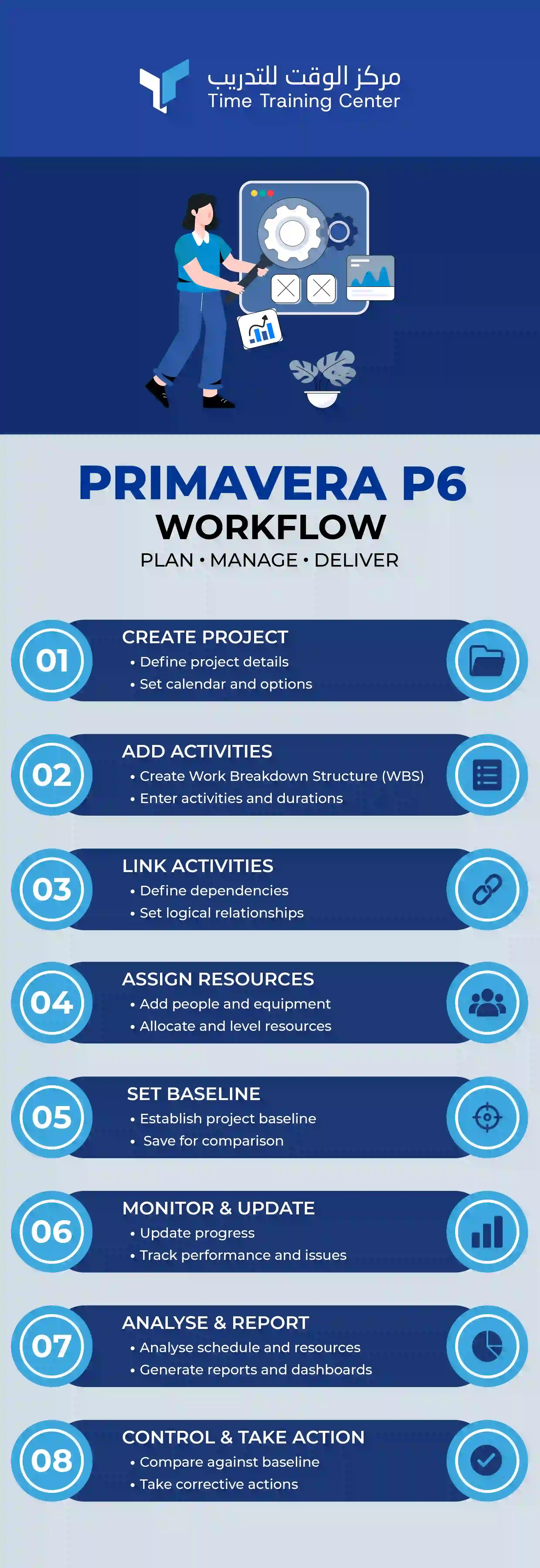
What is the Primavera P6 Workflow?
A typical Primavera P6 workflow, from project kick-off to close-out, generally follows this sequence:
-
Initiate: Create the project (EPS/project structure) and define objectives.
-
Structure: Build the WBS and organisational breakdown structure (OBS).
-
Plan: Add activities, durations, relationships, and constraints.
-
Resource and cost load: Assign labour, equipment, materials, and budgets.
-
Baseline: Approve and freeze the schedule as the reference plan.
-
Execute and update: Record progress, actuals, and field data.
-
Analyse: Review variances, critical path shifts, and resource conflicts.
-
Report: Share dashboards, S-curves, and portfolio summaries with stakeholders.
-
Close out: Archive the project data and lessons learned for future planning.
This structured Primavera P6 workflow is what allows planning teams to move from a static schedule to a living, continuously updated project control system.
The clear steps of the Primavera P6 workflow is illustrated in the infographics below:
How is Primavera P6 Used for Construction Projects in Abu Dhabi?
Primavera P6 for construction projects in Abu Dhabi is arguably its most established use case.
Primavera P6 helps construction teams in Abu Dhabi to:
-
Sequence trade handovers logically (for example, MEP rough-in only after structural completion)
-
Track long-lead procurement items against installation dates
-
Model the impact of weather delays or design changes on the overall timeline
-
Support Extension of Time (EOT) claims with baseline and progress data
-
Coordinate multi-contractor programmes on major infrastructure and building projects
Project management and scheduling account for roughly four in every ten dirhams spent on construction software globally. This highlights the growing importance of advanced scheduling tools.
As a result, Primavera P6 remains deeply embedded in construction and infrastructure projects across the UAE and GCC, from Abu Dhabi's major infrastructure programmes to Dubai's high-rise developments.
The major industries hiring Primavera P6 professionals across Abu Dhabi are listed in the table below;
Industries Hiring Primavera P6 Professionals in Abu Dhabi
| Industry |
Major Abu Dhabi Companies
|
| Oil & Gas |
ADNOC, NPCC, Technip Energies, Saipem
|
| Construction & Real Estate |
Aldar, Trojan Construction, Modon
|
| Infrastructure & Transport |
Etihad Rail, NMDC Group
|
| Energy & Utilities |
TAQA, Masdar, TRANSCO
|
| EPC & Industrial Projects |
Technip Energies, NPCC, NMDC Group
|
Primavera P6 is widely used across Abu Dhabi's construction, oil & gas, infrastructure, and energy sectors, where complex project scheduling and resource management are essential. This increases the need for the right corporate Primavera P6 training in Abu Dhabi.
Not all training providers are created equal. Here's how to choose the right corporate Primavera P6 training provider in Abu Dhabi for your team.
What Makes Primavera P6 Different from Microsoft Excel?
Primavera P6 is purpose-built for managing complex projects, while Microsoft Excel is a general spreadsheet application.
Primavera P6 automatically calculates schedules using the Critical Path Method (CPM), manages resources and costs, tracks baselines, and updates project timelines in real time- capabilities that Excel requires manual formulas and maintenance to replicate.
Primavera P6 vs Microsoft Excel
| Primavera P6 |
Microsoft Excel |
| Built for enterprise project scheduling |
General-purpose spreadsheet software
|
| Automatically calculates the Critical Path (CPM) |
No built-in CPM scheduling
|
| Manages thousands of project activities |
Best suited for smaller task lists
|
| Tracks resources, costs, and baselines |
Requires manual setup and formulas
|
| Supports multi-user collaboration and portfolio management |
Limited collaboration for complex project controls
|
| Ideal for construction, oil & gas, and infrastructure projects |
Better for simple tracking, reporting, and calculations
|
If you're managing large construction, engineering, or infrastructure projects in Abu Dhabi, Primavera P6 provides the scheduling, resource management, and project control capabilities that Excel cannot offer efficiently.
Primavera P6 Opportunities in Abu Dhabi
-
75 million sqm approved: Abu Dhabi approved nearly 75 million m² of development in 2025, driving demand for project planning and Primavera P6 professionals.
-
AED 142 billion property market: Abu Dhabi's real estate transactions reached a record AED 142 billion in 2025, fuelling construction and infrastructure projects.
-
Strong employer demand: Planning Engineer and Project Controls roles requiring Primavera P6 continue to be actively recruited across Abu Dhabi's construction, EPC, and oil & gas sectors (Naukrigulf).
Why Do Project Managers and Engineers Use Primavera P6 in Abu Dhabi?
Primavera P6 for project managers is valued in Abu Dhabi because it converts a complex, multi-team effort into a single, measurable plan.
Primavera P6 for engineers, meanwhile, is central to translating design and execution sequences into a workable schedule. Planning engineers, project control engineers, and scheduling engineers use P6 daily to:
-
Build and maintain baseline and progress schedules
-
Perform schedule risk analysis
-
Coordinate interfaces between design, procurement, and construction
-
Prepare monthly progress reports and delay analyses
This is why Primavera P6 proficiency appears as a core requirement in job listings for Abu Dhabi planning engineers, project controls specialists, and construction project managers.
Pursuing a recognised Primavera P6 certification in Abu Dhabi signals to employers that a candidate can move beyond theory and manage live project schedules independently.
Career Opportunities for Primavera P6 Professional in Abu Dhabi
The common career opportunities for Primavera P6 professionals in Abu Dhabi include the following roles:
Thinking about a career move? See how Primavera P6 can help you break into project coordination in Abu Dhabi.
Key Takeaways
-
Primavera P6 is Oracle's enterprise project management software for planning and controlling complex projects.
-
It uses the Critical Path Method (CPM) to create schedules and identify project risks.
-
It is widely used across construction, oil and gas, infrastructure, and engineering projects.
-
Key features include WBS, resource planning, cost control, baselines, and portfolio management.
-
Demand for Primavera P6 skills continues to grow as organisations adopt advanced project management software.
-
Primavera P6 training in Abu Dhabi helps engineers, planners, and project managers build industry-ready scheduling skills.
Primavera P6 is more than scheduling software; it is the operating system behind some of the world's largest and most complex construction and infrastructure programmes.
FAQ's
1. What is Primavera P6 used for in Abu Dhabi?
Primavera P6 is a project management software used to plan, schedule, track, and control large projects across Abu Dhabi's construction, oil and gas, infrastructure, and engineering sectors.
2. How does Primavera P6 work?
Primavera P6 breaks a project into tasks, assigns resources and timelines, identifies dependencies, and tracks progress in real time to help teams deliver projects on schedule.
3. Who should learn Primavera P6 in Abu Dhabi?
Project managers, planning engineers, project coordinators, civil engineers, construction professionals, and oil and gas specialists can all benefit from Primavera P6 skills.
4. Is Primavera P6 in demand in Abu Dhabi?
Yes. Primavera P6 remains one of the most sought-after project scheduling tools for major construction, infrastructure, energy, and EPC projects across Abu Dhabi.
5. What are the benefits of using Primavera P6?
Primavera P6 improves project planning, resource allocation, cost control, risk management, and schedule tracking, helping organisations complete projects more efficiently.
6. Can Primavera P6 be learned without an engineering background?
Yes. Primavera P6 can be learned without an engineering degree. While it is widely used in construction and engineering, professionals in project management, planning, operations, and other industries can also learn Primavera P6 through structured training and hands-on practice.
 +971 2 6713828

1.jpeg)