Learning data analytics builds a skill set almost every employer now pays for: the ability to turn raw numbers into decisions.
It opens roles in finance, marketing, HR, healthcare, and government, pays well above average entry-level salaries, and future-proofs your resume as AI and automation reshape the job market.
For professionals in Abu Dhabi and across the UAE, it's one of the fastest routes to a promotion or a career switch.
Numbers run every business decision now, from what a retail store in Abu Dhabi stocks next month to how a bank prices risk. Someone has to make sense of them.
That's the job data analytics skills prepare you for, and it's why so many professionals are picking them up as a career-growth move, not a total career change.
This article walks you through what data analytics actually involves, the job opportunities it opens up, what it pays in the UAE, and how to decide if a certification is worth your time.
|
Table of Contents
|
|
1. What Is Data Analytics and Why Does It Matter?
2. Why Learn Data Analytics for Career Growth?
2.1. What Job Opportunities Open Up With Data Analytics Skills?
2.2. What Skills Do You Need to Build a Data Analyst Career?
2.3. How Much Can You Earn With Data Analytics Skills in the UAE?
3. Is a Data Analytics Certification Worth It?
3.1. What Do Employers in Abu Dhabi Expect From Data Analysts?
4. Key Takeaways
5. FAQ: Why Should You Learn Data Analytics for Career Growth
|
What is Data Analytics and Why Does It Matter?
Data analytics is the process of examining raw data to find patterns, answer questions, and support decisions. That's the whole idea, stripped of jargon.
In practice, data analytics covers a few connected activities: collecting data from various sources, cleaning it up so it's usable, analysing it with statistical or visual tools, and presenting findings in a way non-technical people can act on.
A data analyst might spend Monday morning fixing messy spreadsheet columns and Monday afternoon presenting a revenue trend to a director.
Businesses care because gut instinct alone doesn't scale.
A retail chain expanding into Abu Dhabi can't guess which locations will perform; it needs footfall data, competitor pricing, and demand patterns.
That's data-driven decision-making in action, and it's now standard practice across banking, logistics, healthcare, and government services in the region.
Why Learn Data Analytics for Career Growth?
Learning data analytics for career growth makes you harder to replace and easier to promote. Here's what that looks like in practice.
Anyone can report that sales dropped. A data analyst can explain which product line, which region, and what's likely driving it.
HR, finance, supply chain, healthcare, and marketing all need people who can interpret data. You're not locking yourself into one sector.
An accountant who learns SQL and Power BI doesn't start over; they become a stronger accountant. The same applies to marketers, engineers, and HR professionals.
Job postings for coordinator and executive-level roles increasingly mention Excel, SQL, or dashboard tools as requirements, not extras.
Roles built around interpreting data and advising on decisions have held up better against automation than roles built around repetitive data entry.
None of this requires becoming a data scientist. Most professionals only need working fluency to build a dashboard, run a query, or question a chart that doesn't add up.
Thus, a professional data analyst training in Abu Dhabi can help you achieve your career goals.
“By incorporating AI, cloud technologies, and data-driven insights into our government’s DNA, we will transform public service delivery, optimise government operations, and drive sustainable economic growth.”
- H.E. Ahmed Hisham Al Kuttab, Chairman, Department of Government Enablement – Abu Dhabi
What Job Opportunities Open Up With Data Analytics Skills?
The top data analytics job opportunities in Abu Dhabi are listed in the table below.
Data Analytics Job Opportunities in Abu Dhabi
| Career Path |
What They Do |
Common Entry Point
|
| Data Analyst |
Cleans, analyses, and visualises data for business decisions |
Excel, SQL basics
|
| Business Intelligence (BI) Analyst |
Builds dashboards and reports for leadership teams |
Power BI or Tableau
|
| Data Analytics Consultant |
Advises companies on how to use their data better |
2-3 years' analyst experience
|
| Marketing/People Analyst |
Applies analytics within a specific department |
Domain knowledge + data tools
|
| Junior Data Scientist |
Builds predictive models using Python and statistics |
Python, statistics foundation
|
Data analytics skills don't lead to one job title; they lead to a cluster of related ones, and you can move between them.
According to job market research from recruitment platforms covering the UAE, data analysts and scientists are consistently listed among the most in-demand roles in the country for 2025, with demand spread across finance, logistics, retail, and government-linked entities.
Business intelligence analyst vacancies also appear regularly across Dubai and Abu Dhabi employers in banking, FMCG, and consulting.
“Digitalisation is reshaping government work. Mastering technologies like AI, cybersecurity, cloud computing, and data analytics is vital for innovation and efficiency”
- Jahiz, UAE Government Future Skills Initiative
What Skills Do You Need to Build a Data Analyst Career?
Most data analyst careers are built on the five top in-demand data analytics skills and tools, usually in the order given below.
-
Excel: Still the entry point for almost every analyst. Pivot tables, formulas, and basic modelling.
-
SQL: SQL is the language for pulling data out of company databases. Non-negotiable for most analyst roles.
-
Power BI or Tableau: Data visualisation tools that turn numbers into dashboards that leadership can actually use.
-
Python: For those moving toward more advanced analytics, automation, or predictive modelling.
-
Statistics fundamentals: Enough to know when a trend is meaningful and when it's noise.
A common mistake is trying to learn all five simultaneously. Structured data analytics training usually sequences this properly: Excel and SQL first, visualisation tools next, Python later if you want to go further.
How Much Can You Earn With Data Analytics Skills in the UAE?
Salaries vary by experience and sector, but data analytics remains one of the better-paying entry points into a tech-adjacent career in the UAE.
Recruitment data for the market places the entry-level average data analyst salary in Abu Dhabi roughly between AED 10,000–15,000 per month, with experienced analysts.
Specialised roles earn around AED 18,000–35,000 per month depending on industry and seniority (Glassdoor).
Dubai and Abu Dhabi both see steady hiring activity in this space, driven by banking, logistics, retail, and the public sector's continued push toward digital transformation.
Salary growth in this field tends to track skill depth rather than just years in the role; someone who adds SQL and Power BI to a finance background often sees a faster jump than someone waiting for tenure alone to pay off.
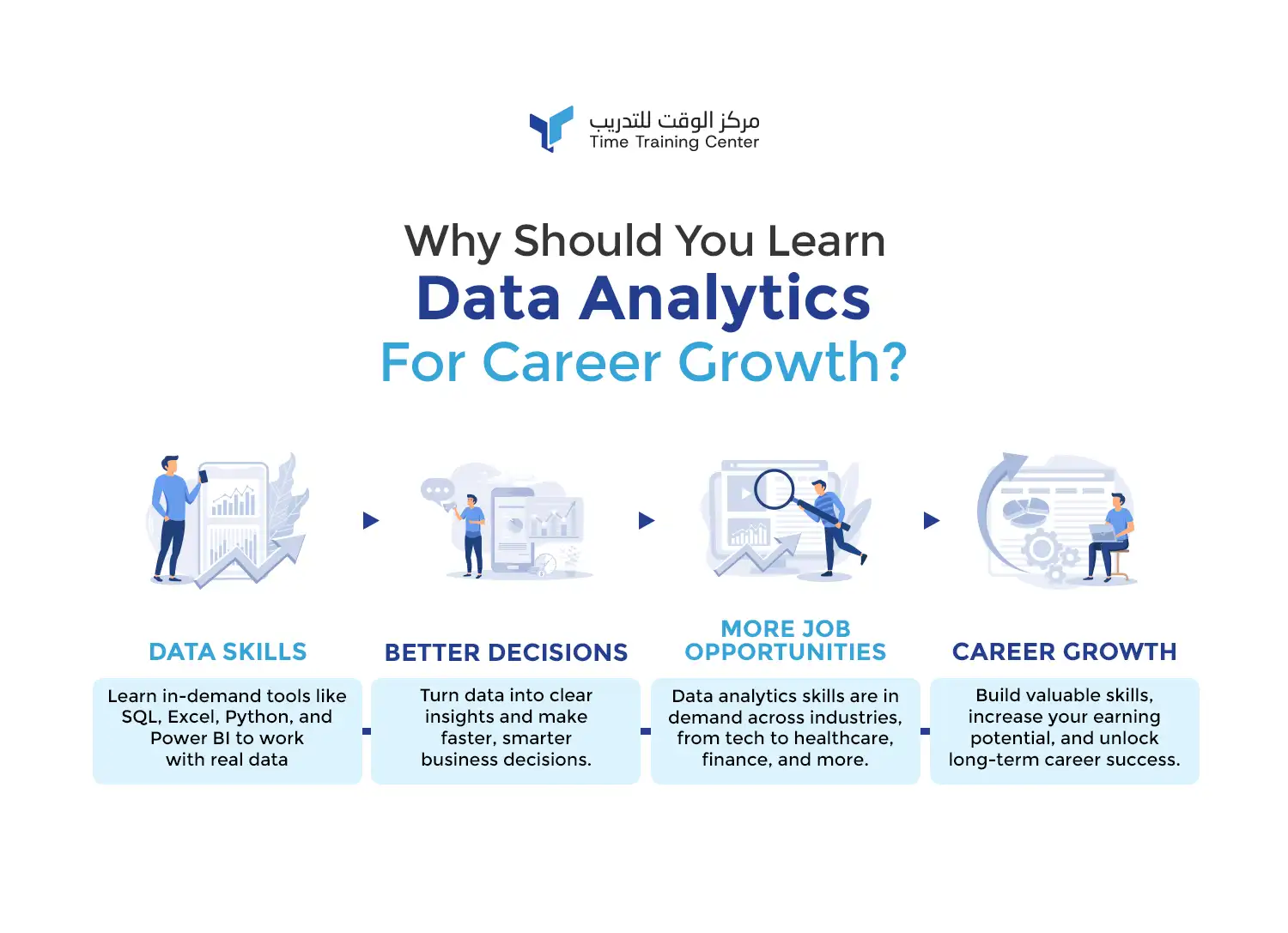
The complete summary of the importance of learning data analytics for career growth is illustrated in the infographics below:
Is a Data Analytics Certification Worth It?
The worth of data analytics certification depends on where you're starting from and how fast you want results. Here's a simple decision matrix:
Which Data Analytics Learning Path is Right for You?
| Situation |
Best Route |
| Complete beginner, want a job within 6 months |
Structured certification course with practical projects
|
| Already working in a related field (finance, marketing, HR) |
Short, focused course on SQL + Power BI/Tableau
|
| Self-motivated, have time to learn independently |
Free online resources + self-built portfolio
|
| Need credibility for a promotion or role change |
Recognised certification with an institute-backed certificate
|
A data analytics certification in Abu Dhabi isn't the only path, but it solves two problems self-learners often struggle with: structure and proof.
Employers reviewing CVs for data analyst jobs UAE-wide often use certifications as a quick filter, especially for candidates switching fields without direct experience.
The World Economic Forum’s Future of Jobs Report 2025 ranks Big Data Specialists among the fastest-growing roles through 2030, with AI, big data and analytical thinking among the most in-demand skills.
What Do Employers in Abu Dhabi Expect From Data Analysts?
Employers increasingly expect candidates to combine technical skill with business sense to become a data analyst in Abu Dhabi.
It's not enough to know how to build a chart; you need to explain what it means for the business.
In practice, that shows up as:
-
Comfort with at least one visualisation tool (Power BI is widely used across Abu Dhabi's banking and government-linked sectors).
-
Basic SQL to pull data without depending on IT.
-
The ability to present findings clearly to non-technical stakeholders.
-
Familiarity with local business context, regulatory reporting, Arabic-English bilingual reporting needs, and sector-specific KPIs.
This is where structured data analytics training in Abu Dhabi has an edge over purely self-taught routes: it usually builds in the presentation and business-context side, not just the technical tools.
Key Takeaways
-
Data analytics has moved from a niche skill to a standard expectation across UAE industries.
-
You don't need to become a data scientist; working fluently in Excel, SQL, and one visualisation tool covers most entry-level roles.
-
UAE data analyst salaries typically range from AED 10,000 to AED 35,000+ per month depending on experience.
-
Data analytics training helps with structure and credibility, especially for career switchers.
-
Abu Dhabi employers value analysts who can explain data, not just produce it.
FAQ's
1. Why is data analytics important for career growth?
Data analytics helps professionals make data-driven decisions, solve business problems, and identify trends. These skills are valuable across industries, making data analytics a strong career-growth option.
2. Is data analytics a good career choice?
Yes. Data analytics is a strong career choice because businesses increasingly rely on data to improve operations, understand customers, reduce costs, and support strategic decisions.
3. What skills do you need to learn data analytics?
Key data analytics skills include Excel, SQL, statistics, data visualization, Power BI or Tableau, Python, and critical thinking. Communication and business understanding are also important.
4. Can data analytics help you get a higher-paying job?
Data analytics can improve earning potential by qualifying professionals for roles such as Data Analyst, Business Analyst, BI Analyst, and Data Scientist. Salaries vary based on experience, skills, industry, and location.
5. Can beginners learn data analytics?
Yes. Beginners can learn data analytics without an advanced technical background. Starting with Excel, SQL, basic statistics, and data visualisation provides a practical foundation before progressing to Python and advanced analytics.
6. What career opportunities are available after learning data analytics?
Learning data analytics can lead to careers such as Data Analyst, Business Analyst, BI Analyst, Marketing Analyst, Financial Analyst, Operations Analyst, and Data Scientist. With experience, professionals can progress into senior and managerial roles.
 +971 2 6713828