Key Takeaways
-
SAP S/4HANA Finance: This is the financial core of SAP's modern ERP system. Abu Dhabi's push for AI-ready, digital systems is driving steady demand for people who can run it.
-
Reported pay: SAP FICO and S/4HANA Finance professionals in Abu Dhabi earn between about AED 16,150 a month at the average level and AED 37,037 a month for solutions architects, based on current labour-market data.
-
New e-invoicing rule: A mandatory e-invoicing framework is being phased in across the UAE from January 2027. This pushes finance teams to build compliance directly into their SAP systems.
-
Major employers: Large Abu Dhabi and UAE organisations, including Emirates Global Aluminium and Gulf Pharmaceutical Industries, are running or moving to SAP S/4HANA.
-
Career paths: Roles span Associate Consultant through to Solutions Architect, across banking, energy, manufacturing, healthcare and government.
-
Certification: Certification helps, but it works best alongside real project experience. It is not a guaranteed shortcut to a job on its own.
Let’s explore what is covered in this blog:
|
Table of Contents
|
|
1. What Is SAP S/4HANA Finance (SAP FICO)?
2. Why Are SAP FICO Skills in High Demand in Abu Dhabi Right Now?
3. How Much Do SAP FICO Professionals Earn in Abu Dhabi?
4. Abu Dhabi's Digital Transformation Is the Real Driver
5. What Career Paths Can SAP FICO Skills Open Up?
6. How Can You Build a Career in SAP S/4HANA Finance in Abu Dhabi?
7. Frequently Asked Questions
8. People Also Ask
|
What Is SAP S/4HANA Finance (SAP FICO)?
SAP S/4HANA Finance is still widely called SAP FICO. This name comes from its two founding modules: FI (Financial Accounting) and CO (Controlling). It is the financial engine sitting inside SAP's modern enterprise resource planning (ERP) platform.
One important difference is worth knowing. SAP FICO first ran on SAP ECC, SAP's older ERP system. SAP S/4HANA Finance is the newer generation, built on the in-memory HANA database.
Most new projects across Abu Dhabi today run on S/4HANA, not the legacy ECC system. People still say “SAP FICO” out of habit, much like people still say “Excel spreadsheet” long after the software has moved on. But the underlying system, and the skills employers want, have shifted. See the scope of SAP FICO for freshers.
Day-to-day, professionals in this field handle the general ledger, accounts payable and receivable, and asset accounting. They also handle cost and profit centre accounting, product costing and profitability analysis. S/4HANA's Universal Journal pulls all of this into one real-time table. So a transaction posted on the factory floor in the morning can show up in a live profit-and-loss view by lunchtime.
Why Are SAP FICO Skills in High Demand in Abu Dhabi Right Now?
Three forces are converging: large-scale ERP migrations by major employers, a new national e-invoicing mandate, and a broader industrial digital-transformation drive across the UAE.
Take Emirates Global Aluminium (EGA), based partly in Abu Dhabi. The producer moved its core ERP system to SAP S/4HANA, hosted on a private Microsoft Azure cloud through the RISE with SAP programme, to handle more than 150,000 business transactions each month. EGA reports that the move increased data-processing speed by around 30 times.
It has also added roughly $90 million in financial impact since the digital-transformation programme began in 2021, helped by upskilling close to 2,000 employees. SAP EMEA President Manos Raptopoulos points to the upgrade as a sign of organisational strength. EGA's CEO, Abdulnasser bin Kalban, describes the shift as central to the company's long-term production plans.
Ras Al Khaimah's Gulf Pharmaceutical Industries (Julphar) is on a similar path. The company is working with IBM Consulting to move from the older SAP ECC system to S/4HANA on RISE, aiming for stronger data transparency and regulatory compliance.
On top of this, the UAE Ministry of Finance has a new mandatory e-invoicing framework, with SAP named among the first pre-approved service providers. This shows why Abu Dhabi's finance teams need people who can configure these systems, not just operate them.
Check out these four ways to successfully move your older system to SAP S4HANA.
SAP FICO Skills vs Where They Matter Most
| SAP FICO / S/4HANA Skill |
Where It Matters in Abu Dhabi |
Typical Role |
| General ledger & financial accounting (FI) |
Banking, government, energy finance teams |
Associate / Support Consultant
|
| Controlling & cost centre accounting (CO) |
Manufacturing, energy, FMCG cost control |
Senior Analyst |
| Asset accounting & product costing |
Industrial and manufacturing groups (e.g. aluminium, pharma) |
Principal Consultant
|
| Universal Journal & real-time reporting |
Any organisation modernising financial reporting |
Solutions Architect
|
| E-invoicing/compliance configuration |
All VAT-registered businesses ahead of the 2027 mandate |
FICO Consultant, Compliance Lead
|
How core SAP FICO skills map to Abu Dhabi's employer needs
How Much Do SAP FICO Professionals Earn in Abu Dhabi?
Abu Dhabi's SAP FICO and S/4HANA Finance professionals typically earn between about AED 16,150 and AED 18,696 a month at an average level. Senior consultants earn AED 19,800 to AED 26,400 a month.
Solutions architects earn up to AED 37,037 a month. These figures come from current labour-market benchmarking. You may also find this SAP Professional salary guide helpful when looking for a SAP career. However, having SAP FICO Certification earns more than your non-certified professionals. See the major benefits of SAP FICO Certification.
Job listings tell a similar story. Some Abu Dhabi postings for S/4HANA Finance and FICO specialists quote annual packages from about AED 138,000 to AED 312,000, depending on seniority and sector. Public sector, banking and energy roles tend to pay the most for technical skill.
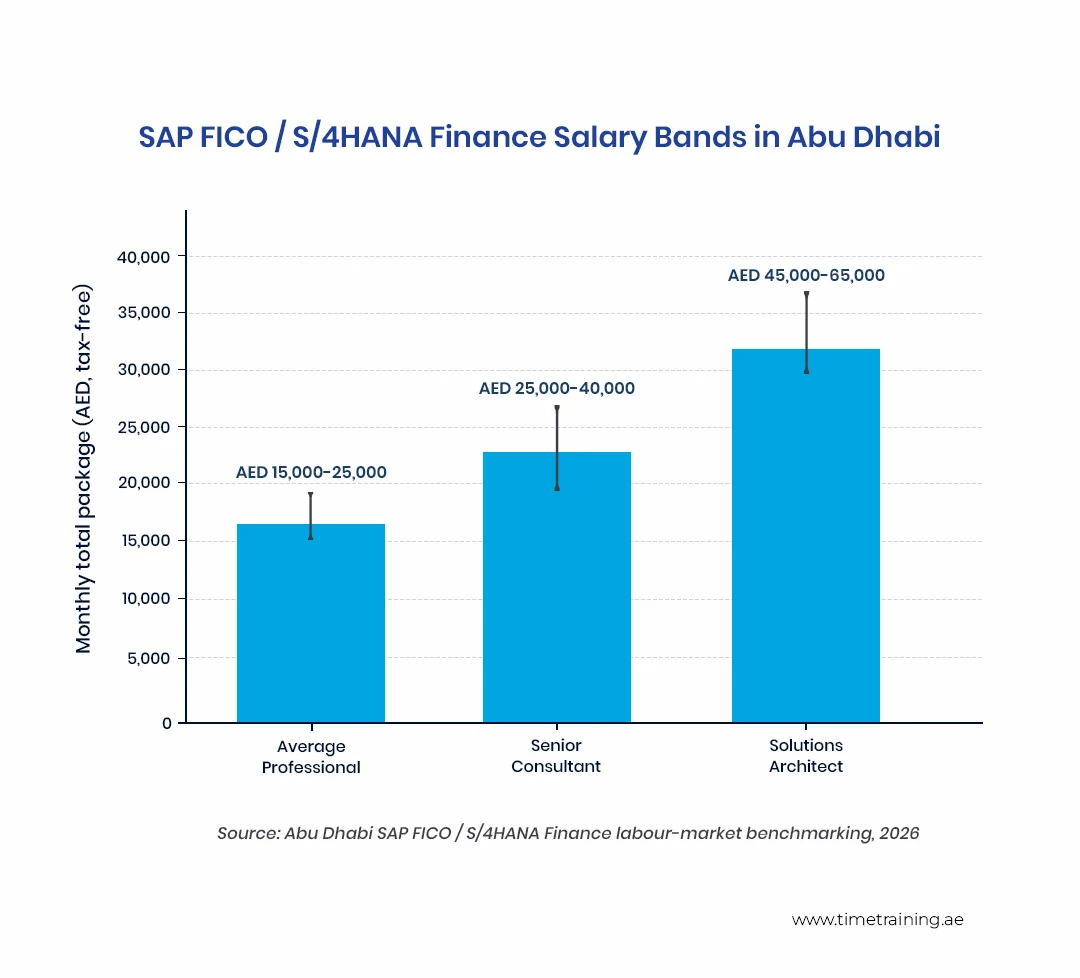
Typical monthly SAP FICO / S/4HANA Finance salary bands in Abu Dhabi
These figures are ranges, not guarantees. Actual pay moves with experience, certification, industry and negotiation. Across the wider GCC, a pattern appears: Abu Dhabi and Dubai both pay more than Qatar and Saudi Arabia on average for SAP FICO work. However, Dubai's top pay can edge higher for niche, high-pressure implementation roles.
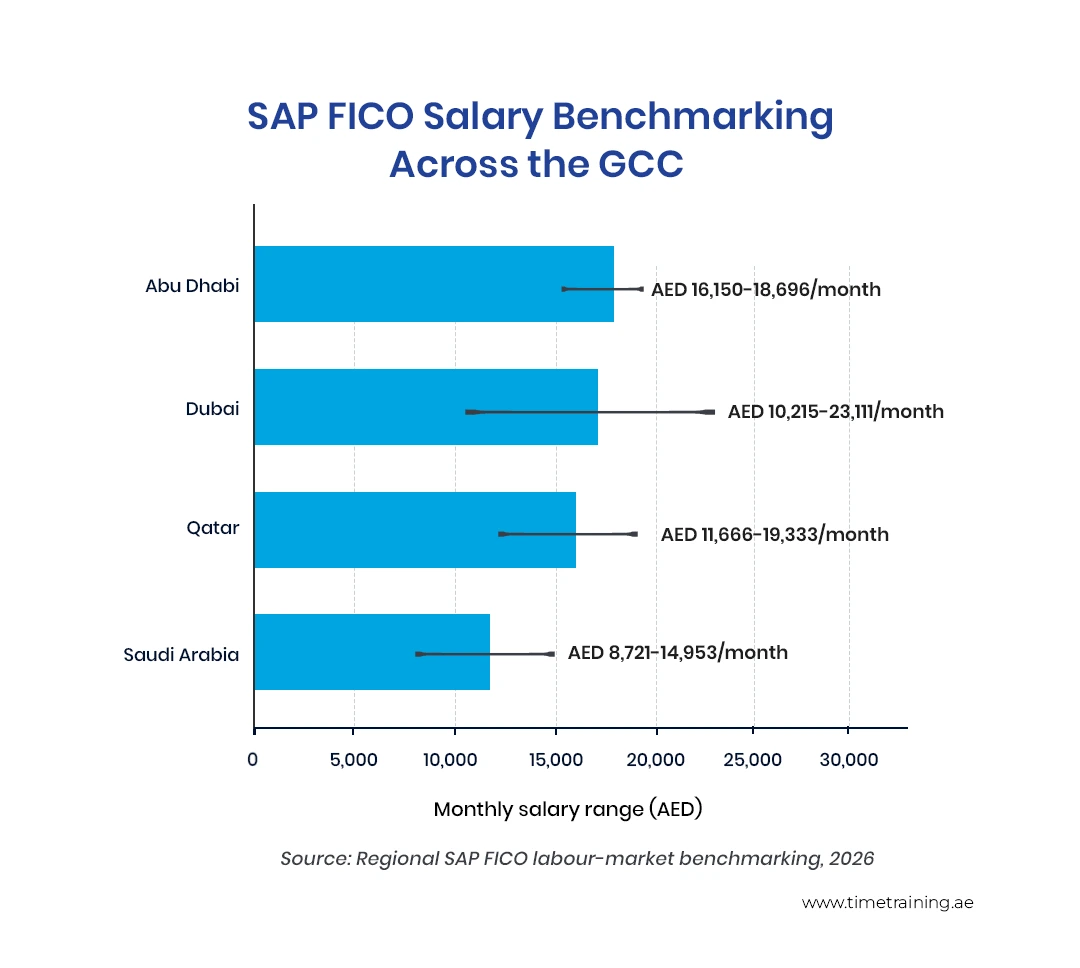
SAP FICO monthly salary benchmarking across GCC hubs
For a closer look at the day-to-day route into one of these roles, see our guide on how to become an SAP FICO consultant in Abu Dhabi.
Abu Dhabi's Digital Transformation Is the Real Driver
SAP FICO demand does not exist by itself. It is a direct result of Abu Dhabi and the wider UAE treating ERP modernisation as core national infrastructure, not an IT side project.
The government's e-invoicing rollout is a good example. Under Ministerial Decisions No. 243 and 244 of 2025, structured e-invoicing becomes mandatory for large businesses (annual revenue of AED 50 million or more) from 1 January 2027. It becomes mandatory for smaller businesses from 1 July 2027, and for government entities from 1 October 2027.
A voluntary pilot phase opened before this, in mid-2026. SAP was named among the Ministry of Finance's first pre-approved service providers. This means organisations running SAP can manage this compliance from inside their existing finance systems, rather than adding separate software.
According to Marwan Zeineddine, Managing Director of SAP UAE, the country continues to set a strong example in building modern digital infrastructure for business and finance. This links closely to the UAE's wider digital and AI goals, which we cover in more depth in our article on the UAE AI Strategy 2031.
UAE E-Invoicing Mandate: Key Dates
| Milestone |
Date |
Who It Applies To
|
| Voluntary pilot phase opens |
1 July 2026 |
All businesses (invited/voluntary)
|
| Large-business go-live |
1 January 2027 |
Annual revenue ≥ AED 50 million
|
| SME go-live |
1 July 2027 |
Annual revenue < AED 50 million
|
| Government entity go-live |
1 October 2027 |
Federal and local government bodies
|
Phased UAE e-invoicing implementation timeline, Ministerial Decisions No. 243 & 244 of 2025
This single mandate touches every SAP-run business in the emirate. It sits alongside company-level projects like EGA's and Julphar's. A steady stream of other Abu Dhabi employers, including groups such as GMG, Al-Futtaim and Exalogic Consulting, are also recruiting for SAP Finance talent. None of this guarantees any individual a job. But it does explain why this particular skill set keeps showing up on hiring lists across the capital. Here are the top skills required to become an SAP FICO Consultant; check it out.
What Career Paths Can SAP FICO Skills Open Up?
SAP FICO training in Abu Dhabi typically opens doors into roles such as Associate Consultant, Support Consultant, Senior Analyst, Financial Controller, Principal Consultant and, further down the line, Solutions Architect.
These roles show up across a genuinely wide spread of industries. This matters because it means SAP Finance skills are not tied to any single sector's fortunes. If hiring slows in energy or banking, manufacturing implementations are often still running.
Job Roles vs Hiring Industries in Abu Dhabi
| Job Role |
Industries Commonly Hiring
|
| Associate / Support Consultant |
IT services, business consulting
|
| Senior Analyst / Financial Controller |
Banking and finance, energy, healthcare
|
| Principal Consultant |
Manufacturing, FMCG, logistics
|
| Solutions Architect |
Large industrial groups running multi-entity SAP landscapes
|
Where SAP FICO career paths tend to lead in Abu Dhabi
How Can You Build a Career in SAP S/4HANA Finance in Abu Dhabi?
The practical route is training, certification and hands-on project experience, roughly in that order, and ideally overlapping rather than one after another.
There is no strict academic requirement for SAP S/4HANA Finance training.
However, a working knowledge of accounting or finance concepts (cost accounting, taxation, payroll, reimbursements) helps the technical side click faster. From there, most people follow three broad steps: enrol on a structured SAP Finance training course, sit the certification exam, and start applying the configuration and reporting skills on real or simulated projects.
Certification alone does not land a role. Employers increasingly want to see project experience and problem-solving alongside the certificate. But certification remains one of the fastest, most recognised ways to show that you can actually work inside these systems, not just talk about them. See how SAP FICO training can bring positive changes to your business operations.
Time Training Center's SAP Finance Training in Abu Dhabi is built around exactly this combination: structured FI/CO fundamentals, certification preparation, and practical, project-style exercises guided by experienced trainers. You can browse the full course library on the Time Training Center Learning Hub for related finance, accounting and ERP courses.
Final Thought
Abu Dhabi is not short of buzzwords about digital transformation. But SAP FICO demand is one of the more concrete examples of it, tied to real migrations, a real compliance deadline, and real hiring. Whether it is the right move for you still depends on your own goals and background. But the underlying trend is well documented and, for now, still building.
FAQ's
What is the difference between SAP FICO and SAP S/4HANA Finance?
SAP FICO is the traditional name for the Financial Accounting (FI) and Controlling (CO) modules. It historically ran on SAP ECC. SAP S/4HANA Finance is the modern successor, built on the in-memory HANA database, with real-time reporting through the Universal Journal. Most Abu Dhabi projects today are S/4HANA-based.
Is SAP FICO training worth it in Abu Dhabi?
For most finance and accounting professionals, yes. Demand is driven by ongoing ERP migrations, the UAE's 2027 e-invoicing mandate, and steady hiring across banking, energy and manufacturing. The value depends on pairing training with genuine hands-on practice.
Do I need an accounting background to learn SAP FICO?
There is no strict requirement. However, a working knowledge of accounting concepts such as cost accounting, taxation and payroll helps you grasp the configuration side faster. It is recommended before you start.
How long does SAP FICO certification training take?
Course length varies by provider and format. Structured SAP FICO training programmes in Abu Dhabi commonly run around 60 days, combining classroom and practical sessions.
Which industries in Abu Dhabi hire SAP FICO professionals?
IT and business consulting, manufacturing, banking and finance, energy, healthcare, logistics and fast-moving consumer goods are among the most active sectors recruiting SAP Finance talent.
Is SAP FICO certification alone enough to get a job in Abu Dhabi?
Not usually. Certification shows technical grounding and gets your CV noticed. But employers also look for practical project experience, problem-solving ability and, ideally, some real-world implementation experience.
What does SAP FICO stand for?
SAP FICO stands for Financial Accounting (FI) and Controlling (CO). These are the two core modules that together manage an organisation's financial transactions, reporting and internal cost control.
Is SAP FICO still relevant now that S/4HANA exists?
Yes. The FI/CO concepts remain the foundation of financial processes in S/4HANA. The terminology has stayed the same, even though the underlying technology, database and reporting tools have moved on.
What is the typical SAP FICO course duration in Abu Dhabi?
Most structured programmes run for around 60 days, combining core module training with certification preparation. Intensive or corporate formats can be shorter.
How does UAE e-invoicing affect SAP FICO jobs?
The phased mandate, running from 2027, requires structured, system-generated invoices reported to the Federal Tax Authority. Businesses running SAP need finance professionals who can configure this compliance layer inside their existing ERP system.
Can a fresher get an SAP FICO job in Abu Dhabi?
It is possible, particularly for support or associate consultant roles. However, freshers usually improve their chances by pairing certification with practical, project-based exercises and a genuine grasp of finance fundamentals.
What companies in Abu Dhabi use SAP S/4HANA for finance?
Organisations publicly reported to be running or moving to SAP S/4HANA include Emirates Global Aluminium and Gulf Pharmaceutical Industries (Julphar), alongside a broader base of UAE businesses across manufacturing, retail and logistics.
 +971 2 6713828