The future of AI in the UAE is likely to be shaped by three things: wider adoption across industries, increasing demand for AI-skilled professionals, and stronger emphasis on responsible AI. The UAE is focused on transforming itself into a global tech superpower. The government plans to move 50% of federal operations to agentic AI models by 2028, supported by multi-billion-dollar infrastructure projects like Abu Dhabi’s massive AI campus, localised large language models and nationwide AI education.
Precedence Research notes that the UAE is positioning itself as an integral part of its economy and technology by having strong government initiatives around AI, and demand for intelligent applications from enterprise customers is growing. To survive in the competitive UAE job market, building practical AI knowledge is mandatory
What are the Trends in AI in the UAE?
The UAE has taken AI seriously longer than most countries. Back in 2017, it became the first country in the world to appoint a Minister of State for Artificial Intelligence. That set the tone for everything after it. A few clear trends are shaping where things are headed next.
| Trend |
What It Means in Practice |
| Generative AI adoption |
Businesses use tools that draft content, summarise data and support customer service, cutting down repetitive work. |
| AI-enabled government services |
Public sector bodies are automating processes like applications and approvals to speed up citizen services. |
| Growing AI talent pipeline |
National programmes are training more data scientists and AI specialists to meet rising demand. |
| Responsible AI and governance |
Ethics, privacy and regulation are becoming a bigger part of how AI projects get approved and run. |
| Sector-specific AI tools |
Healthcare, finance and logistics are adopting AI systems built around their own specific problems, not generic tools. |
| AI agents and automation |
Systems that can plan tasks and carry out multi-step work with less human input are starting to show up in business operations. |
For a deeper look at how this strategy plays out across different sectors, the guide on UAE AI Strategy 2031: Key Opportunities, Industries & Career Impact breaks it down further.
Why Responsible AI Will Matter More in the UAE
This deserves its own space rather than a passing mention. As AI takes on more decisions, from screening job applications to flagging fraud, questions around fairness, privacy and accountability get harder to ignore. A few things organisations in the UAE are being pushed to think about:
-
Privacy: Where is the data coming from, and who has access to it?
-
Transparency: Can people understand why an AI system made a particular decision?
-
Bias: Is the system treating different groups fairly or quietly favouring some over others?
-
Human oversight: Is there always a person who can review or override an AI decision?
-
Security: Are AI systems protected against manipulation or misuse?
These aren't abstract concerns. They're becoming part of how AI projects get approved, funded and regulated across the region. Any organisation building or buying AI tools now needs a plan for handling these questions, not just a plan for the technology itself.
How Is AI Actually Being Used Across UAE Industries?
AI adoption isn't spread evenly. Some industries are moving faster than others because the payoff is clearer.
| Industry |
Common AI Applications |
| Healthcare |
Diagnostic support tools, patient triage systems, administrative automation |
| Finance |
Fraud detection, credit risk scoring, customer service chatbots |
| Government |
Automated citizen services, predictive planning, smart city systems |
| Education |
Personalised learning tools, administrative automation, AI tutoring support |
| Cybersecurity |
Threat detection, anomaly monitoring, automated incident response |
| Retail & Logistics |
Demand forecasting, inventory optimisation, customer personalisation |
Healthcare providers in the UAE use AI to support faster, more consistent diagnoses and to handle some of the admin load that eats into clinical time.
Finance is a natural fit too. Banks and insurers have relied on data models for years, and AI just sharpens fraud detection and risk scoring further.
Government use is probably the most visible to residents, with smart city projects and automated citizen services aimed at cutting down waiting times and paperwork.
In education, AI tools are starting to personalise learning paths for students while easing some of the admin burden on teaching staff.
Cybersecurity is quietly one of the biggest growth areas, since AI-based systems can spot unusual activity much faster than manual monitoring ever could.
Retail and logistics are another space to watch. AI-driven demand forecasting is becoming more relevant here, helping businesses plan inventory more accurately and reduce waste.
What are the Emerging AI Jobs in the UAE?
AI hiring in the UAE has picked up noticeably. Industry reports, including PwC's AI Jobs Barometer research, point to a rise in job postings that specifically call for AI skills. Exact figures shift depending on the source and time period, so it's worth checking the latest PwC UAE analysis directly for current numbers rather than relying on a single quoted stat.
That growth isn't limited to deeply technical roles either. AI is creating new positions while reshaping requirements for a lot of existing ones.
| Job Role |
What It Typically Involves |
| Machine Learning Engineer |
Building and training models that learn from data to make predictions |
| Data Scientist |
Analysing data to uncover patterns and support business decisions |
| AI Business Analyst |
Bridging AI capabilities with real business needs and processes |
| Prompt Engineer / AI Specialist |
Designing and refining how teams use generative AI tools effectively |
| AI Ethics & Governance Officer |
Overseeing responsible use, compliance and data privacy in AI projects |
Machine learning engineers and data scientists are common technical roles tied to most AI projects, since someone still needs to build and refine the models behind the scenes. Prompt engineering and AI specialisation are newer roles, directly influenced by generative AI showing up in everyday workflows.
AI is NOT going to replace all jobs and to think so is missing the point. Most roles are shifting rather than disappearing. AI takes on the repetitive tasks, and people shift toward judgement, strategy and relationships.
For more on this, see the article on Career Opportunities in Artificial Intelligence in Abu Dhabi.
Which AI Skills Are Actually Worth Building?
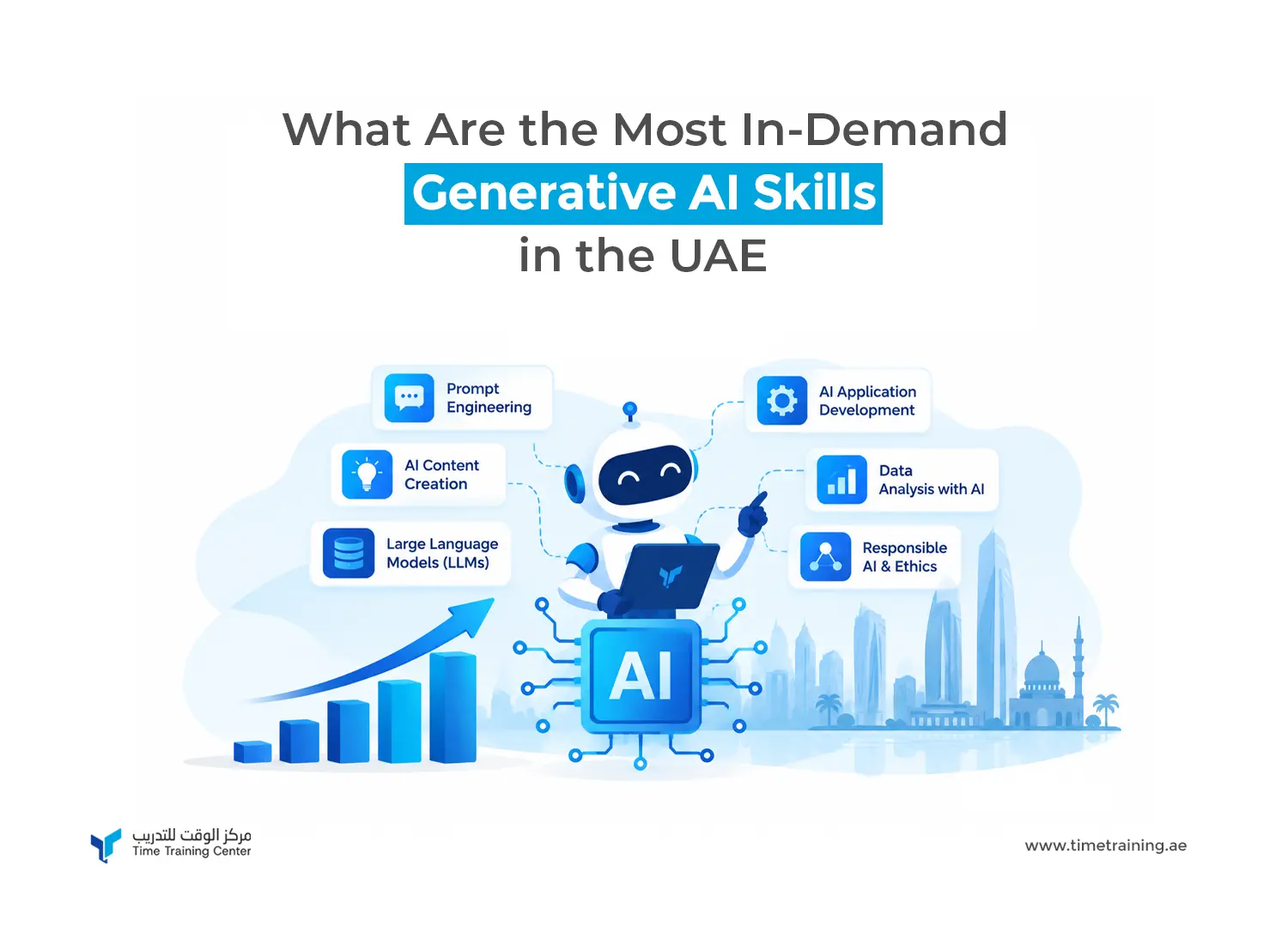
Skills matter more than qualifications alone right now. Employers want people who can apply AI practically, not just talk about it in theory. ML is still the foundation, because it is the basis for most of the practical AI applications, from recommender systems to fraud detection. Data analysis, however, is just as crucial, because AI models are only as good as the data that feeds them, and someone still needs to clean, structure and interpret that data.
Python is still one of the most popular languages to build and custom-build artificial intelligence systems and is a good place to start for beginners. Cloud computing to the list. A lot of AI work is done now on cloud platforms and through APIs and not just local machines.
| Skill Type |
Examples |
| Technical skills |
Machine Learning, data analysis, Python programming, cloud computing, AI tool proficiency |
| Non-technical skills |
Critical thinking, communication, problem-solving, AI literacy |
Non-technical skills are as important, if not more, but less talked about. Critical thinking helps people decide if an AI output is really trustworthy, rather than taking it on faith. Communication is also important, because someone needs to translate technical AI results into action for non-technical stakeholders. Finishing off the list is problem-solving and general AI literacy, helping people in every department to work sensibly alongside AI tools.
For anyone building these skills from scratch, exploring Artificial Intelligence training in Abu Dhabi is a practical starting point, with structured learning that covers both the technical and applied side of AI. Those specifically interested in generative tools can also look into a dedicated Generative AI Course in Abu Dhabi for more focused, hands-on training.
A Roadmap to Enhance Practical AI Career and Skills
Here's a simple, step-by-step way to approach building a future-ready AI career in the UAE.
1. Start with the fundamentals
Learn what AI, Machine Learning and Generative AI actually are and how they differ, since mixing these terms up creates confusion later.
2. Pick up core technical skills
Focus on Python, basic statistics and data handling before moving into machine learning concepts.
3. Get hands-on with real tools
Practise with generative AI platforms and simple ML projects rather than relying on theory alone.
4. Build the non-technical skill set
Work on communication and critical thinking alongside the technical stuff, since employers value both.
5. Specialise where it fits personal goals
Whether that's healthcare AI, cybersecurity or generative AI tools, narrowing the focus makes someone more employable.
6. Keep learning through structured training
Formal courses and certifications, like those offered through AI training in Abu Dhabi, help validate skills along the way.
For a broader view on getting started, the guide on How to Start a Career in Artificial Intelligence in Abu Dhabi walks through this in more detail. Those comparing course options first might also find the roundup of Top AI Courses in Abu Dhabi for Beginners & Professionals useful.
Ready to be an Artificial Intelligence Professional in the UAE?
AI in the UAE is increasingly moving beyond experimentation into everyday, practical use across organisations. The national strategy, rising job postings and expanding training initiatives all point the same direction.
No one knows for sure how AI will evolve in the next few years. What's more useful is to build skills that are relevant across changing technologies. Know the difference between AI, Machine Learning and Generative AI. Then learn the technical basics and mix them with judgement, communication and problem-solving skills that will always be in demand no matter how the technology changes. As a beginner or a mid-career reskiller, structured training through Abu Dhabi’s Time Training Centre’s AI programmes is one option worth exploring with hands-on learning instead of theory alone.
Frequently Asked Questions
1. What is the future of Artificial Intelligence in the UAE?
The UAE is expanding AI use across government, healthcare, finance and education, backed by its National Strategy for Artificial Intelligence 2031. The focus is on practical adoption and responsible governance rather than speculation.
2. Which AI jobs are in demand in the UAE?
Machine Learning Engineers, Data Scientists, AI Business Analysts and AI governance specialists are among the roles seeing growing demand, based on recent industry hiring trends.
3. What skills do I need for an AI career in the UAE?
Useful technical skills include Machine Learning, Python, cloud computing and data analysis. Non-technical skills like critical thinking and communication matter just as much for most AI-related roles.
4. Will AI replace jobs in the UAE?
AI is more likely to reshape jobs than eliminate them outright. Many roles are shifting toward tasks that need human judgement, while AI takes on repetitive or data-heavy work.
5. How is AI being used in UAE businesses today?
Common uses include fraud detection in finance, diagnostic support in healthcare, automated citizen services in government and demand forecasting in retail and logistics.
6. Where can I learn AI skills in Abu Dhabi?
Time Training Centre offers Artificial Intelligence and Generative AI training in Abu Dhabi, covering practical skills for beginners and working professionals.
 +971 2 6713828