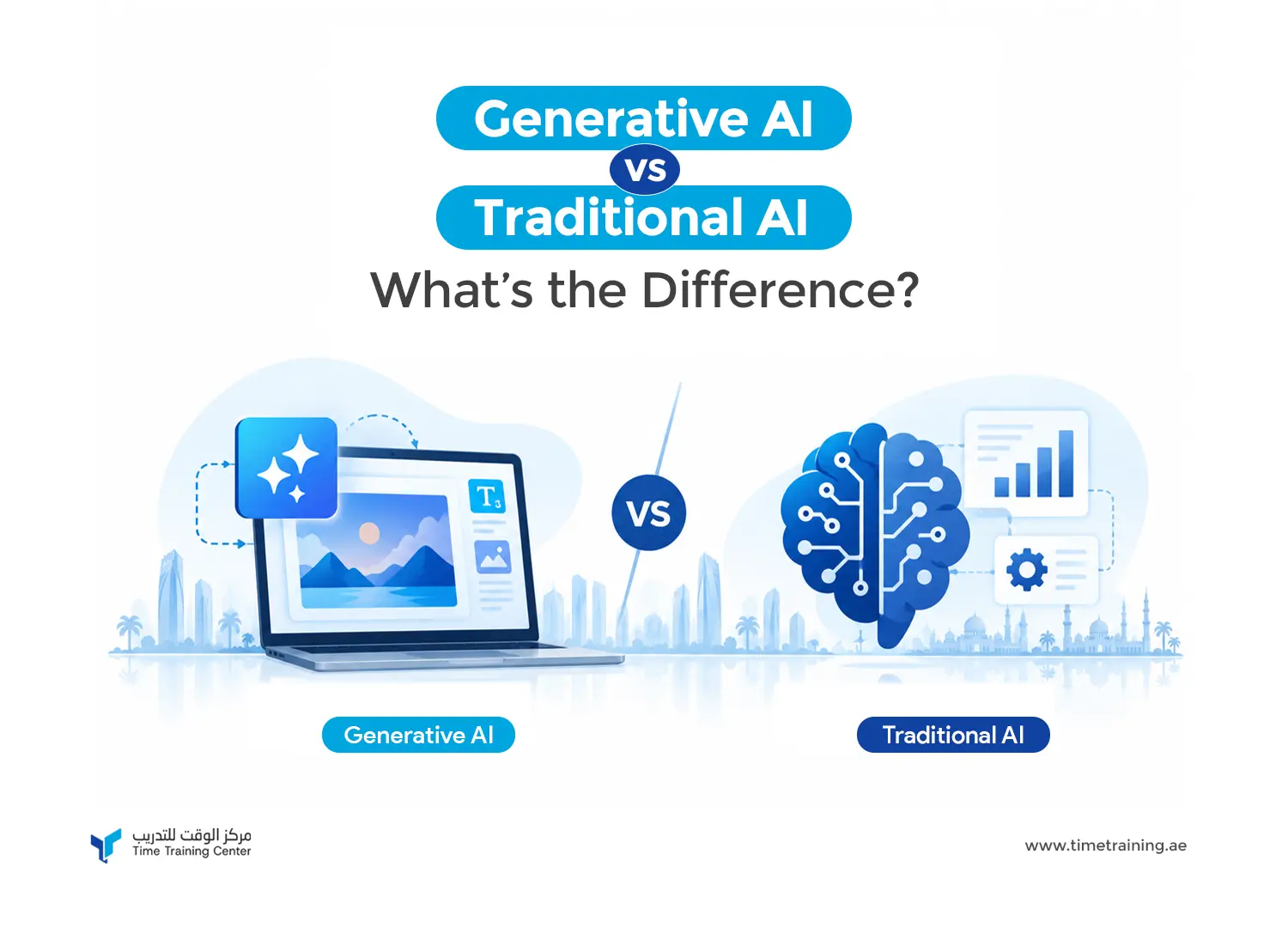
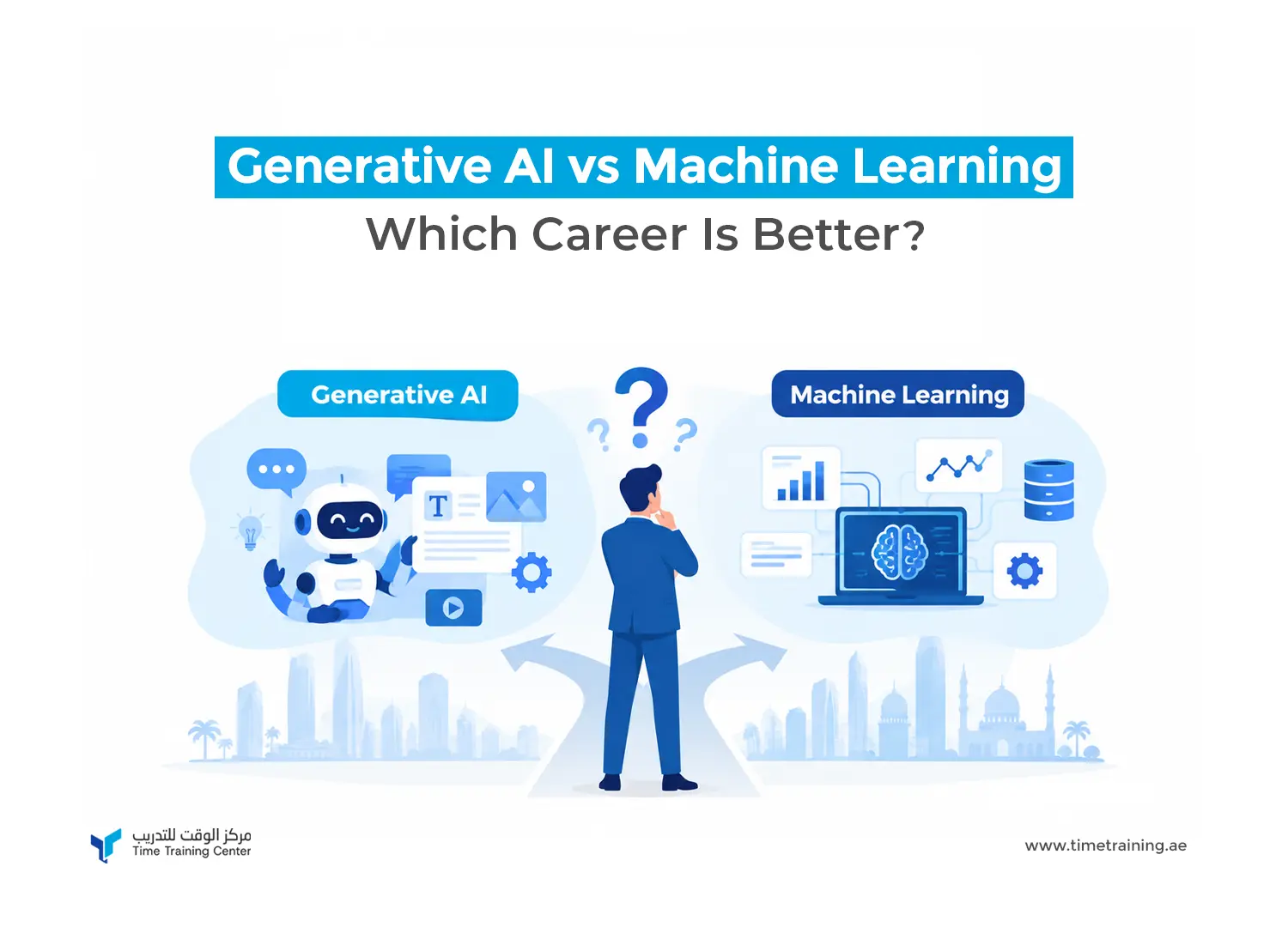
Traditional AI mainly analyses data to classify, predict or decide. Generative AI creates new content, such as text, images, code or audio, from patterns it has learned. Both are types of artificial intelligence, and both rely on machine learning. Neither is better in every case. The right choice depends on the job.
You have probably used both today without noticing. The fraud alert from your bank is usually traditional AI. Asking ChatGPT or Gemini to draft an email is generative AI.
People mix them up because generative AI took over the headlines. Now many say “AI” when they mean chatbots. But AI is a much bigger field, and generative AI is one part of it.
This guide explains the difference in plain English: how each works, where they are used in Abu Dhabi and the UAE, their limits, and the skills worth building.
Key takeaways
-
Traditional AI analyses data, spots patterns and predicts or classifies.
-
Generative AI creates new content such as text, images and code.
-
Both use machine learning, but their goals and outputs are different.
-
Generative AI often uses large language models (LLMs), but not every system uses the same technology.
-
Traditional AI is still very useful for prediction, automation and decision support.
-
The right approach depends on your problem, your data and the result you want.
Table of contents
|
|
1. What Is Traditional AI?
2. What Is Generative AI?
3. Generative AI vs Traditional AI: Key Differences at a Glance
4. How Do They Work?
5. Where Are They Used? Examples From Abu Dhabi and the UAE
6. Benefits and Limitations of Each
7. Which One Should You Use? A Simple Guide
8. How Big Is the Opportunity?
9. AI Skills for Careers in Abu Dhabi and the UAE
10. People Also Ask: Quick Answers
11. The Bottom Line
12. FAQs
|
What Is Traditional AI?
Traditional AI is AI that analyses data to recognise patterns, make predictions or follow set rules, rather than creating new content. You may also see it called predictive AI. It is not an official technical label, so writers use it slightly differently.
Think of a sharp-eyed inspector. It checks what is in front of it and gives a verdict: this payment looks suspicious, this email is spam, this machine may fail next week.
Traditional AI covers older rule-based systems and classic machine learning models. They are usually built for one clear task and can often work with smaller datasets, so results are easier to test and explain. Examples include spam filters, credit scoring, recommendation engines and demand forecasting.
What Is Generative AI?
Generative AI is AI that creates new content, such as text, images, audio, video or code, from a prompt. It uses patterns learned from huge amounts of data. IBM puts the shift simply: traditional AI was designed to recognise patterns and make predictions, while generative AI produces new content.
Think of a junior writer. You give a brief and get a first draft back. It is quick, but you still need to check it.
Generative AI is not one single technology, either. Large language models (LLMs), the engines behind ChatGPT and Gemini, use a design called the transformer to work with text. Image tools often use other methods, such as diffusion models. So “generative AI” describes what a system does, not how it is built. Other popular tools include Microsoft Copilot, Canva AI, NotebookLM and Napkin AI.
Need more information? Here is a complete guide on what generative AI is.
Generative AI vs Traditional AI: Key Differences at a Glance
The biggest difference is the goal: traditional AI decides, generative AI creates. This table covers the rest.
| Feature |
Traditional AI |
Generative AI |
| Main purpose |
Analyse, classify, predict or decide |
Create new content from a prompt
|
| Usual output |
A label, score, forecast or decision |
Text, images, code, audio or video
|
| Data used |
Often smaller, structured and labelled |
Very large, mostly unstructured (text, images, code)
|
| Core technology |
Rules and classic machine learning |
Deep learning, such as LLMs, transformers and diffusion models
|
| Main risk |
Bias in data; narrow scope |
Hallucinations; privacy and copyright concerns
|
| Everyday examples |
Spam filters, fraud alerts, route planning |
ChatGPT, image generators, code assistants
|
| Human role |
Set the task and check the score |
Write clear prompts and review every output
|
Traditional AI and Generative AI: How Do They Work?
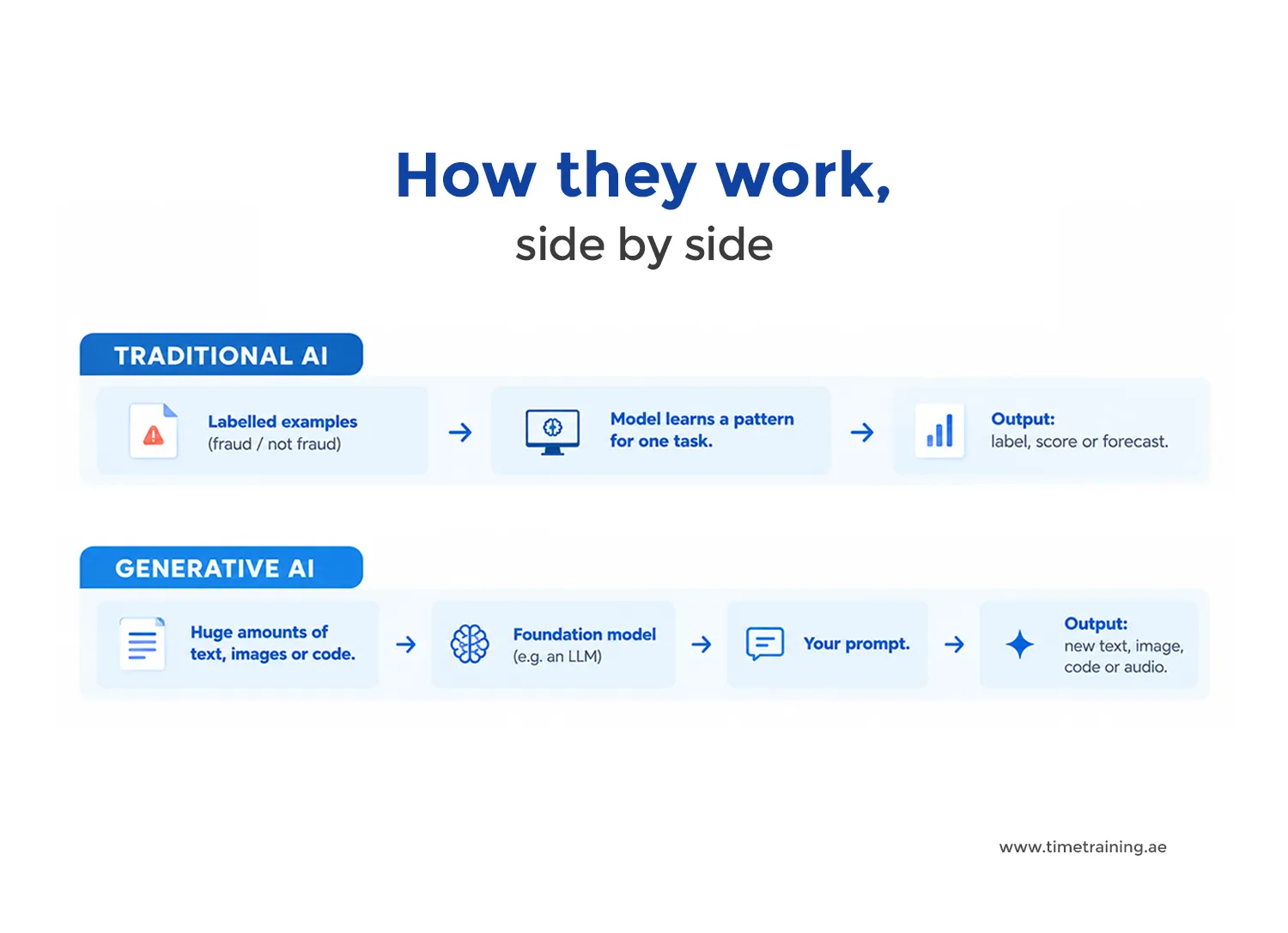
Traditional AI learns to label things. Generative AI learns to make things.
With traditional AI, you show a model many examples with known answers, such as payments marked “fraud” or “not fraud”. It learns the pattern, then labels or scores new data.
With generative AI, a model is trained on vast amounts of text, images or code. It learns how the pieces usually fit together. When you type a prompt, it builds a new answer piece by piece. IBM explains that LLMs predict the next word from learned patterns. They are not pulling facts from a database, so they are making educated guesses. That is why a fluent answer can still be wrong.
Where Do Machine Learning, Deep Learning and LLMs Fit In?
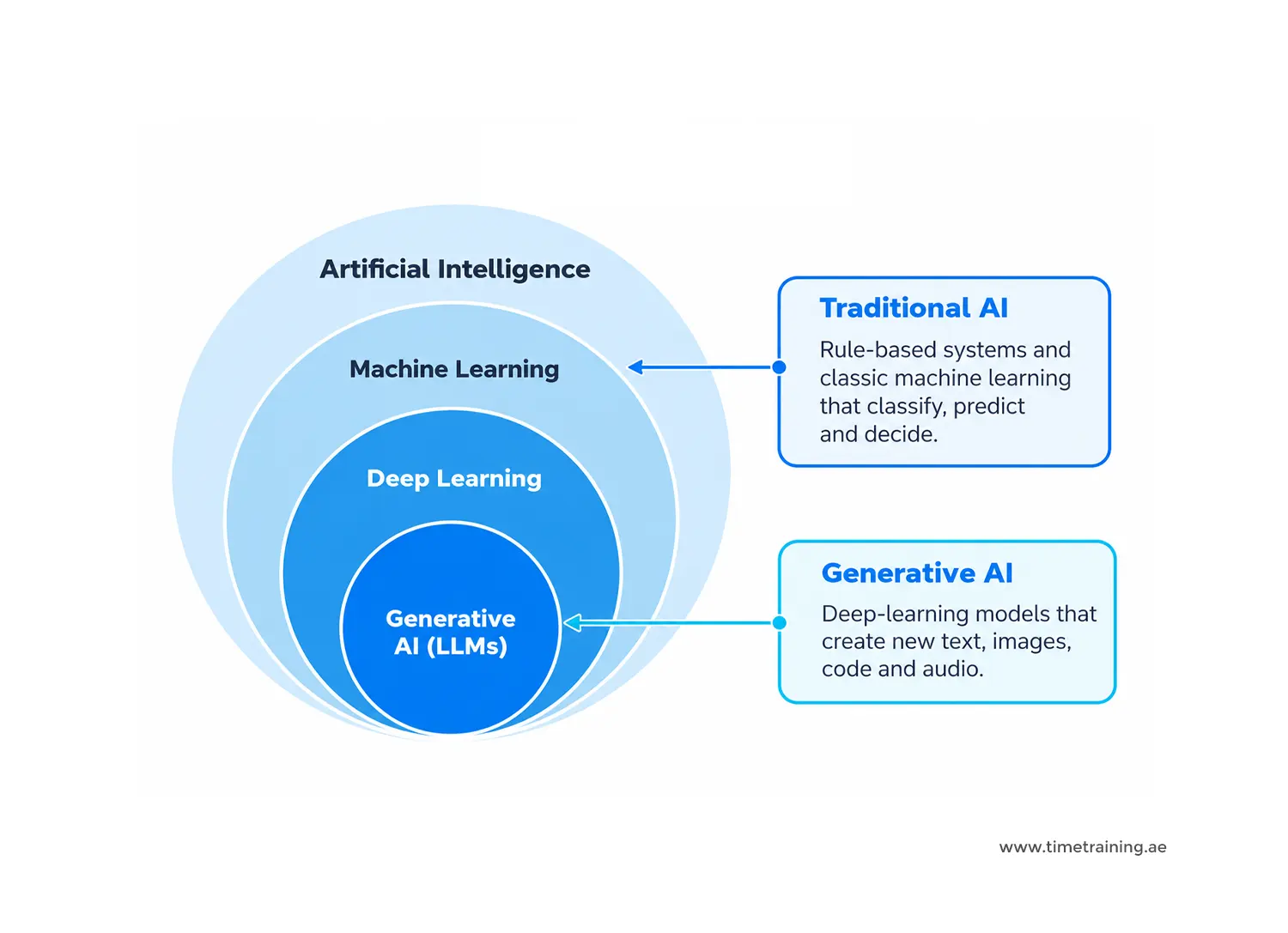
Think of them as layers. Artificial intelligence is the broadest idea. Machine learning sits inside it: systems that learn from data. Deep learning sits inside machine learning and uses many-layered neural networks. Generative AI mostly runs on deep learning, and LLMs are one family of generative models.
Traditional AI draws on machine learning and older rule-based methods. IBM notes that deep learning also powers computer vision and robotics, not only generative AI. So the two are not opposites. Generative AI is a specialised branch of the same family.
See the major differences between AI vs Machine Learning vs Deep Learning.
Where Are Traditional AI and Generative AI Used? Examples From Abu Dhabi and the UAE
Traditional AI mostly powers detection and prediction. Generative AI mostly powers drafting, summarising and conversation. Many organisations now use both.
| Sector |
Traditional AI example |
Generative AI example
|
| Banking |
Fraud detection, credit scoring |
Drafting customer replies, summarising reports
|
| Healthcare |
Reading scans, predicting patient risk |
Drafting notes and plain-language patient information (clinician-reviewed)
|
| Government |
Predicting service demand |
Multilingual chat assistants
|
| Education |
Spotting students who need support |
Lesson plans, quizzes and study notes
|
| Retail and tourism |
Demand forecasts, recommendations |
Product descriptions, chat assistants
|
Examples are illustrative, not claims about named organisations.
Abu Dhabi shows both working together. Its Digital Strategy 2025–2027, backed by AED 13 billion, aims to make it the world’s first fully AI-native government by 2027. The government’s own description of its TAMM platform mentions predictive delivery through machine learning alongside multilingual AI assistance. That mix of prediction and conversation is the hybrid pattern many organisations are moving towards.
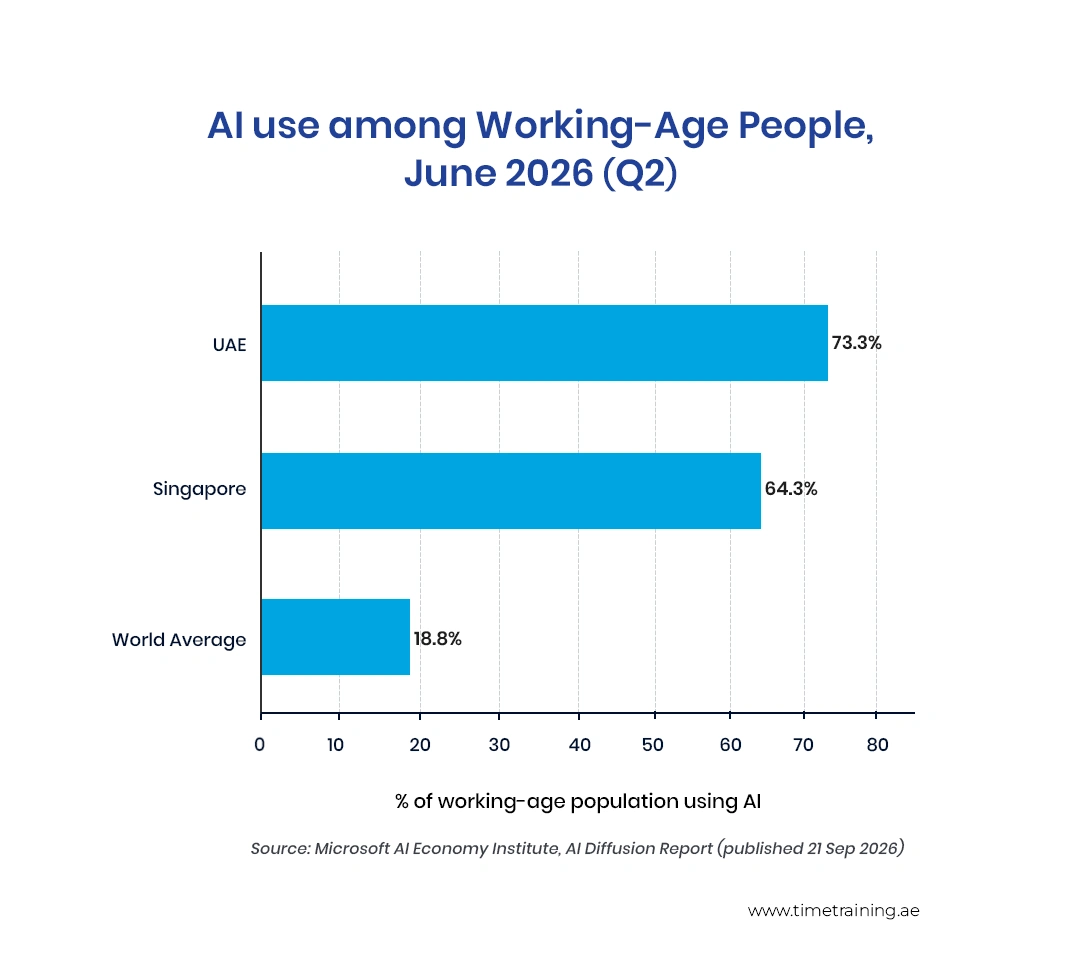
The UAE is also one of the most active AI users anywhere. Microsoft’s latest AI Diffusion Report, published on 21 September 2026, puts UAE usage at 73.3% of working-age people in June, against a world average of 18.8%.
Benefits and Limitations of Generative AI and Traditional AI
Each has real strengths and real weak spots. Neither is outdated.
| |
Traditional AI |
Generative AI |
| Strengths |
Reliable on defined tasks; easier to audit; can work with smaller datasets |
Fast first drafts; flexible through plain-language prompts; handles text, images and code
|
| Limitations |
Narrow scope; needs clean, labelled data; cannot write or design |
Can give confident but false answers; needs human review
|
| Watch out for |
Bias hidden in the training data |
Privacy, copyright and data-security risks; hard-to-explain outputs
|
A quick word on hallucinations: that is when a generative model gives an answer that sounds right but is false or invented. Check names, numbers and sources before you use anything.
Check here to understand the roles and responsibilities of an AI Engineer.
Which One Should You Use- Traditional AI vs Generative AI? A Simple Guide
Use traditional AI to decide or predict, generative AI to draft or explain, and both when a process needs each.
| Your goal |
Better fit |
Example |
| Flag unusual payments |
Traditional AI |
A fraud model scores each transaction
|
| Forecast next month’s demand |
Traditional AI |
A forecasting model reads past sales
|
| Draft a customer email |
Generative AI |
An LLM writes a first version
|
| Summarise a 60-page report |
Generative AI |
NotebookLM or ChatGPT produces key points
|
| Predict who may leave, then write tailored offers |
Both |
Prediction first, drafting second
|
Andrew Ng, the Stanford AI scientist and Coursera co-founder, famously said “AI is the new electricity”. In a Berkeley talk summary, he described supervised learning, the method behind spam detection and ad prediction, as today’s workhorse, with generative AI newer but full of potential.
So ask “which fits this task?”, not “which is better?”. Microsoft UAE says something similar: start with a defined problem and measurable outcome, then scale what works.
Teams get more from either approach when people know how to use it. Practical AI training helps staff choose the right tool and check results. HR teams can also read about the impact of AI on human resources.
How Big Is the Opportunity?
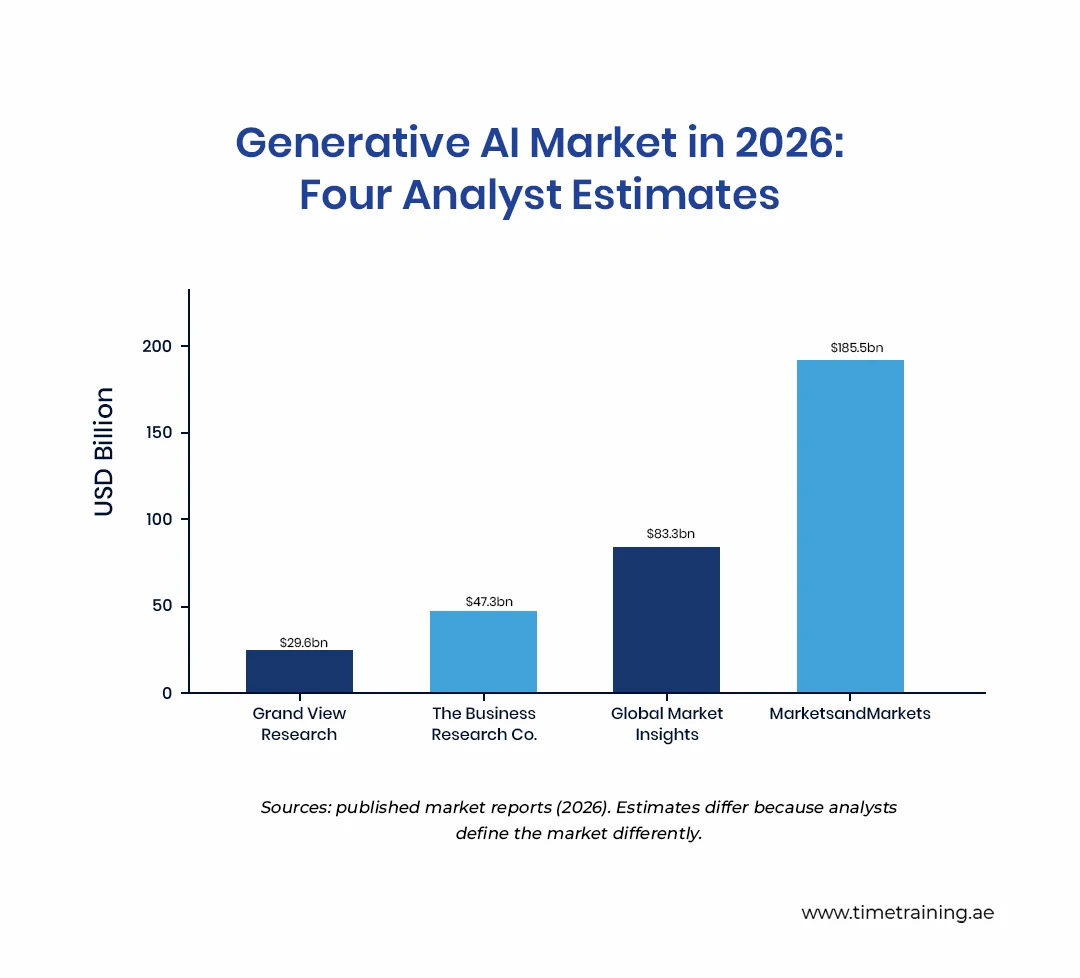
Generative AI is growing fast, but nobody agrees on its exact size. For 2026, published estimates run from about USD 30 billion to USD 185 billion, mainly because analysts count different things, such as models, software, infrastructure or services.
Closer to home, Global Market Insights estimates the UAE’s generative AI market at USD 0.79 billion in 2025, an analyst estimate rather than a fixed fact. The UAE’s AI Strategy 2031 says AI could add up to AED 335 billion in extra growth.
Want to learn Generative AI for your career in Abu Dhabi? Here is a guide on how to start a career in Generative AI in Abu Dhabi.
AI Skills for Careers in Abu Dhabi and the UAE
The most useful AI skills combine data understanding with hands-on generative AI practice. The World Economic Forum’s Future of Jobs Report 2025 says employers expect 39% of key skills to change by 2030, with AI and big data at the top of the fastest-growing list.
| Skill |
Helps you with |
Works with |
| Data literacy |
Reading outputs and judging data quality |
Both |
| Machine learning basics |
Classification, prediction and forecasting |
Traditional AI |
| Prompt writing |
Getting clear, useful answers from LLMs |
Generative AI |
| Fact-checking |
Catching hallucinations before they spread |
Generative AI |
| AI ethics and privacy |
Using AI safely and responsibly |
Both |
You do not need to become an engineer to use generative AI well. Clear thinking and good checking habits go a long way. To go deeper, our course builds Generative AI skills such as AI content creation, visuals with Canva AI and Napkin AI, research with Perplexity AI and NotebookLM, workflow automation and ethical AI use. Shahista Tabassum, an ACTVET-licensed senior trainer with over 14 years of experience in IT, data science, and generative AI, leads the course.
No course can promise a job. Good training can help you build practical skills and show employers you have put in the work. For career routes, read our guides to AI engineer careers in Abu Dhabi and the top AI training institutes in Abu Dhabi. Developers may also like our Java vs Python for AI guide.
Quick Answers for the Questions People Ask Most
Is ChatGPT traditional AI or generative AI?
Generative AI. It is an LLM-based tool that creates text from your prompts.
Is generative AI part of machine learning?
Yes. It is a specialised branch of machine learning, mostly built on deep learning.
Will generative AI replace traditional AI?
Unlikely. They do different jobs, and many systems combine them.
What is an example of using both together?
A bank’s model flags a suspicious payment (traditional AI), then an assistant drafts a message to the customer (generative AI) for a person to review.
The Bottom Line
In one line: traditional AI analyses and predicts, while generative AI creates. Both sit inside artificial intelligence, both use machine learning, and each does some jobs best. In the UAE, where AI use is among the highest in the world, knowing which to use is becoming an everyday work skill. Start with a clear problem, pick the right tool, and always check the output.
FAQs
What is the main difference between Generative AI and Traditional AI?
Traditional AI analyses data to classify, predict or decide. Generative AI creates new content such as text, images or code from a prompt. Both use machine learning, so they are related rather than opposites.
What is generative AI used for in Abu Dhabi and the UAE?
Common uses include drafting text, summarising documents, creating presentations and powering chat assistants. Abu Dhabi also aims for an AI-native government by 2027.
Are LLMs traditional AI?
No. Large language models are a type of generative AI built with deep learning. Traditional AI usually means rule-based systems and classic machine learning for prediction and classification.
Can I learn generative AI without a technical background?
Many people do. Pick a course that teaches tools, prompt writing and fact-checking, and check its entry requirements.
Which AI skills are in demand in the UAE?
The WEF ranks AI and big data as the fastest-growing skills globally, and the UAE tops Microsoft’s adoption ranking. Useful skills include data literacy, prompt writing, machine learning basics and responsible AI use.
Does a Generative AI certification guarantee a job?
No. A certification can help you build practical skills and show commitment to learning, but hiring decisions rest with employers. Pair it with real projects and a strong CV.
 +971 2 6713828