Generative AI is a type of artificial intelligence that learns patterns from large amounts of data and then uses that knowledge to produce new, original content such as text, images, audio, video, or software code based on a prompt or instruction given by a user.
Key Takeaways
-
Generative AI creates new content, text, images, audio, code, video, rather than just analysing existing data.
-
The global generative AI market is set to exceed $100 billion in 2026, growing at 30-40% annually through the next decade.
-
McKinsey (2025) found 79% of organisations now use generative AI, but only 7% have scaled it enterprise-wide.
-
Popular tools include ChatGPT, Google Gemini, Claude, and Midjourney, covering text, image, and code generation.
-
Prompt engineering and core AI skills are becoming a career advantage across marketing, engineering, healthcare, and education.
Traditional software runs on fixed, pre-written rules. Generative AI works differently.
It learns statistical patterns from vast datasets, then produces original outputs- text, images, code, and more- that never existed before. This is the core distinction between tools like ChatGPT and Midjourney and conventional rule-based automation systems.
This guide explains generative AI in clear, accessible terms, without assuming prior knowledge of concepts like "large language models."
Table of Contents
|
|
1. What Is AI? A Quick Refresher
2. What Is Generative AI?
2.1 What Are the Different Types of Generative AI?
3. How Does Generative AI Work?
3.1 What Are the Top Generative AI Career Roles and Salaries in Abu Dhabi?
3.2 How Is Generative AI Used Across Different Industries?
3.3 What Do the Latest Generative AI Reports Reveal in 2026?
4. AI-Generated Content: What You Need to Know
4.1 Prompt Engineering: The Skill Behind Great AI Output
5. How can beginners build generative AI skills in 2026?
6. FAQs: What is Generative AI
|
What Is AI? A Quick Refresher
Before diving deeper into generative AI, a quick recap helps to understand artificial intelligence basics. AI is the broad field of computer science focused on building systems that can perform tasks typically requiring human intelligence: reasoning, learning, problem-solving, and perception.
Generative AI is a subset of AI, and understanding where it fits helps clarify the bigger picture:
AI vs Machine Learning vs Deep Learning vs Generative AI: Key Differences
| Term |
What It Means |
Example |
| Artificial Intelligence (AI) |
The broad field of machines simulating human intelligence |
Voice assistants, recommendation engines
|
| Machine Learning (ML) |
A subset of AI where systems learn from data instead of fixed rules |
Spam filters, fraud detection
|
| Deep Learning |
A subset of ML using neural networks with many layers |
Image recognition, speech-to-text
|
| Generative AI |
A subset of deep learning that creates new content |
ChatGPT, DALL-E, Midjourney
|
"The Abu Dhabi Government Digital Strategy 2025–2027 reflects our leadership's vision of being an AI-native government, seamlessly integrating AI across all government systems for a future that is proactive, agile and fully technology-enabled."
- H.E. Ahmed Hisham Al Kuttab, Chairman, Department of Government Enablement – Abu Dhabi
What is Generative AI?
Generative AI refers to artificial intelligence systems that can create new content, such as text, images, audio, video, or even code, instead of just analysing existing data.
Generative AI is changing how people create content and solve problems. Here's what makes it different:
-
Creates original content such as text, images, videos, audio, and code.
-
Learns from massive datasets to understand patterns, context, and user intent.
-
Powers tools like ChatGPT, Midjourney, and DALL·E to generate content from simple prompts.
-
Uses advanced AI models, including Large Language Models (LLMs), to produce human-like outputs.
-
Transforms industries such as marketing, software development, healthcare, education, and customer service.
-
A Generative AI course or Generative AI certification helps professionals develop in-demand AI skills and advance their careers.
"Abu Dhabi Government has announced the rollout of Microsoft 365 Copilot across Abu Dhabi's public sector, as the emirate advances its bid to become the world's first AI-native government by 2027."
- Department of Government Enablement, Abu Dhabi
What Are the Different Types of Generative AI?
Generative AI isn't a single technology; it's a family of approaches. Here are the 4 main types of Generative AI you'll encounter:
-
Large Language Models (LLMs)
-
Diffusion models
-
Generative Adversarial Networks (GANs)
-
Multimodal models
1. Large Language Models (LLMs): These are trained on massive text datasets and specialise in understanding and generating human language. ChatGPT, Claude, and Gemini are all built on LLMs. They can write, summarise, translate, code, and answer questions.
2. Diffusion Models: Used primarily for AI image generation, diffusion models work by learning to remove "noise" from an image step by step until a coherent picture emerges. Tools like Midjourney and Stable Diffusion rely on this approach.
3. Generative Adversarial Networks (GANs): GANs use two competing neural networks, a generator and a discriminator, that improve each other through competition. GANs were among the earliest generative AI models and are still used in image synthesis and deepfake detection research.
4. Multimodal Models: Newer generative AI models can process and generate across multiple formats text, image, audio, and video within a single system, reflecting where the industry is heading in 2026.
How Does Generative AI Work?
Understanding how generative AI works doesn't require a computer science degree. Here's how generative AI works in 3 stages:
1. Training on Massive Datasets
Generative AI models are trained on large volumes of text, images, or other data. During the training phase, the model learns statistical relationships: which words tend to follow other words, which pixel patterns form recognisable shapes, and so on.
2. Learning Patterns Through Neural Networks
A generative AI model uses a neural network, a system to identify deep patterns in the training data. Most modern text-based generative AI models rely on an architecture called the transformer. The transformer allows the system to weigh the importance of different words in a sentence relative to one another.
3. Generating New Content from a Prompt
Once trained, the model can take a prompt a question, instruction, or partial input and generate new content based on the patterns it learned. This is why the same prompt engineering approach used on ChatGPT can produce different results on other Generative AI models, since each system was trained differently.
Professionals looking to stay competitive can explore What Are the Top Generative AI Tools Every Professional Should Know? to understand the AI platforms driving innovation across industries.
What Are the Top Generative AI Career Roles and Salaries in Abu Dhabi?
The table below compares the top generative AI career roles, responsibilities, and salaries in Abu Dhabi.
| Job Role |
Key Responsibility |
Average Monthly Salary (Abu Dhabi)
|
| Generative AI Engineer |
Build, fine-tune, and deploy generative AI applications and LLMs. |
AED 25,000-45,000 |
| Prompt Engineer |
Create and optimise prompts to improve AI-generated outputs. |
AED 18,000-35,000 |
| Machine Learning Engineer |
Develop, train, and maintain AI and machine learning models. |
AED 20,000-40,000 |
| AI Solutions Architect |
Design enterprise AI solutions and oversee AI implementation. |
AED 35,000-60,000+ |
| AI Product Manager |
Lead the strategy, development, and delivery of AI-powered products. |
AED 30,000-50,000 |
| AI Consultant |
Advise organisations on AI adoption, automation, and digital transformation. |
AED 25,000-45,000 |
| Data Scientist (Generative AI) |
Analyse data and develop AI-driven predictive and generative solutions. |
AED 20,000-38,000 |
(Source: JobXDubai)
Professionals with a Generative AI certification and hands-on experience in LLMs, prompt engineering, and AI automation often command higher salaries in Abu Dhabi's growing AI job market.
What Skills Are Required for a Career in Generative AI?
A successful career in Generative AI requires a combination of technical and soft skills.
-
Technical Skills: Prompt engineering, Python programming, machine learning, Large Language Models (LLMs), AI automation, and cloud platforms.
-
Soft Skills: Problem-solving and decision-making, critical thinking, communication, creativity, collaboration, and an understanding of responsible AI practices.
Developing these skills through a Generative AI training can improve your career prospects in the AI industry.
How Is Generative AI Used Across Different Industries?
Generative AI is now used across different industries. Here's a snapshot of where generative AI adoption is accelerating:
Common Applications of Generative AI by Industry
| Industry |
Common Use Case
|
| Business |
Drafting reports, automating customer service, generating marketing copy
|
| Education |
Personalised tutoring, lesson plan generation, automated grading support
|
| Healthcare |
Summarising patient records, drafting clinical notes, accelerating drug discovery research
|
| Engineering |
Generating design drafts, automating documentation, simulating structural scenarios
|
| Retail and e-commerce |
Product descriptions, personalised recommendations, virtual try-ons
|
| Media and entertainment |
Script drafts, video editing, AI-generated content for campaigns
|
According to McKinsey's 2025 Global AI Survey, media, entertainment, and marketing are among the biggest adopters of generative AI, with marketing leading business adoption.
Anyone considering an AI career can review What Are the Roles and Responsibilities of a Generative AI Engineer? to gain insights into the skills, responsibilities, and career path of this in-demand role.
What Do the Latest Generative AI Reports Reveal in 2026?
Numbers help ground the hype in reality. Here's what recent research shows about where generative AI stands in 2026:
-
The global generative AI market is valued at $80–160 billion in 2026 and is projected to grow at over 30% CAGR through the early 2030s.
-
88% of organisations now use AI, while 79% have adopted generative AI in at least one business function.
-
Marketing and sales lead generative AI adoption, followed by product development and customer service.
-
Only 5-7% of organisations report significant business value from generative AI, showing that many companies are still learning how to scale AI effectively.
The takeaway: generative AI adoption is now mainstream, but the organisations and professionals who understand how to apply it strategically, not just experiment with it, are the ones capturing real value.
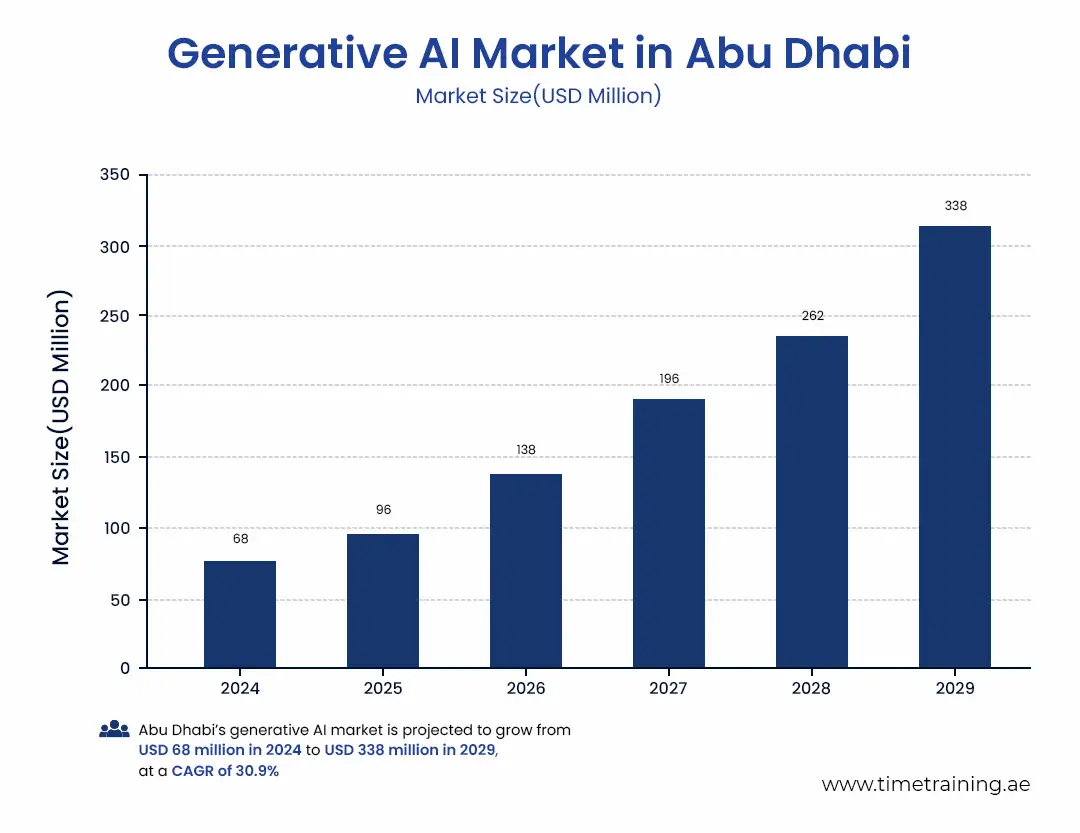
The generative AI market in Abu Dhabi, according to Mordor Intelligence, is illustrated below
AI-Generated Content: What You Need to Know
AI-generated content spans blog posts, product descriptions, social captions, video scripts, and more. It's transforming content marketing, but it comes with important caveats:
-
Accuracy matters: Generative AI models can produce confident-sounding but incorrect information, often called "hallucination." Always fact-check AI output.
-
Originality and editing still matter: The best results typically combine AI-generated drafts with human editing, subject-matter expertise, and brand voice.
-
Search engines reward genuinely useful content: Content built purely to game rankings, without real value, tends to underperform over time regardless of whether AI or a human wrote it.
Prompt Engineering: The Skill Behind Great AI Output
Prompt engineering is the practice of crafting clear, specific instructions to get better results from generative AI tools. It's quickly become one of the most in-demand AI skills for beginners entering the workforce.
A few practical prompt engineering tips:
-
Be specific about format, tone, and length ("Write a 150-word product description in a friendly tone").
-
Provide context or examples when possible.
-
Break complex tasks into smaller steps.
-
Ask the AI to critique or refine its own output for better results.
Aspiring AI professionals can follow How Can You Start a Career in Generative AI in Abu Dhabi? for a step-by-step guide to building the right skills, earning certifications, and finding local job opportunities.
How Can Beginners Build Generative AI Skills in 2026?
Building practical generative AI skills is easier than ever. Here's how beginners can get started:
-
Learn the fundamentals of generative AI, including how AI models, prompts, and Large Language Models (LLMs) work.
-
Enrol in a Generative AI Course in Abu Dhabi or earn a Generative AI certification to gain structured, industry-relevant training.
-
Master prompt engineering to create accurate and high-quality AI outputs.
-
Explore leading AI tools such as ChatGPT, Midjourney, DALL·E, and AI automation platforms.
-
Understand responsible AI practices, including AI ethics, privacy, and bias mitigation.
-
Work on hands-on projects to build a portfolio that demonstrates your practical AI skills.
-
Apply AI to your profession, whether you're in marketing, engineering, software development, education, or business, to improve productivity and career opportunities.
FAQ's
What is generative AI in simple terms?
Generative AI is technology that creates new content like text, images, or audio by learning patterns from existing data, rather than just analysing or sorting information.
Is ChatGPT generative AI?
Yes. ChatGPT is one of the most well-known generative AI tools, built on a large language model that generates human-like text responses based on user prompts.
What is the difference between AI and generative AI?
AI is the broad field covering all machine intelligence, including prediction, automation, and robotics. Generative AI is a specific subset focused on creating new content, such as text, images, or audio.
Can generative AI replace human jobs?
Generative AI is more likely to change job tasks than eliminate entire roles outright, particularly in content creation, coding, and design. Professionals who learn to work alongside AI tools tend to remain more competitive than those who avoid them.
Do I need coding skills to learn generative AI?
No. Many generative AI applications, like ChatGPT, Midjourney, and Canva's AI tools, require no coding knowledge. Coding becomes more relevant if you want to build or customise AI models yourself.
What industries use generative AI the most?
Marketing, software development, media and entertainment, education, healthcare, and engineering are among the industries seeing the fastest generative AI adoption in 2026.
 +971 2 6713828