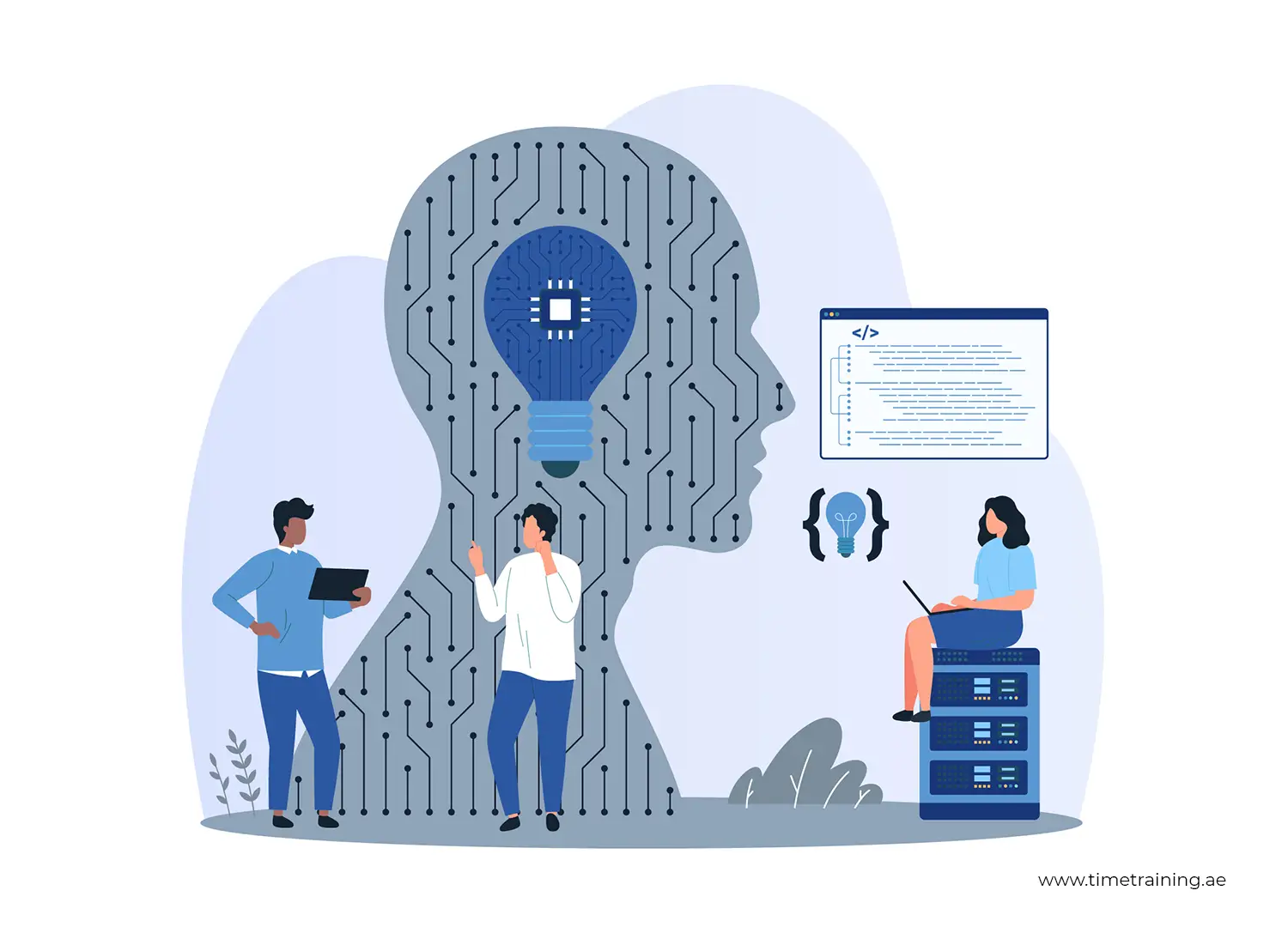
The roles and responsibilities of a generative AI engineer include designing, building, fine-tuning, and deploying AI systems that create new content (text, code, images or audio) using large language models (LLMs) and generative frameworks. They also build RAG pipelines, fine-tune foundation models, integrate LLM APIs into products, manage AI agents, monitor model performance, and ensure outputs are accurate, ethical and production-ready.
Besides model development, the responsibilities of a Generative AI Engineer include integrating AI into company workflows, ensuring responsible use of AI, fine-tuning the models, and monitoring their performance in the production environment.
In Abu Dhabi, demand for this role is rising fast across banking, energy, telecom and government-linked technology firms.
In this article, you will learn about the roles and responsibilities of the Generative AI Engineer, skills needed for the job, industries looking for AI talent, career opportunities and salaries, as well as steps to get started in this exciting profession.
Table of Contents
|
|
1. Who is a Generative AI Engineer?
2. What are the roles and responsibilities of a generative engineer in Abu Dhabi?
3. Why is Abu Dhabi a growing hub for generative AI engineer roles?
4. Key Takeaways
5. FAQs: Roles and Responsibilities of a Generative AI Engineer in Abu Dhabi
|
Who is a Generative AI engineer?
A generative AI engineer is the person who takes a large language model, something like GPT, Claude or Gemini, and turns it into a working product. That could be a customer service chatbot, an internal knowledge assistant, a code-generation tool, or an AI agent that automates a manual business process.
It's a hybrid role. Part software engineer, part machine learning practitioner, part product thinker. The job didn't really exist in its current form five years ago, but with generative AI now embedded in banking, healthcare, retail and government services across the UAE, it has become one of the fastest-growing tech careers in the region.
Salary Insight
Generative AI and LLM engineers command a 25-40% salary premium over traditional machine learning roles in 2026. Mid-to-senior GenAI engineers in Abu Dhabi can earn between AED 38,000 and AED 65,000 monthly
What are the roles and responsibilities of a generative engineer in Abu Dhabi?
The major roles and responsibilities of a generative engineer in Abu Dhabi are the following:
1. Designing and Building LLM-Powered Applications
The core of the job is building applications on top of foundation models. This means writing the logic that connects a model to real business data, designing conversation flows, and building retrieval-augmented generation (RAG) pipelines so the AI answers questions using a company's own documents rather than guessing.
2. Fine-Tuning and Customising Models
Off-the-shelf models rarely fit a business perfectly. Generative AI engineers fine-tune foundation models on domain-specific data, legal documents, financial reports, and customer transcripts so outputs are accurate and relevant to the industry they're built for.
3. Prompt Engineering and Evaluation
Getting consistent, reliable output from an LLM is harder than it looks. Engineers design and test prompts systematically, build evaluation frameworks to measure accuracy and hallucination rates, and refine prompts based on real user feedback.
4. Building and Managing AI Agents
A growing part of the role involves agentic AI systems that don't just answer questions but take multi-step actions. This includes designing agent workflows using frameworks such as LangChain or LangGraph, connecting agents to tools and APIs, and deciding where human sign-off is still required for high-stakes actions.
5. Integrating AI into Existing Software
Generative AI rarely lives in isolation. Engineers integrate models into existing enterprise systems through APIs, build backend services (often using FastAPI or similar frameworks), and ensure the AI layer works smoothly with a company's existing infrastructure.
Key Abu Dhabi Infrastructure and Entities
-
G42 (Group 42): Based in Abu Dhabi, G42 is the region's most prominent AI infrastructure player. In 2026, G42 announced it had begun recruiting AI agents into enterprise roles across the organisation.
-
Microsoft Partnership: A landmark $1.5 billion investment by Microsoft into G42 has accelerated the deployment of sovereign-compatible AI infrastructure in the capital.
-
Hub71: Abu Dhabi’s global tech ecosystem operates Hub71+ AI, a specialised vertical that offers startups up to AED 500,000 in incentives and office space to develop generative AI solutions
6. Deploying and Scaling AI Systems
Once a model works well in testing, it has to be deployed reliably. This covers cloud infrastructure setup, containerisation, load handling, and ensuring the system performs under real user traffic, not just in a demo.
Wondering what AI careers are in demand? Read Career Opportunities in Artificial Intelligence in Abu Dhabi to explore the latest roles and growth opportunities.
7. Monitoring, Testing and Auditing AI Output
Because generative models can hallucinate or drift over time, engineers build monitoring systems to track output quality, flag anomalies, and audit AI-generated content or code for security vulnerabilities and edge cases before it reaches production.
Expert Insight: “We will transform the UAE into a global leader in artificial intelligence by attracting top AI talent, building a sophisticated and secure ecosystem, and creating the conditions to develop new AI solutions with global economic potential.”
- Omar Sultan Al Olama, Minister of State for Artificial Intelligence, Digital Economy, and Remote Work Applications, United Arab Emirates
How will the UAE AI Strategy 2031 shape your career? Read UAE AI Strategy 2031: Key Opportunities, Industries & Career Impact Explained to discover what's ahead.
8. Working Cross-Functionally
Generative AI engineers rarely work alone. They collaborate closely with data scientists, product owners, DevOps teams and business stakeholders to translate a business problem into a working AI solution and to explain, in plain language, what the model can and can't reliably do.
The difference in the roles and responsibilities of a generative AI engineer, data scientist, and machine learning engineer must be well understood to distinguish among these roles and avoid confusion among freshers.
Generative AI Engineer vs Data Scientist vs ML Engineer
| Aspect |
Generative AI Engineer |
Data Scientist |
ML Engineer |
| Primary focus |
Building applications with generative models (LLMs) |
Extracting insights and patterns from data |
Building and training predictive ML models
|
| Core tools |
LangChain, LangGraph, vector databases, LLM APIs |
Python, R, statistical modelling, SQL |
TensorFlow, PyTorch, model pipelines |
| Typical output |
Chatbots, AI agents, copilots, content tools |
Reports, forecasts, dashboards |
Trained models embedded in products |
| Deployment involvement |
High - owns production deployment |
Low to medium |
High |
| Business exposure |
Direct - works with product and end users |
Medium |
Medium |
Skills Every Generative AI Engineer Needs
The key skills every Generative AI engineer needs in Abu Dhabi are the following:
-
Strong Python fundamentals: It is still the backbone of nearly every AI workflow.
-
LLM frameworks: Hands-on experience with LangChain, LangGraph, or similar agent-orchestration tools.
-
RAG and vector databases: Understanding how retrieval pipelines reduce hallucination and improve accuracy.
-
Cloud platforms: AWS, Azure or GCP, since most production systems run there.
-
API design and backend engineering: often using FastAPI or Node.js to expose AI capabilities to other systems.
-
Model evaluation: Knowing how to measure hallucination rates, bias and output quality, not just accuracy scores.
-
Communication: Translating technical limitations of AI systems into language business stakeholders understand.
Discover what are the top generative AI tools every professional should know and explore the AI tools shaping the future of work.
Why Is Abu Dhabi a Growing Hub for Generative AI Engineer Roles?
Abu Dhabi's banking, energy, telecom and defence-technology sectors are actively building in-house generative AI capability rather than relying solely on vendors.
Roles currently open in the emirate span everything from AI engineers embedding LLM-powered copilots into retail banking platforms, to applied AI specialists building customer-facing tools in the energy sector, to senior engineers leading agentic AI use cases end-to-end for defence tech and telecom firms.
Several roles specifically call out RAG pipelines, LangGraph agent design, and MCP tool integrations as day-to-day requirements, a clear sign that the market has moved past experimentation and into production deployment.
For professionals based in Abu Dhabi or Dubai looking to move into this field, the practical route is usually a structured, project-based training programme rather than piecing together skills from scattered tutorials, particularly given how quickly the tooling in this space changes.
Did You Know?
AI Specialist Visa: The UAE introduced a new 3-year renewable visa for AI professionals, requiring a minimum monthly salary of AED 30,000
Where Do Generative AI Engineers Work in Abu Dhabi?
The sectors and locations in Abu Dhabi where generative AI engineers work are listed in the table below:
Where Generative AI Engineers Work in Abu Dhabi
| Abu Dhabi Location / Sector |
Major Responsibilities |
| Masdar City |
Develop AI solutions for clean energy, sustainability, and smart city projects.
|
| Abu Dhabi Global Market (ADGM) |
Build generative AI applications for fintech, banking, risk analysis, and compliance.
|
| Khalifa Industrial Zone Abu Dhabi (KEZAD) |
Implement AI for manufacturing automation, logistics, and predictive operations.
|
| Government & Digital Services |
Create AI-powered citizen services, document automation, and virtual assistants.
|
| Healthcare & Research Institutions |
Develop AI tools for medical imaging, clinical documentation, and healthcare analytics.
|
Key Takeaways
-
Generative AI engineers sit at the intersection of software engineering, machine learning and applied research.
-
Their day-to-day work spans prompt engineering, fine-tuning, RAG pipeline design, and deploying LLM-powered applications.
-
Abu Dhabi's banking, energy and defence-tech sectors are actively hiring for this role in 2026, often pairing it with backend engineering skills.
-
The role differs meaningfully from a traditional data scientist or ML engineer, though the three often overlap on a team.
-
Strong programming skills (Python), cloud platforms, and hands-on LLM tooling (LangChain, LangGraph, vector databases) are now baseline expectations, not bonuses.
FAQ's
What is the main responsibility of a Generative AI engineer?
Building and deploying working AI applications on top of large language models; this includes RAG pipeline design, fine-tuning, prompt engineering and production deployment.
Is Generative AI engineering the same as machine learning engineering?
No. ML engineers typically build and train predictive models from scratch. Generative AI engineers work primarily with pre-trained foundation models, adapting and deploying them for specific applications.
Do I need a background in data science to become a Generative AI engineer?
Not necessarily. A strong software engineering background combined with focused LLM and RAG-specific training is often enough to enter the field, especially for application-focused roles.
What industries in Abu Dhabi are hiring Generative AI engineers?
Banking, energy, telecom, defence technology, and government-linked technology companies are among the most active hirers in 2026.
Which Generative AI tools should I learn first to become a Generative AI Engineer?
Start with Python, then move to LangChain or LangGraph for agent design, and a vector database (such as Pinecone or Weaviate) for RAG pipelines to become a generative AI engineer.
 +971 2 6713828