Artificial Intelligence, or AI, is technology that lets computers learn from information and make decisions the way a human might. It's already part of your day, whether you're asking a voice assistant for the weather, scrolling a personalised social feed, or letting your phone finish your sentences.
In the simplest terms, AI takes in data, spots patterns in it, and uses those patterns to predict, decide or create something useful. That one idea sits behind virtual assistants, streaming recommendations, chatbots, sat-nav apps, and newer tools like ChatGPT.
This guide breaks AI down in plain English. You'll learn what it actually is, how it works, the difference between AI, Machine Learning, Deep Learning and Generative AI, where it's used, and how to start learning it yourself. We've also included a dedicated look at how Abu Dhabi and the wider UAE are shaping the global AI story, since it's one of the most AI-active places on the planet.
No coding background needed. Let's start with the basics.
|
Table of Contents
|
|
1. What Is Artificial Intelligence?
2. How Does Artificial Intelligence Actually Work?
3. How Does AI Learn From Data?
4. What Are the Different Types of Artificial Intelligence?
5. What Are the Key AI Technologies Beginners Should Know?
6. What Is the Difference Between AI, Machine Learning, Deep Learning and Generative AI?
7. Where Do We See Artificial Intelligence in Everyday Life?
8. How Is AI Used Across Different Industries?
9. What Are the Benefits of Artificial Intelligence?
10. What Are the Limitations and Risks of AI?
11. Will AI Replace Jobs, or Change Them?
12. What AI Skills Do Beginners Need to Learn?
13. What Career Opportunities Does AI Offer?
14. How Can Beginners Start Learning Artificial Intelligence?
15. How Is Abu Dhabi Leading the Global AI Revolution?
16. What Does the Future of AI in Abu Dhabi and the UAE Look Like?
17. Frequently Asked Questions About Artificial Intelligence
|
What Is Artificial Intelligence?
Artificial Intelligence (AI) is a field of computer science dedicated to developing machines and software that are capable of performing tasks that usually require human intelligence. These include understanding language, recognizing images, identifying patterns, and making informed decisions.
AI is not a single product. It's an umbrella term for many different technologies and techniques that all share one goal. That is, getting a machine to behave intelligently. Some AI systems recommend what to watch next. Others detect fraud on your bank card in real time, or help a doctor read a scan.
Computer scientist Alan Turing asked one of the founding questions of the field back in 1950: "Can machines think?" That question still shapes how researchers test and define intelligent behaviour in machines today, even though today's AI works very differently from what Turing could have imagined.
It helps to separate AI from ordinary software. A calculator follows fixed rules you can predict every time. AI systems, by contrast, learn from data and can handle situations they weren't explicitly programmed for, which is exactly why they can feel so much more capable.
How Does Artificial Intelligence Actually Work?
AI works by processing large volumes of data through an algorithm that learns patterns from that data and then uses those patterns to make a prediction, decision, or output. Every AI system, however advanced, follows some version of this same basic loop.
Here's the process that happens in AI broken into its five core building blocks:
The Five Building Blocks of AI
| Building block |
What it means in plain English
|
| Data |
The raw information the system learns from→ text, images, numbers, sound or video.
|
| Algorithm |
The set of mathematical instructions that finds patterns in that data.
|
| Model |
The trained result, the algorithm after it has learned from the data, ready to be used.
|
| Training |
The learning phase, where the model is repeatedly shown data and adjusts itself to get more accurate.
|
| Inference |
The moment the trained model is used on new, real-world data to produce an answer.
|
Here is a simple way to picture it→ Training is like a student practising with hundreds of past exam papers, and inference is the student sitting the real exam and applying what they've learned to a brand-new question.
How Does AI Learn From Data?
AI systems normally learn in one of three ways: from labelled examples, from unlabelled patterns, or through trial and error with rewards. Most AI tools you use today rely on the first method. Here is how these learnings are categorised:
-
Supervised learning: The AI model is trained on labelled examples (e.g., thousands of photos already tagged "cat" or "dog") so it learns to label new photos correctly.
-
Unsupervised learning: The AI model looks for hidden patterns or groupings in data that hasn't been labelled, such as grouping customers by shopping habits.
-
Reinforcement learning: The AI model learns by trial and error, getting a "reward" for good decisions. This is how many game-playing and robotics systems are trained.
The more relevant, high-quality data a system sees, the better it usually gets. This is exactly why data quality, not just data quantity, matters so much in AI projects.
What Are the Different Types of Artificial Intelligence?
AI is usually classified by capability into three categories, but only one of them actually exists today. Narrow AI is real and everywhere. General AI and Superintelligent AI remain research goals, not working technologies.
Different Types of Artificial Intelligence
| Type |
Does it exist today? |
What it means |
| Narrow AI (also called Weak AI) |
Yes, this is all AI in use today |
Built to perform one task or a specific set of tasks well, such as translating language or recommending a film. It cannot think beyond its trained purpose.
|
| General AI (AGI) |
No, it’s an active research goal |
A hypothetical system that could understand, learn and apply intelligence across any task a human can, not just a narrow set.
|
| Superintelligent AI |
No, for theoretical purposes only |
A hypothetical AI that would exceed human intelligence across every field. This remains speculative and is not close to existing.
|
Every AI tool mentioned in this guide, such as chatbots, recommendation engines, fraud detection, and image generators, is Narrow AI. Be cautious of any content that implies AGI or superintelligence is already operating; as of today, it isn't.
What Are the Key AI Technologies Beginners Should Know?
Six technologies make up most of what people mean when they talk about "AI": Machine Learning, Deep Learning, Natural Language Processing, Computer Vision, Generative AI, and Robotics/AI agents.
Here's what each one actually does.
Key AI Technologies Used
| Technology |
What it does |
Everyday example
|
| Machine Learning (ML) |
Learns patterns from data to make predictions |
Email spam filters
|
| Deep Learning |
Uses layered neural networks to handle complex data like images and speech |
Face unlock on your phone
|
| Natural Language Processing (NLP) |
Understands and generates human language |
Voice assistants and chatbots
|
| Computer Vision |
Interprets images and video |
Traffic camera systems, medical scan analysis
|
| Generative AI |
Creates new text, images, audio or code |
ChatGPT, AI image generators
|
| Robotics & AI Agents |
Combines AI with physical or software systems that act autonomously |
Warehouse robots, automated customer-service agents
|
What Is the Difference Between AI, Machine Learning, Deep Learning and Generative AI?
Artificial Intelligence is the broad goal. Machine Learning is one major way to achieve it. Deep Learning is a specialised type of Machine Learning. Generative AI is an application built mostly on Deep Learning. Think of it as a set of nested circles, not four separate things. Here is an illustration of how each of these is interconnected and differentiated.
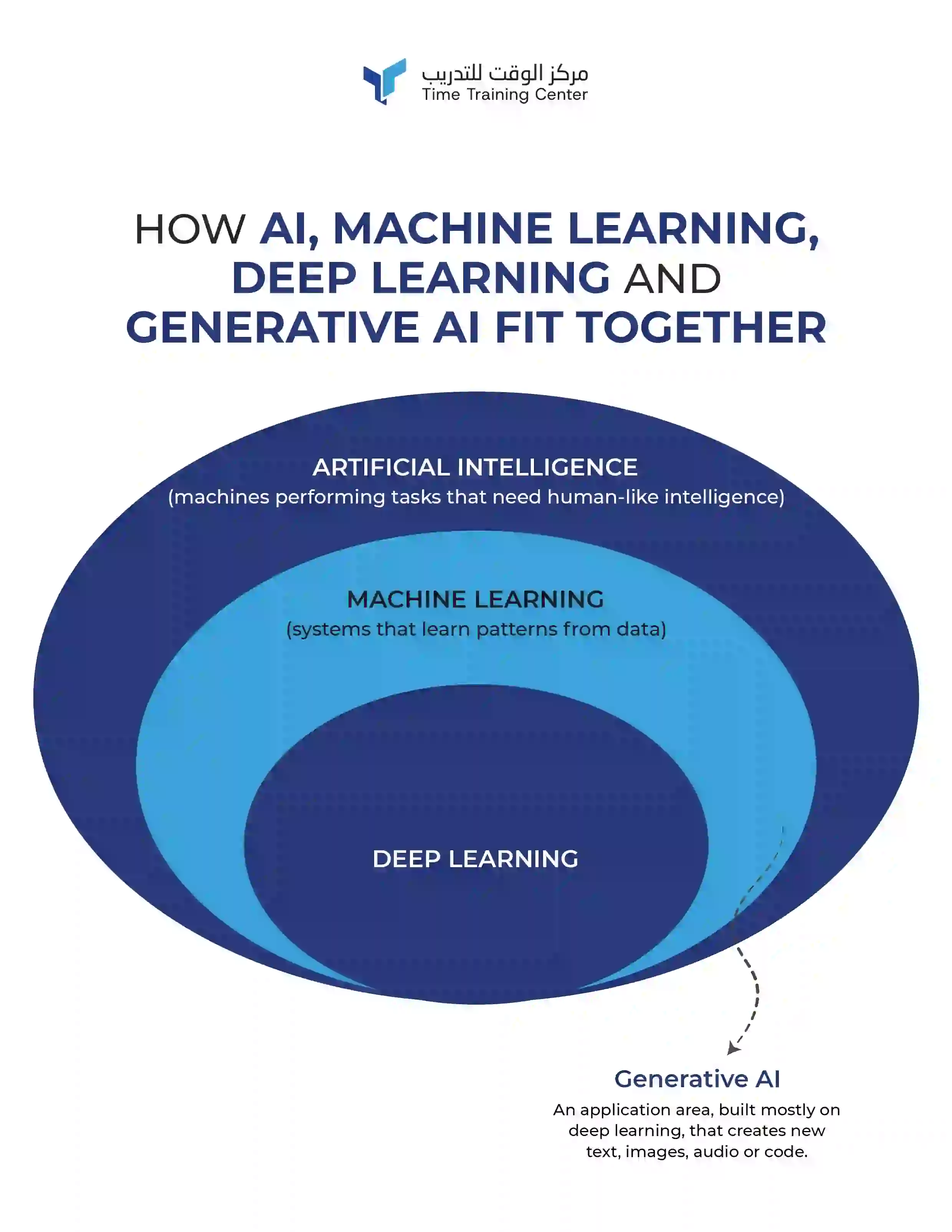
AI, Machine Learning and Deep Learning are nested, not separate. Generative AI is a modern application area built largely on deep learning techniques.
This matters because people often use these words interchangeably, which confuses.
Not every AI system is Machine Learning-based (some early AI used hand-written rules instead of learned patterns). And not every Machine Learning system is Generative; most ML models predict or classify rather than create something new.
Where Do We See Artificial Intelligence in Everyday Life?
You probably interact with AI dozens of times a day without noticing. Here are the most common places it shows up, including examples close to your home in the UAE.
-
Virtual assistants: Siri, Google Assistant and Alexa use Natural Language Processing (NLP) to understand spoken questions.
-
Streaming recommendations: Netflix and Spotify use ML to suggest what you'll want to watch or hear next.
-
Navigation apps: AI-optimised traffic systems in Abu Dhabi and Dubai adjust signal timing in real time to ease congestion.
-
Banking and fraud alerts: machine learning models scan transactions instantly to flag suspicious activity.
-
Government services: Abu Dhabi's TAMM platform uses AI to predict which government service a resident needs next, based on real-life events like starting a business.
-
Healthcare: AI-supported diagnostic tools help clinicians detect conditions like cancer earlier, while "ambient AI scribes" cut down on note-writing time.
Once you notice it, AI is genuinely everywhere, which is exactly why understanding the basics is becoming a practical life skill, not just a technical one. To get started, you may find the top AI Courses in Abu Dhabi for beginners as well as professionals helpful.
How Is AI Used Across Different Industries?
AI is reshaping how entire industries operate, from hospitals to ports. Here's a snapshot of real applications, including several from the UAE.
AI Use Across Different Industries
| Industry |
AI application |
Benefit |
| Healthcare |
AI-supported diagnostics and imaging tools; ambient AI scribes for clinical notes |
Earlier disease detection; up to 83% less time spent on documentation
|
| Finance & banking |
Real-time fraud detection, AI-driven credit scoring |
Faster, more accurate risk decisions
|
| Government |
Predictive, proactive service delivery (e.g., Abu Dhabi's TAMM platform) |
Fewer manual applications; faster service
|
| Retail & marketing |
Personalised recommendations, demand forecasting |
Better customer experience, less wasted stock
|
| Transport & logistics |
Route optimisation, predictive maintenance, port container routing |
Lower fuel use, fewer delays
|
| Education |
AI-assisted lesson planning and marking support for teachers |
Reduced admin workload, more time for mentoring
|
| Energy |
Predictive maintenance for utilities and infrastructure |
Fewer outages, supports sustainability goals
|
If you'd like to see how these tools are actually built and used, Time Training Center's Generative AI Training in Abu Dhabi covers practical, job-ready applications across several of these industries. See how AI will transform jobs and industries in the UAE by 2031.
What Are the Benefits of Artificial Intelligence?
AI's core benefit is speed and consistency at scale: it can process huge amounts of information, spot patterns humans would miss, and free people up for higher-value work.
-
Productivity: automates repetitive tasks like data entry, scheduling and basic customer queries.
-
Better decisions: surfaces patterns in data that support faster, evidence-based decisions.
-
Personalisation: tailors content, offers and services to individual preferences.
-
Accessibility: powers tools like live captioning and text-to-speech that widen access for people with disabilities.
-
Operational efficiency: one UK banking case study reported customer complaints falling by more than 50% and productivity rising 8% after introducing AI-assisted case management and voice analytics.
In the infographic below, you can see how AI benefits your day-to-day life.
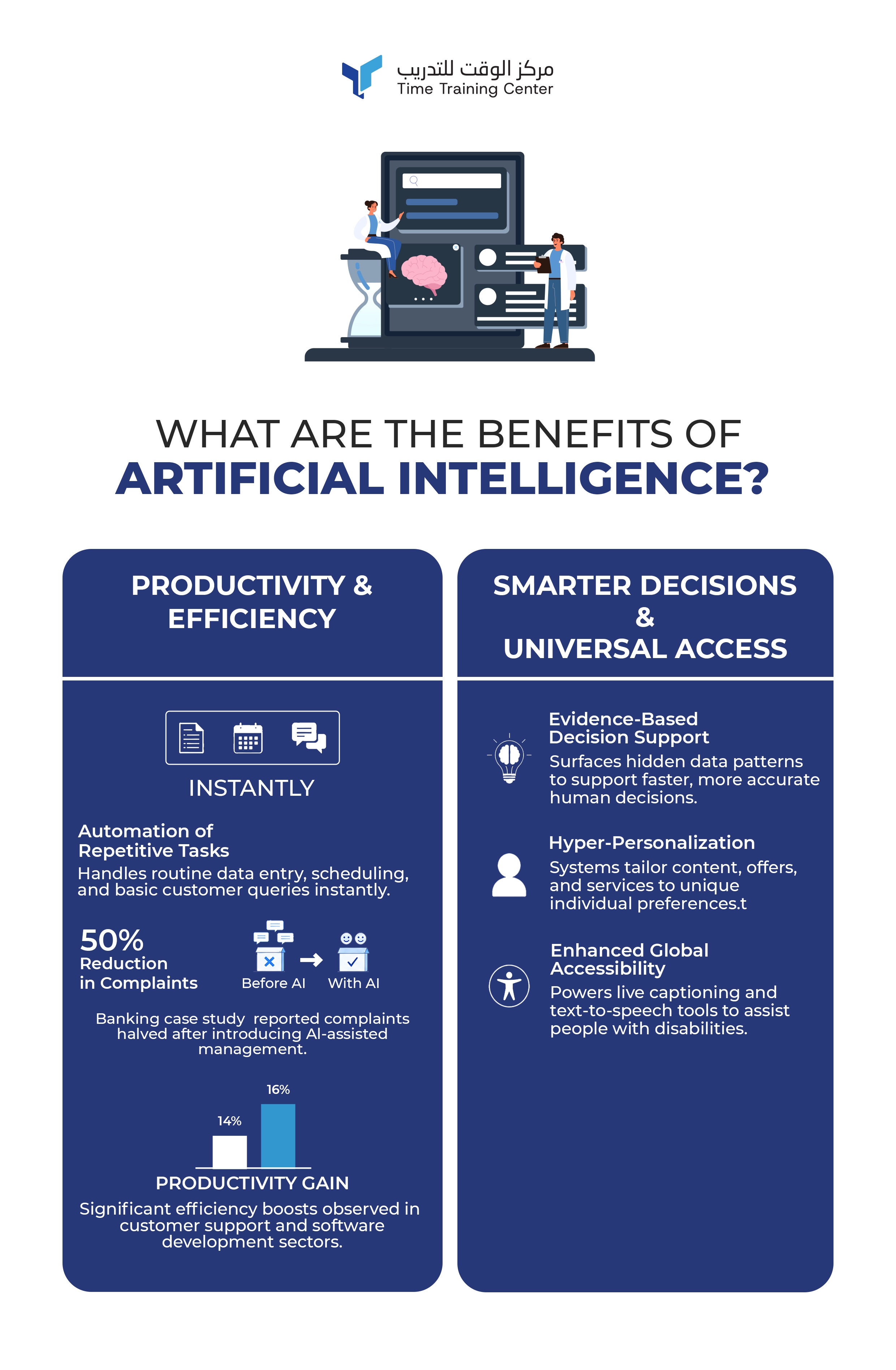
These gains are real, but they depend on the AI system being well-designed, well-monitored, and used for the right task, which brings us to its limits.
What Are the Limitations and Risks of AI?
AI is powerful, but it isn't infallible. It can be confidently wrong, biased by the data it learned from, or misused if left unchecked. Therefore, healthy scepticism is part of using it well.
Limitations and Risks of Using AI
| Limitation |
What it means |
| Hallucinations |
AI can generate answers that sound convincing but are factually incorrect.
|
| Bias |
If training data reflects real-world bias, the AI's outputs can repeat or amplify it.
|
| Privacy |
AI systems often need large volumes of personal data, raising data-protection questions.
|
| Explainability |
Some AI models are a "black box"; even developers can struggle to explain a specific decision.
|
| Over-reliance |
Leaning on AI without human review can let errors slip through unnoticed.
|
| Security |
AI systems can be targeted, manipulated or exploited if not properly secured.
|
The responsible approach isn't to avoid AI, but to keep a human reviewing important decisions, question surprising outputs, and choose tools and training that build these habits from day one.
Will AI Replace Jobs, or Change Them?
AI is set to change far more jobs than it eliminates outright. Global research points to a net gain in jobs by the end of the decade, even as some tasks are automated.
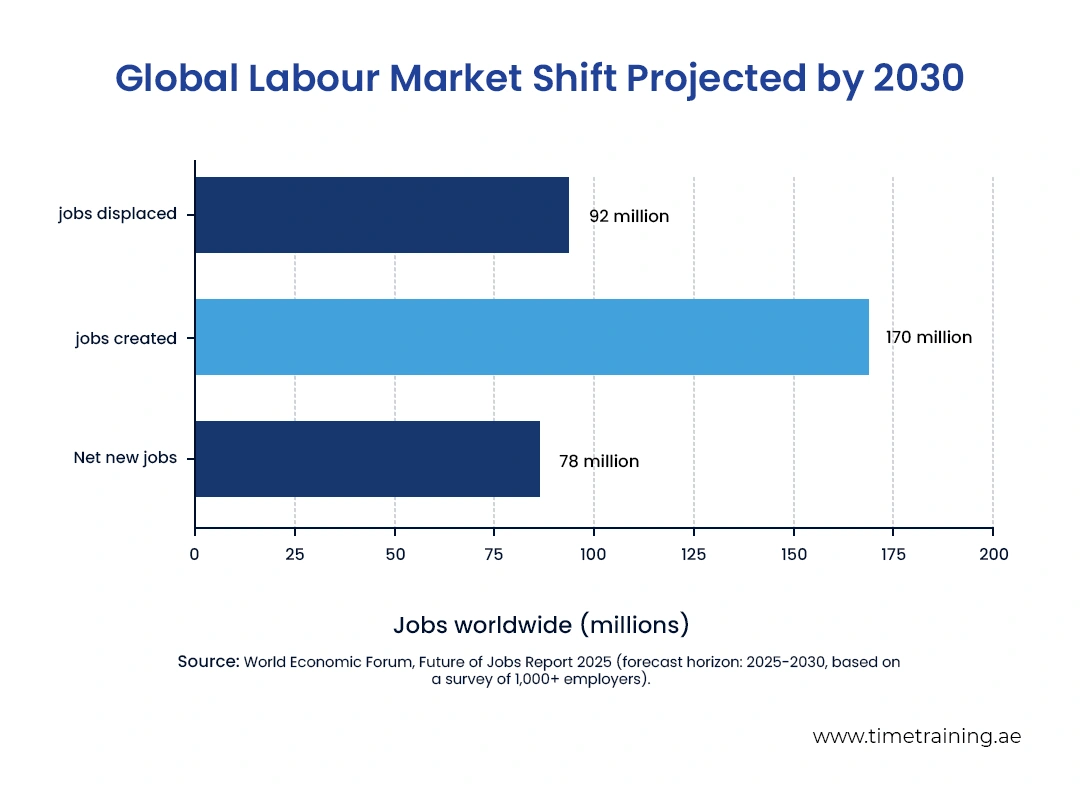
The World Economic Forum's Future of Jobs Report 2025 projects 92 million roles displaced and 170 million created worldwide by 2030, a net gain of 78 million jobs.
It's important to separate two different ideas: automating a task and eliminating a whole job. Most roles include a mix of tasks, and AI tends to take over the repetitive ones. This will free up time for the judgement-based, creative or people-facing parts of the job that are much harder to automate.
The World Economic Forum's research also found that nearly 40% of core job skills are expected to change by 2030, which is why continuous reskilling (not standing still) is the safest long-term career strategy.
What AI Skills Do Beginners Need to Learn?
You don't need to become an advanced programmer to work with AI. Most beginners need a mix of foundational understanding, some technical grounding, and strong "human" skills.
AI Skills Beginners Need
| Skill category |
Examples |
Who needs it |
| Foundational |
AI concepts, data literacy, basic statistics, responsible AI awareness |
Everyone, regardless of role
|
| Technical |
Python, data handling, model evaluation, using AI APIs |
Those pursuing hands-on technical AI roles
|
| Generative AI skills |
Prompt engineering, evaluating AI output, grounding responses in real sources |
Marketers, analysts, consultants, educators
|
| Professional |
Critical thinking, communication, domain expertise |
Anyone applying AI within their own field
|
A useful rule of thumb: the more you combine AI literacy with expertise in your own field ( whether that's marketing, healthcare, education or finance), the more valuable you become. This "hybrid profile" is increasingly what employers are looking for.
What Career Opportunities Does AI Offer?
AI has created an entirely new set of career paths, and not all of them require heavy coding. Here's a snapshot of common roles and what they usually involve.
Career Opportunities AI Offers
| Career |
Core skills |
Programming needed? |
Typical entry route
|
| AI/Machine Learning Engineer |
Python, ML frameworks, model building |
Yes, significant |
Computer science background + ML certification
|
| Data Scientist |
Statistics, data analysis, ML basics |
Yes, moderate |
Analytics background + data science training
|
| Prompt Engineer / GenAI Specialist |
Prompt design, tool evaluation, workflow design |
No, light or none |
Generative AI certification, subject-matter background
|
| AI Product Manager |
Strategy, user needs, working with technical teams |
No, conceptual understanding only |
Business/product background + AI fundamentals
|
| AI Ethics / Governance Specialist |
Policy, risk assessment, responsible AI frameworks |
No |
Legal, policy or compliance background + AI literacy
|
| Data Analyst |
Data visualisation, reporting, basic statistics |
Light |
Any analytical background + data tools training
|
Here, you can get a broad outlook on the career opportunities in Artificial Intelligence in Abu Dhabi.
On pay: specialised, in-demand AI and Python roles have been reported at premium salary levels in mature markets, particularly for professionals combining strong technical skills with real project experience. Exact figures vary widely by role, seniority, sector and country, so treat any single salary figure as a guide rather than a guarantee.
Locally, the picture is especially promising: Abu Dhabi's digital strategy alone is targeting more than 5,000 new high-skilled digital roles by 2027, in fields spanning data science, cybersecurity and AI engineering.
How Can Beginners Start Learning Artificial Intelligence?
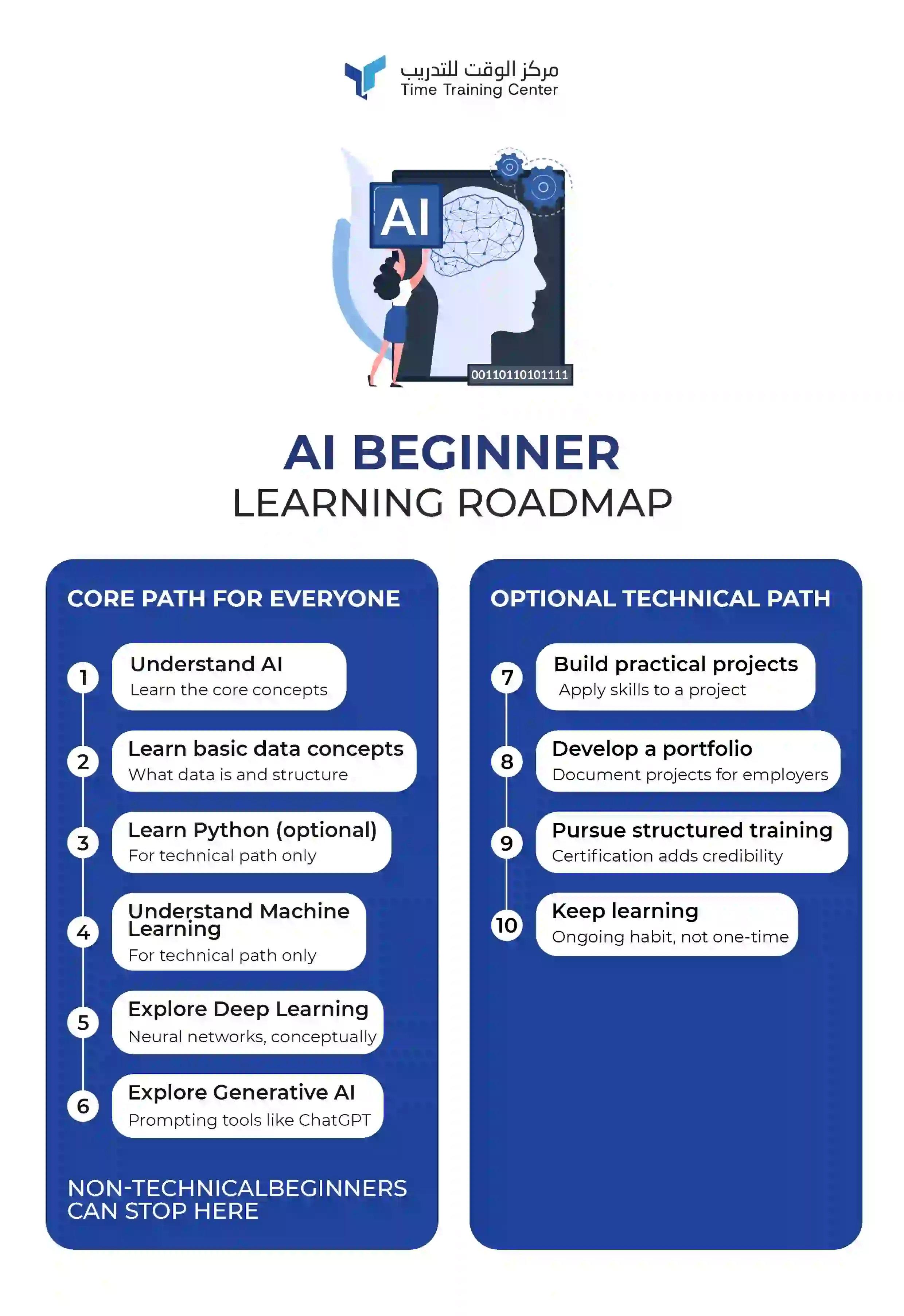
The most reliable way to start learning AI is step by step: understand the concepts first, then build practical skills, then apply them to real projects. Here's a beginner-friendly roadmap.
10-Step Guide for Beginners to Start a Career in AI
| Stage |
Focus |
| Understand AI |
Learn the core concepts covered in this guide — what AI is and how it works.
|
| Learn basic data concepts |
Get comfortable with what data is and how it's structured.
|
| Learn Python (optional) |
Needed only if you're pursuing a technical AI path.
|
| Understand Machine Learning |
Learn how models are trained and evaluated.
|
| Explore Deep Learning |
Understand neural networks at a conceptual level.
|
| Explore Generative AI |
Learn prompting and how to use tools like ChatGPT effectively and responsibly.
|
| Build practical projects |
Apply what you've learned to a real, small project.
|
| Develop a portfolio |
Document your projects to show employers or clients.
|
| Pursue structured training |
A certification adds structure, feedback and credibility to self-study.
|
| Keep learning |
AI tools evolve fast. Treat this as an ongoing habit, not a one-time course.
|
Non-technical beginners can comfortably stop after Stage 6 and still become highly effective AI users in their own field. Technical learners and career changers aiming for engineering or data science roles should continue through Stage 10.
You may also follow this step-by-step guide on how to become an AI Engineer in Abu Dhabi to get a better idea. Also understand the responsibilities of an AI Engineer in Abu Dhabi and the average salary an AI Engineer can earn in Abu Dhabi.
The infographic below gives a better idea of the Journey of a Beginner in AI.
How Is Abu Dhabi Leading the Global AI Revolution?
Abu Dhabi is one of the fastest-moving places in the world for AI adoption, and it's investing at a national level to stay that way. Generative AI adoption in the UAE has reached around 64% of the population, among the highest rates measured anywhere, according to Stanford's 2026 AI Index Report, well above the United States' 28.3%.
This isn't an accident. It's the result of a deliberate, government-led strategy that treats AI as core national infrastructure rather than an optional upgrade. To keep up with the trend, it’s deliberate that the citizens of Abu Dhabi, especially the professionals, learn Generative AI.
The UAE National Strategy for Artificial Intelligence 2031
Launched in 2017, the UAE National Strategy for Artificial Intelligence 2031 aims to make the UAE a global leader in AI by integrating it across priority sectors (energy, logistics, tourism, healthcare and cybersecurity) while building local AI talent and data infrastructure. The strategy is projected to contribute an estimated AED 335–353 billion to the UAE's GDP by 2031, roughly 13.6–14% of total output.
Check out this guide on the UAE AI Strategy 2031: Key Opportunities, Industries & Career Impact Explained.
Abu Dhabi's AI-Native Government Push (2025–2027)
Abu Dhabi is aiming to become the world's first fully AI-native government by 2027, backed by an AED 13 billion (around US$3.54 billion) investment under the Abu Dhabi Government Digital Strategy 2025–2027.
"AI-native" means AI is built into how government services are designed from the outset, not added on as a chatbot afterwards.
The graph below shows the UAE’s projection of AI-driven growth.
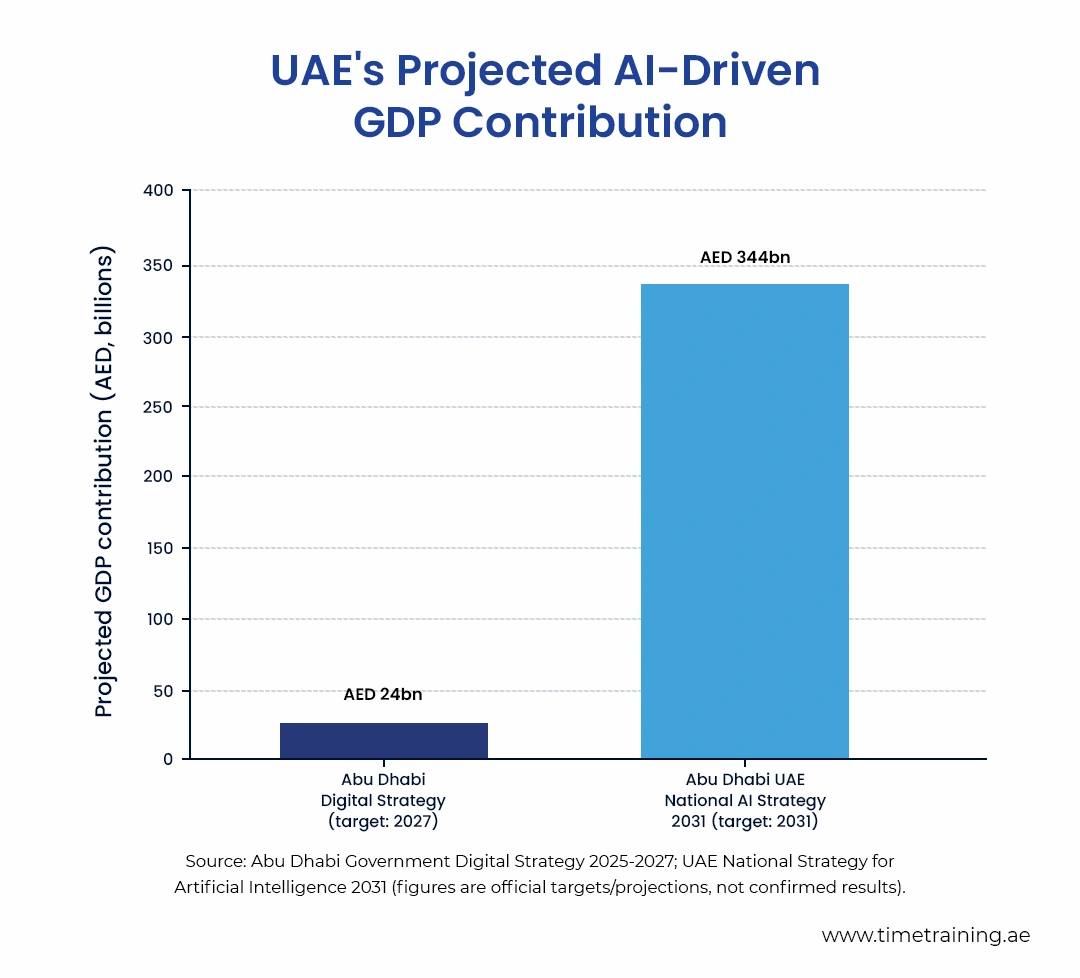
Two of the UAE's headline AI economic targets — Abu Dhabi's Digital Strategy (by 2027) and the UAE's National AI Strategy 2031 (by 2031). These are official government targets, not confirmed outcomes.
The centrepiece of this push is TAMM, Abu Dhabi's digital government platform. TAMM 3.0 already cut offline visits by 90% and made 73% of transactions instantaneous. Its successor, TAMM 4.0, uses AI to anticipate "life events", like starting a business or having a child, and deliver the relevant government service automatically, in more than 15 languages, without residents needing to apply.
Talent, Research and Sovereign Technology
Abu Dhabi backs this vision with serious investment in people and infrastructure:
-
Workforce training: over 95% of Abu Dhabi's 30,000+ government employees have completed comprehensive AI training.
-
Falcon LLM: an open-source large language model developed by the Technology Innovation Institute in the UAE, built to compete with major global models, positioning the UAE as an AI developer, not just a consumer.
-
MBZUAI: the Mohamed bin Zayed University of Artificial Intelligence is a dedicated graduate research university feeding local AI talent pipelines.
-
Sovereign cloud: a landmark partnership between the Abu Dhabi Government, Microsoft and Core42 (a G42 company) keeps sensitive government data under national jurisdiction while processing around 11 million daily digital interactions.
-
AI Majalis: community forums, based on the traditional Emirati majlis, that open up AI ethics and everyday applications to the wider public, not just technologists.
According to Stanford's 2026 AI Index Report, AI engineering skills are growing fastest of anywhere measured in the UAE, alongside Chile and South Africa, a strong signal for anyone building an AI career locally right now.
What Does the Future of AI in Abu Dhabi and the UAE Look Like?
Between now and 2031, expect three clear trends: AI becoming standard in schools, AI-native government services expanding, and continued heavy investment in sovereign AI infrastructure.
-
AI in schools: the UAE has introduced AI literacy as a required part of the school curriculum from the 2025–26 academic year onward, starting with basic AI awareness at primary level and building toward designing simple AI systems by high school.
-
Government-wide rollout: Abu Dhabi's 2027 target includes 100% automation of government workflows and 100% adoption of sovereign cloud infrastructure across entities.
-
Sovereign compute: the Stargate UAE project, developed with partners including G42, OpenAI, Oracle and Nvidia, is building large-scale AI data centre capacity to support this growth.
-
Ongoing upskilling: with the UAE AI Strategy 2031 targeting thousands of new STEM graduates per year, demand for structured AI and data training is expected to keep growing well beyond 2027. Check out the top AI training Institutes in Abu Dhabi, where you can upskill.
What's genuinely evergreen in this guide→ the definitions of AI, Machine Learning, Deep Learning and Generative AI, and the difference between Narrow and General AI, will still hold in 2031. What will keep changing is the tools, the statistics, and the specific government milestones, so treat the strategy figures here as a snapshot rather than a permanent scoreboard.
See how Time Training Center prepares you for a successful AI career in Abu Dhabi.
FAQ's
1. What is artificial intelligence in simple words?
Artificial Intelligence is technology that lets computers learn from data and perform tasks that normally need human thinking, like understanding language or recognising patterns.
2. What is AI used for?
AI is used for tasks like personalised recommendations, fraud detection, medical diagnostics support, navigation, customer service chatbots and content creation.
3. How does AI work in simple terms?
AI systems learn patterns from large amounts of data during a "training" phase, then apply those learned patterns to make decisions or predictions on new information.
4. What are the four types of AI?
AI is often described by function as reactive machines, limited memory systems, theory of mind, and self-aware AI. By capability, the simpler and more accurate split is Narrow AI (exists today), General AI and Superintelligent AI (both hypothetical).
5. Is AI and Machine Learning the same thing?
No. Machine Learning is one method used to build AI. AI is the broader goal; Machine Learning is one major way of achieving it, alongside older rule-based approaches.
6. What is the difference between AI and Generative AI?
AI is a broad field. Generative AI is a specific application within it, focused on creating new content like text, images or code, mostly using deep learning.
7. Can I learn AI without coding?
Yes. Many AI-related roles, especially in Generative AI, prompt engineering, AI product management and AI governance, need strong conceptual understanding rather than heavy programming.
8. Is AI difficult to learn for beginners?
The core concepts are genuinely approachable. Technical AI roles take longer to master, but non-technical learners can become confident, effective AI users within weeks of structured training.
9. What skills are needed to learn AI?
Beginners benefit most from data literacy, basic problem-solving, curiosity, and (for technical paths) foundational Python and statistics.
10. What jobs use AI in the UAE?
AI-related roles are growing across government, banking, healthcare, logistics and education in the UAE, including data science, prompt engineering, AI governance and AI-assisted teaching roles.
11. How can I start a career in AI in Abu Dhabi?
Start with foundational AI knowledge, build practical skills through structured training, then apply them through projects — Abu Dhabi's growing digital economy is actively creating new AI-related roles.
12. What AI courses are available in Abu Dhabi?
Time Training Center offers Artificial Intelligence Training and Generative AI training in Abu Dhabi, covering both technical foundations and practical, non-technical AI skills for professionals.
More Questions People Ask About AI
1. Will AI take over all human jobs?
No credible research supports this. Global projections point to a net gain of jobs by 2030, with AI automating specific tasks rather than eliminating entire occupations wholesale.
2. What is a Large Language Model?
A Large Language Model (LLM) is a type of Generative AI trained on huge amounts of text, allowing it to understand and generate human-like language. It's the technology behind tools like ChatGPT.
3. Is Artificial Intelligence safe to use?
AI is generally safe for everyday tasks when used with common sense. It’s about checking important facts, protecting personal data, and keeping a human in charge of high-stakes decisions.
4. What is prompt engineering?
Prompt engineering is the skill of writing clear, well-structured instructions for AI tools like ChatGPT to get more accurate and useful results. You can learn Prompt Engineering in Abu Dhabi within 24 hours.
5. Start Your AI Learning Journey Today
Artificial Intelligence is no longer a futuristic idea. It's a practical skill shaping how we work, learn and live, and Abu Dhabi is one of the most exciting places in the world to build that skill right now. You now understand what AI is, how it works, where it's used, and how careers in this field are opening up.
 +971 2 6713828