To become an HVAC technician in Abu Dhabi, you learn air conditioning basics, practise on real equipment, complete safety training and apply for helper or trainee jobs. Employers care most about what you can do. Many also ask for a diploma or site experience, and the rules change by role.
Abu Dhabi is hot for most of the year. So homes, hotels, hospitals and malls all need people who keep AC systems running. In this guide, we show you the steps, skills, pay and first jobs in simple words.
Key Takeaways
-
Start small: Helper and trainee roles are the usual first step.
-
Learn the basics first: Refrigeration, airflow and electrical safety come before advanced work.
-
Rules vary: Employers set most requirements, so read each job advert closely.
-
Pay follows skill: Simple split units pay less than chillers and VRF systems.
-
Training helps: A good course builds knowledge, but it is not a licence or a job offer.
-
Stay safe: Safe isolation and careful refrigerant handling protect you and your team.
|
Table of Contents
|
|
1. What does an HVAC technician do?
2. Is there demand in Abu Dhabi?
3. How to become an HVAC technician: 6 steps
4. What qualifications do you need?
5. Which skills matter most?
6. Which course suits beginners?
7. How much does an HVAC technician earn?
8. Where to find jobs, and how to prepare
9. How can you grow your career?
10. Mistakes to avoid
11. FAQs
|
1. What Does an HVAC Technician Do in Abu Dhabi?
An HVAC technician installs, services and repairs the systems that cool and ventilate buildings. HVAC means heating, ventilation and air conditioning. In Abu Dhabi, cooling is the main job. A normal week of an HVAC Technician includes:
-
Installation: Fitting split units, ducts, fan coil units (FCUs) and pipes.
-
Maintenance: Cleaning coils and filters, and checking gas pressure and electrical parts.
-
Fault finding: Finding out why a unit is warm, noisy or leaking.
-
Records: Logging each job and reporting to your supervisor.
An HVAC technician is not an engineer. A technician works hands-on with equipment. An engineer designs systems and does load calculations. Both roles matter, but the training paths are different.
2. Is There Demand for HVAC Technicians in Abu Dhabi?
The signs are positive, but nobody can promise you a job. Here is what the latest data shows:
| Data point |
What it tells you |
Source |
| Over 38,600 active construction licences (Feb 2026) |
The building sector is large and active |
Abu Dhabi Chamber
|
| AC uses about 60–70% of building electricity in the UAE |
Cooling is the biggest energy load, so upkeep matters |
Abu Dhabi Department of Energy
|
| AC systems are often oversized by 25–35% |
Skilled people who understand right sizing add value |
Abu Dhabi Department of Energy, July 2026
|
These figures describe the market. They are not a hiring count. As Ali Mohamed Al Marzooqi of the Abu Dhabi Chamber said, "Value today comes from integration, quality, and certainty of delivery, not just scale." For you, that means careful, skilled work stands out.
3. How to Become an HVAC Technician in Abu Dhabi: 6 Steps
Here are the six steps to become an HVAC Technician in Abu Dhabi.
1. Choose your route: Decide if you want hands-on service work or design work. This guide focuses on the technician route.
2. Learn the basics: Study the refrigeration cycle, heat transfer, airflow and simple electrical circuits.
3. Practise with real tools: Use gauges, multimeters and split units under supervision. Skills grow with practice, not just reading.
4. Complete safety training: Learn safe isolation, lockout and tagout (LOTO), working at height and safe refrigerant handling. Abu Dhabi workplaces follow OSHAD (Occupational Safety and Health Abu Dhabi) safety rules.
5. Start as a helper or trainee: Facilities management firms, AC contractors and hotels often hire at this level.
6. Build your CV and apply: List only what you have actually done, and keep learning on the job.
For a deeper look at the mechanical, electrical and plumbing side of buildings, read our beginner guide to Revit MEP.
4. What Qualifications Do You Need to Become an HVAC Technician in Abu Dhabi?
There is no single rule for every role. Employers set most requirements, so always check the job advert. This table separates what is required, preferred and only recommended:
| Requirement |
Who sets it |
What it means for you
|
| Basic school education |
Employer |
Common for helper roles
|
| Technical diploma in refrigeration, air conditioning or mechanical, or an ITI certificate |
Abu Dhabi Quality and Conformity Council (QCC) |
Listed for the HVAC Team Leader (Level 4) standard, a later career step
|
| Work experience |
Employer and QCC |
Level 4 asks for 5 years in HVAC, including 3 years as a Level 3 technician
|
| Safety training |
Site rules and OSHAD |
Needed in practice, so ask each employer what proof they want
|
| Refrigerant handling training |
Recommended |
The UAE recognised its first certified AC technicians under a UN-backed programme in 2024
|
| Course certificate |
Training provider |
Shows what you learned. It is not a government licence
|
Can you become an HVAC technician without experience? Yes, through helper and trainee jobs. Technician adverts often ask for more. One recent Dubai and Abu Dhabi listing asked for 2 or more years, and another asked for 3 years.
Rules on trade cards and licences can change. Please confirm current requirements with your employer and the relevant Abu Dhabi authority before you apply.
5. Which Skills Should an HVAC Technician Develop?
The best technicians mix technical skill with good habits. Focus on these four:
-
Electrical basics: Read wiring diagrams, test circuits and isolate power safely.
-
Refrigeration and airflow: Understand compressors, coils, gas pressure, filters and drainage.
-
Troubleshooting: Follow a clear step-by-step check instead of guessing.
-
Safety and reporting: Wear the right protection and write clear job notes.
Do you need to be good at maths? Only the basics. You should be comfortable with simple measurements, temperatures and pressure readings.
6. Which HVAC Course Is Suitable for Beginners in Abu Dhabi?
Choose a course that is clear about what it teaches, offers hands-on practice and has small batches. Be careful with any course that promises a job.
Our HVAC Course in Abu Dhabi is a 24-hour programme from an ACTVET-approved institute. It covers cooling load calculations, ductwork, chillers, VRF systems, controls and UAE design standards. You practise with HAP and Duct Sizer software. Classes run at Al Otaiba Tower, Electra Street, or live online. Batches have 3 to 5 learners.
Be aware that this is a design-focused course. It suits learners with a basic understanding of mechanical systems. It does not replace hands-on site work. If maintenance and troubleshooting are your priority, look at our 30-hour HVAC Design & Maintenance course.
7. How Much Does an HVAC Technician Earn in Abu Dhabi?
Entry-level pay is modest, and it grows with the systems you can handle. The table below shows evidence checked on 28 October 2026:
| Source |
What it shows |
| Gulf Salary Hub (Oct 2026) |
New split and window AC technicians: AED 2,000–3,500 a month. Experienced technicians on chillers, VRF and electrical faults: AED 3,000–5,509
|
| Taj HR Services (to 30 Sep 2026) |
Median basic offer for overseas intake: AED 2,150. Resident self-reported average: AED 2,939
|
| GulfTalent Abu Dhabi advert |
Up to AED 2,800 inclusive, plus housing, transport and duty meals
|
| Qureos advert (Dubai and Abu Dhabi) |
AED 3,500–5,000 for 2 or more years of experience and a UAE driving licence
|
| Apt Resources advert |
AED 3,000–3,200 plus food and housing, for 3 years of experience
|
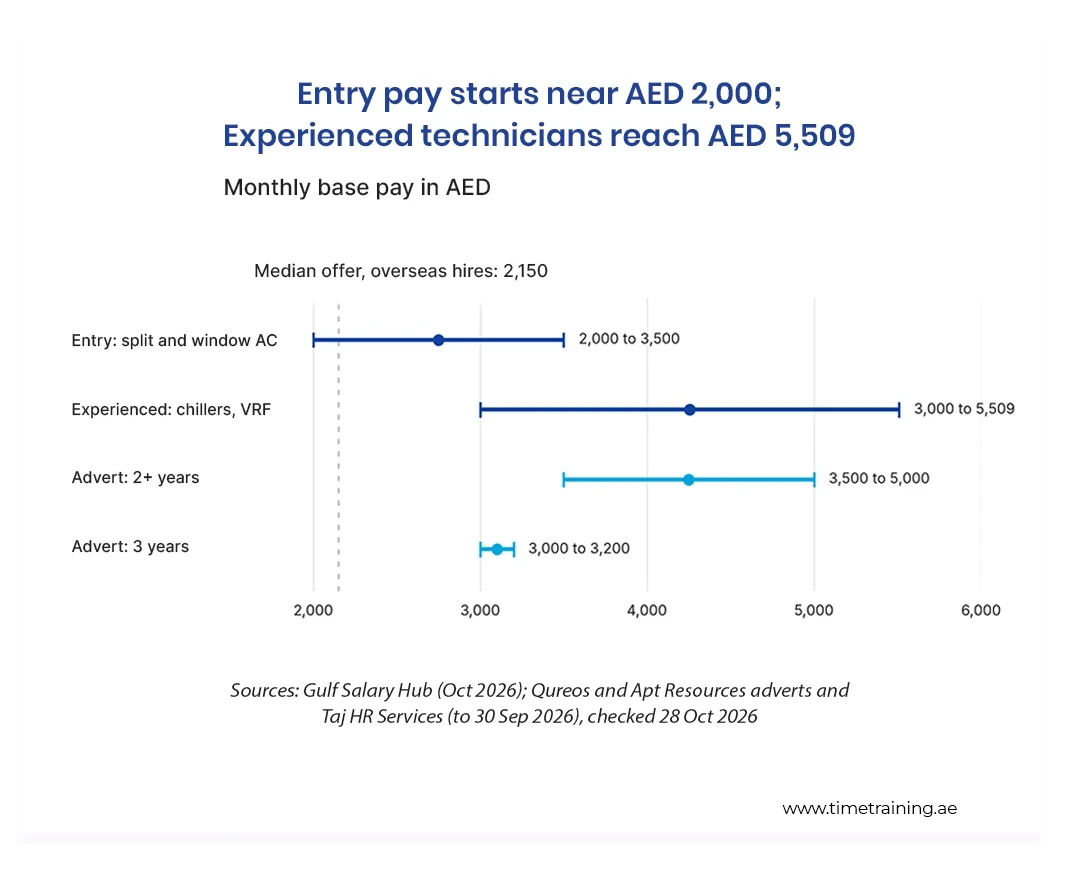
Gulf Salary Hub (Oct 2026); Qureos and Apt Resources adverts and Taj HR Services (to 30 Sep 2026), checked 28 Oct 2026
Pay climbs as you move from simple split units to chillers and VRF systems. Adverts that ask for more years of experience sit higher up the range.
A few adverts are not a salary survey, so treat these as a guide. Look at the whole package too:
-
Housing and transport: Many entry-level offers include both.
-
Summer overtime: Call-outs rise in the hottest months, so ask how overtime is paid.
-
Medical cover: Employers normally provide health insurance.
-
Air tickets: Some contracts include a return ticket every 1 or 2 years.
8. Where Can You Find HVAC Jobs, and How Do You Prepare?
Start with facilities management companies, AC contractors, hotels, hospitals and malls. Job boards such as GulfTalent and Talentmate list new roles often. Always apply to the employer directly or through a licensed agent, and never hand over your original passport.
Make your CV count:
-
Be honest: List tools and systems you have really used.
-
Show safety: Add any safety or refrigerant training.
-
Keep it short: One page is enough for a first technician role.
-
Add a practice log: Photos or notes from supervised workshop tasks help.
Common interview questions: Expect questions on how the refrigeration cycle works, how you would check a unit that is not cooling, what you do before touching electrical parts, and how you would handle a worried customer.
9. How Can You Grow Your Career as an HVAC Technician?
Most people move from helper to technician, then senior technician, then team leader. The QCC Level 4 HVAC Team Leader leads Level 2 and 3 technicians, reads shop drawings and keeps records in systems such as CMMS and BMS. Learn more with our CMMS course or Safe Isolation course.
The future also asks for new skills. Smart controls, energy-saving upgrades and lower-impact refrigerants are growing topics. If you like design, see how tools support sustainable building in our blog on Abu Dhabi building regulations and Revit. You can also explore the HVAC course in Abu Dhabi if you want to move towards design later.
10. What Mistakes Should Beginners Avoid?
The mistakes a beginner applying for HVAC Jobs should avoid are:
-
Skipping safety: Never work on live electrical parts without isolation.
-
Trusting big promises: No honest course or agent can guarantee a job.
-
Confusing certificates: A course certificate is not a government licence.
-
Weak practice: Reading alone is not enough, so get hands-on time.
-
Unverified recruiters: Check licences and keep your original documents.
-
Unrealistic pay hopes: Start with the data above, then plan your growth.
Take the Next Step
Your HVAC career starts with one clear decision. Explore our HVAC Course in Abu Dhabi at Time Training Center, check the current details and request a callback on +971 2 6713828. For more guides, visit the Learning Hub.
FAQ's
1. How do I become an HVAC technician in Abu Dhabi?
Learn HVAC basics, practise on real equipment, complete safety training and apply for helper or trainee roles. Then build experience step by step.
2. What qualifications are required in the UAE?
It depends on the role and employer. Helper jobs often need basic education. Higher roles may ask for a technical diploma or years of experience.
3. Can I become an HVAC technician without experience?
Yes, you can start as a helper or trainee. Technician adverts often ask for 2 or more years.
4. How long does HVAC training take?
Short courses take days or weeks. For example, our courses run for 24 and 30 hours. Diplomas and apprenticeships take much longer.
5. What is the average HVAC technician salary in Abu Dhabi?
Recent sources show about AED 2,000–3,500 a month at entry level and up to AED 5,509 for experienced technicians. Packages differ by employer.
6. What is the difference between an HVAC technician and an HVAC engineer?
A technician installs, services and repairs equipment. An engineer designs systems and calculates loads.
 +971 2 6713828