You can become a Primavera P6 professional in Abu Dhabi by completing accredited hands-on training, practising on real project schedules, and earning a recognised certificate, ideally from an ACTVET-licensed centre. Most working professionals reach this point in four to eight weeks, studying part-time alongside their job.
Abu Dhabi is in the middle of one of the biggest building booms in the Gulf. That means one thing for you: if you can read a schedule, spot a delay before it happens, and speak the language of Primavera P6, you are in demand right now. This guide walks you through exactly how to get there, step by step, with real Abu Dhabi numbers, costs and job data.
Table of Contents
|
|
1. Why Does Abu Dhabi Need So Many Primavera P6 Professionals?
2. What Jobs Can You Get With Primavera P6 Skills?
3. What's New in Primavera P6 Version 25.12?
4. Classroom or Online: Which Training Suits You Best?
5. What Are the Exact Steps to Become Certified?
6. How Much Does Training and Certification Cost?
7. Frequently Asked Questions
|
Why Does Abu Dhabi Need So Many Primavera P6 Professionals?
Abu Dhabi needs many Primavera P6 professionals because it is funding an infrastructure programme worth roughly AED 240 billion, and every one of those projects needs a certified scheduler to keep it on track.
The emirate recorded over 38,600 active construction licences by early 2026, and new construction registrations jumped by 66% in a single year. Across the wider UAE, the construction market is forecast to reach USD 69 billion by 2034.
On top of that, Primavera P6 is not optional here; it is the contractual scheduling standard on almost every major UAE project, and proficiency is frequently required for senior engineering work visas. Check out why Primavera P6 is essential for Civil Engineers in Abu Dhabi.
This local boom sits inside a much bigger global story. The Project Management Institute expects a shortfall of around 29.8 million project professionals worldwide by 2035, with construction facing 60–66% growth in talent demand. In the GCC, that translates into an estimated 18–22% rise in demand for certified Primavera P6 experts by 2030.
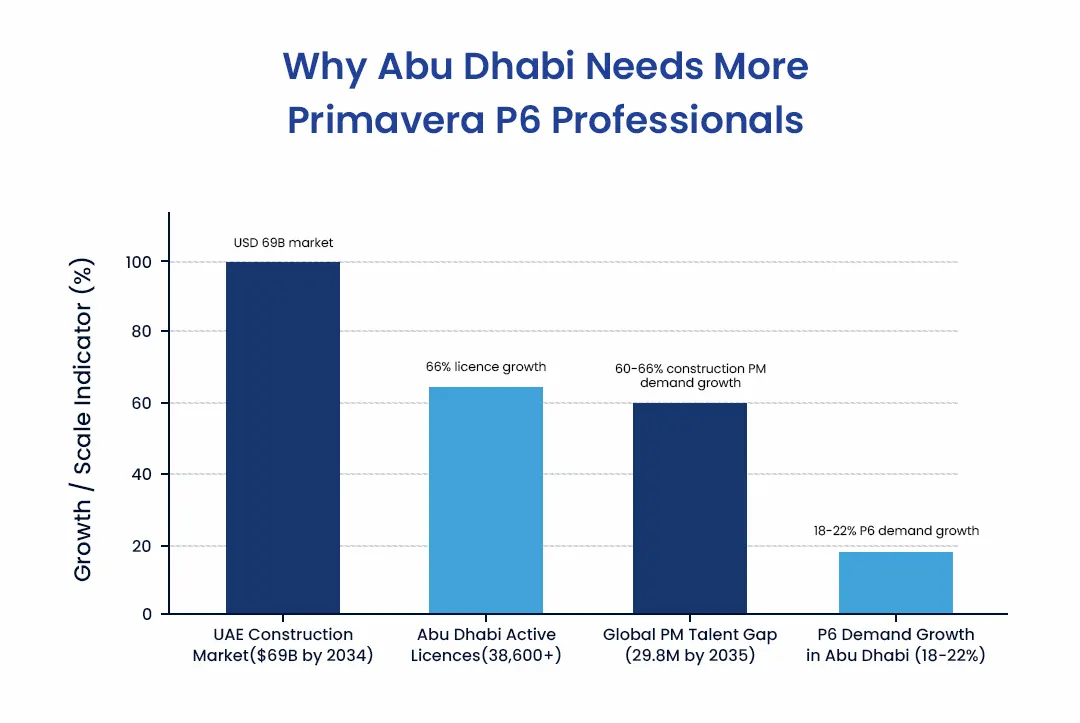
Why Primavera P6 demand keeps rising in Abu Dhabi. Sources: PMI Global Talent Gap Report 2025; UAE construction market forecasts; Abu Dhabi licensing data.
“Mastering Primavera P6 is often the tipping point that shifts a career from a purely technical site-based role to a high-value management and strategic role.”
— Sujoy Dutta, PMP
Check why you should learn Primavera and how long it takes to learn Primavera.
What Jobs Can You Get With Primavera P6 Skills?
P6-certified professionals move into Planning Engineer, Project Controls Engineer and PMO Analyst roles, with hundreds of live vacancies advertised across the UAE at any given time.
A search on Indeed UAE alone regularly shows 200+ open Primavera P6 roles, while Naukrigulf lists over 340 vacancies. Here is what each role typically does and earns in the GCC:
| Role |
What They Do |
Typical GCC Monthly Salary |
| Planning Engineer |
Builds and maintains the CPM schedule, tracks progress and flags delays. |
AED 15,000 – 30,000 |
| Project Controls Engineer |
Links schedule data to cost, risk and Earned Value Management (EVM). |
AED 18,000 – 35,000 |
| PMO Analyst |
Uses P6 as a business-intelligence tool across the whole project portfolio. |
AED 11,000 – 25,000 |
Planning Engineer vs Project Controls Engineer: What's the Difference?
A Planning Engineer focuses mainly on building and tracking the schedule itself and monitoring the critical path. A Project Controls Engineer has a wider brief, combining that schedule data with cost management, Earned Value Analysis and risk forecasting to give a full picture of project health. Many professionals start as Planning Engineers and grow into Project Controls roles as they gain P6 experience.
Can Primavera P6 help you start a career as a Project Coordinator in Abu Dhabi? Check it out!
What's New in Primavera P6 Version 25.12?
Oracle's December 2025 release (v25.12) focuses on schedule accuracy, adding out-of-sequence alerts, safer bulk edits and new labour-forecasting fields.
-
Out-of-Sequence (OOS) Alerts: Warn you the moment a status update breaks logical sequencing, such as starting a task before its predecessor finishes.
-
Global Change Previews: Let's you check every row a bulk-edit rule will change before you apply it, cutting the risk of costly data errors.
-
Estimate Time to Complete (ETC) fields: Forecasts remaining effort based on real labour performance, so you can catch overruns early.
-
Baseline Variables in Report Headers: Automatically shows which baseline (Project, Primary, Secondary) a report is measuring against.
Learning these features properly matters because employers now expect candidates to know the current release, not an older version. It is one of the reasons up-to-date, instructor-led training beats self-teaching from old tutorials.
Classroom or Online: Which Training Suits You Best in Abu Dhabi?
Both formats lead to the same recognised certificate, so the right choice depends on your schedule, not the label on the course.
| Factor |
Classroom Training |
Online Training |
| Best for |
Fresh graduates, hands-on learners |
Shift workers, busy professionals |
| Biggest advantage |
Face-to-face feedback, local networking |
No commute, replay recorded sessions
|
| Completion speed |
Fixed batch schedule |
Up to 40–60% faster reported |
| Retention |
Strong, instructor-led |
Up to 25–60% higher in digital formats
|
| Certificate |
ACTVET / Oracle-recognised |
ACTVET / Oracle-recognised |
If you're a site coordinator on rotating shifts, online or blended training removes the guesswork of matching a fixed class time to an unpredictable roster. If you're new to the industry, a classroom seat with immediate instructor correction can help the fundamentals stick faster.
“Primavera is only a tool. It is your project management knowledge and scheduling skills that determine the quality of the schedule.”
— Paul E. Harris, author of the Planning and Control series
What Are the Exact Steps to Become a Certified Primavera P6 Professional?
Here are six steps you can follow to become a Certified Primavera P6 Professional. Start by learning the fundamentals, then train with an accredited provider, practise on real schedules, sit the certification exam, add a complementary credential, then apply for roles.
-
Build your foundation: Get comfortable with basic project management ideas: Work Breakdown Structure (WBS), Critical Path Method (CPM) and simple scheduling logic. An engineering background helps, but isn't compulsory.
-
Join an accredited course: Enrol in a Primavera P6 Professional programme. Time Training Centre's Primavera P6 Course in Abu Dhabi runs across roughly 18–24 hours and covers EPS, WBS, CPM scheduling, resource and cost management, baselining and Earned Value Management.
-
Practise on real project data: Work through reflection projects and EPC-style case studies so you can apply P6 to genuine construction, oil & gas or infrastructure scenarios, not just theory.
-
Sit your certification exam: This can be the Oracle-recognised exam or an ACTVET-aligned assessment through your licensed training centre.
-
Consider a complementary credential: Many professionals pair P6 with PMP or PMI-SP to strengthen their profile for senior planning and project controls roles.
-
Apply with confidence: Update your CV with specific P6 skills (CPM scheduling, EVM, resource levelling) and start applying to Planning Engineer or Project Controls roles across Abu Dhabi's active projects.
Check Out: What are the Roles and Responsibility of Primavera p6 professionals
How Much Does Primavera P6 Training and Certification Cost in the UAE?
Expect to pay roughly AED 1,200 to AED 6,000 for training, plus USD 245 (+5% VAT) if you sit the official Oracle exam. The cost of the Primavera P6 Training and Exam is given in the table below:
| Item |
Typical Cost |
| Foundation course (approx. 12 hours) |
From AED 1,200 |
| Professional-level course (approx. 18–24 hours) |
Up to AED 6,000 |
| Oracle certification exam |
USD 245 + 5% VAT (via Pearson VUE) |
Always check that your training provider is a licensed centre issuing ACTVET or Oracle-aligned certificates. This is what UAE employers actually check, not whether you studied online or in person.
Ready to Start Your Primavera P6 Journey?
Abu Dhabi's AED 240 billion project pipeline isn't slowing down, and neither is demand for people who can schedule it properly. Whether you choose classroom, online or blended learning, the fastest way forward is structured, accredited training with real project practice.
Frequently Asked Questions
How long does it take to learn Primavera P6?
Most learners complete a foundation-to-professional pathway in four to eight weeks of part-time study, combining course hours with independent practice on sample schedules.
Is Primavera P6 certification worth it in Abu Dhabi?
Yes. It is widely treated as a baseline requirement for senior planning and project controls roles in the GCC, and is sometimes required for work visa eligibility, given its status as the contractual scheduling standard on major projects.
Do I need an engineering degree to learn Primavera P6?
No. An engineering background helps you apply P6 faster, but Time Training Center's courses are also designed for fresh graduates and career-changers with no prior scheduling experience.
Are online Primavera P6 certificates accepted by employers in Abu Dhabi?
Yes. Employers focus on whether the certificate comes from a licensed ACTVET or Oracle-aligned centre, not whether you trained in a classroom or online.
What jobs currently need Primavera P6 in Abu Dhabi?
Planning Engineer, Project Controls Engineer, Project Scheduler, and PMO Analyst roles across construction, oil & gas and infrastructure regularly list Primavera P6 as a mandatory skill, with 200+ live vacancies typically visible on major UAE job boards at any time.
 +971 2 6713828

1.jpeg)