To start a career in Artificial Intelligence, begin with programming and data fundamentals, then build your knowledge of AI and Machine Learning before choosing a specialisation. You do not need to learn every AI technology at once. A structured approach, learning programming, understanding data, practising Machine Learning, building AI projects, and developing a portfolio can help you progress towards your target AI role.
Artificial Intelligence is becoming an important part of modern business and technology, with applications across healthcare, finance, manufacturing, logistics, cybersecurity, education, and customer service. As adoption grows, organisations need professionals who can build, manage, analyse, and apply AI systems.
So, what should you learn first to start a career in AI? This guide provides a practical AI learning roadmap for beginners, including the skills, courses, projects, certifications, and career choices you should consider.
Why Start a Career in AI?
AI is changing how organisations develop products, analyse information, automate processes, and make decisions. According to the World Economic Forum, employers expect 39% of workers' existing skill sets to be transformed or become outdated between 2025 and 2030. AI and big data are identified as the fastest-growing skills during this period.
The same report identifies AI and Machine Learning specialists among the fastest-growing roles globally. This does not mean every AI-related job requires advanced programming. The field includes technical and business-facing opportunities. The right choice depends on your existing skills and the type of work you want to do.
Read: How AI is Transforming Jobs and Industries in the UAE by 2031
What Should You Learn First for an AI Career?
Before choosing a specialisation, build the core skills that most AI paths have in common. If you are starting from scratch, follow this learning sequence:
-
Learn Python for AI
-
Build foundations in mathematics and statistics.
-
Learn data analysis and SQL.
-
Understand fundamental Artificial Intelligence and Machine Learning concepts.
-
Learn how to train and evaluate Machine Learning models.
-
Move into Deep Learning.
-
Learn Generative AI, Prompt Engineering, and modern AI tools.
1. Learn Python for AI
Python is the practical starting point for most technical AI roles. You do not need to become a full software engineer first. Start by getting a beginner-friendly Python Training and focus on:
-
Variables, data types, operators
-
Conditionals and loops
-
Functions
-
Lists, tuples, dictionaries
-
File handling and exception handling
-
Modules, packages, and basic object-oriented programming
Once comfortable, work with key libraries for data and AI. The goal is to achieve practical fluency, including writing programs that process data, perform calculations, automate tasks, and solve real problems and not just memorise syntax.
2. Build Mathematics and Statistics Foundations
You can start coding before mastering advanced maths, but mathematics becomes essential as you progress into Machine Learning and Deep Learning.
Prioritise:
-
Algebra and functions
-
Probability and descriptive/inferential statistics
-
Linear algebra (vectors, matrices)
-
Basic calculus and optimisation concepts
A Machine Learning engineer typically needs deeper mathematical understanding than someone applying AI tools inside a business role. Match depth to your target job.
3. Learn Data Analysis and SQL
AI systems are only as good as the data they use. Learn Data Analysis, including basic of how data is collected, cleaned, stored, explored, and interpreted.
Key Data Analysis skills:
-
Data cleaning and missing-value handling
-
Exploratory data analysis and visualisation
-
Basic SQL
-
Feature selection and data preparation
-
Clear data storytelling
These skills are especially valuable if you lean toward Data Science.
4. Understand Artificial Intelligence Fundamentals
Clarify the landscape before diving into models:
-
Artificial Intelligence vs Machine Learning vs Deep Learning vs Generative AI
-
Predictive AI and automation
-
Core concepts: training data, features, models, inference, evaluation
This foundation makes later topics far easier to absorb.
5. Learn Machine Learning
With Python and data skills in place, focus on Machine Learning.
Cover:
-
Supervised and unsupervised learning
-
Classification, regression, clustering
-
Feature engineering
-
Train/test splits, cross-validation
-
Model evaluation, overfitting, and underfitting
Understand why an algorithm fits a problem and how to judge whether the model is useful, not just how to call a library function.
6. Move into Deep Learning
After solid Machine Learning foundations, explore:
-
Neural networks, activation and loss functions
-
Optimisation and backpropagation
-
Training/validation practices
-
Convolutional neural networks
-
Transformer architectures
Deep Learning matters most for Computer Vision, NLP, speech, and advanced Generative AI work.
7. Learn Generative AI and Prompt Engineering
Learn generative AI models and understand how it create or transform text, images, audio, video, code, and structured data.
Practical topics include:
-
Large language models and embeddings
-
Retrieval-augmented generation (RAG)
-
AI APIs and agents
-
Prompt engineering
-
Model evaluation and responsible AI
Prompt engineering is useful but is not a complete foundation. Pair it with programming, data skills, domain knowledge, or software development for stronger career options.
Which AI Career Path Should You Choose After Learning AI?
There is no single AI career path for everyone. Choose based on your interests, background, and career goals. The following are some popular career paths;
| Career Path |
Key Skills |
| AI Engineer |
Python, Machine Learning, Deep Learning, APIs, Cloud, Generative AI
|
| Machine Learning Engineer |
Machine Learning, Python, Mathematics, MLOps, Data Pipelines
|
| Data Scientist |
Python, Statistics, SQL, Data Science, Machine Learning
|
| Generative AI Specialist |
LLMs, Prompt Engineering, RAG, Embeddings, APIs
|
| NLP Specialist |
NLP, Machine Learning, Deep Learning
|
| Computer Vision Specialist |
Deep Learning, Image Processing, Computer Vision
|
Choose one area to specialise in rather than trying to master every AI technology. Many top training institutes offer AI courses that can be customised according to career goals and needs.
What AI Projects Should Beginners Build?
Practical projects help demonstrate that you can apply your AI skills.
| Level |
Project Examples
|
| Beginner |
House price prediction, customer churn, spam classification, sales forecasting, sentiment analysis
|
| Intermediate |
Recommendation systems, fraud detection, image classification, demand forecasting, document classification
|
| Generative AI |
Q&A systems, knowledge assistants, research assistants, customer-support chatbots, RAG applications
|
Focus on solving a clear problem rather than building projects simply because they seem advanced.
Read: How to Start a Career in Artificial Intelligence in Abu Dhabi
Do You Need an AI Course for Beginners?
You can learn independently, but structured AI courses can provide a clear curriculum, guided practice, instructor support, and practical projects.
What Should an Artificial Intelligence Course Include?
Look for an Artificial Intelligence course that covers:
-
Python
-
Data fundamentals
-
Machine Learning
-
Deep Learning
-
Generative AI
-
AI tools
-
Practical projects
-
Model evaluation
-
Real-world applications
What Should You Look for in AI Training?
Good AI training should balance theory with practical application. Before enrolling, check the:
-
AI Course Curriculum
-
Trainer expertise
-
Hands-on projects
-
Learning format
-
Assessment methods
-
Certification
-
Career support
-
Industry relevance
Also ensure the course content is regularly updated to reflect changes in AI technology.
Check Out: Top AI Courses in Abu Dhabi for Beginners & Professionals
Is AI Certification Necessary for an AI Career?
An AI certification can support your professional profile, but it should not be the main goal of your learning. Certification can help demonstrate structured training. It does not automatically demonstrate that you can build or deploy an AI system. A stronger career profile combines:
AI skills + practical projects + portfolio + relevant certification
Before choosing an AI certification, ask:
-
Is the curriculum relevant to my target role?
-
Does the program include practical work?
-
Is the assessment meaningful?
-
Does it cover current AI technologies?
-
Will the credential add value to my existing qualifications?
For a beginner, practical capability should come before collecting multiple certificates.
What AI Jobs Can Beginners Target?
Your first role does not necessarily need to have "AI" in its title. Depending on your skills, you may consider:
The appropriate entry point depends on your education, previous experience, technical skills, and portfolio. Do not assume that completing one AI course means you are qualified for every AI job. Instead, match your skills to the requirements of a specific role.
Read: How to Become an AI Engineer in Abu Dhabi: Step-by-Step Guide
What Is the Future of AI Jobs UAE?
The Future of AI jobs in the UAE will be influenced by AI adoption, digital transformation, workforce development, regulation, and business investment. For aspiring professionals, this means building transferable skills rather than depending on a single AI tool.
The UAE is actively developing its knowledge economy and future skills agenda. The UAE's National Employment Strategy 2031 specifically includes artificial intelligence among value-added economic sectors and emphasises future-skills training, lifelong learning, talent development, and attracting skilled professionals.
Focus on Programming, Data, Machine Learning, AI application development, Analytical thinking, Problem-solving, communication, and Responsible AI. These capabilities can remain useful as specific platforms and tools evolve.
How Long Does It Take to Start a Career in AI?
There is no fixed timeline. Your progress will depend on your existing knowledge, learning schedule, and career goal. The following framework provides a practical starting point:
| Timeline |
Learning Stage |
Key Focus Areas |
Goal |
| Months 1–2 |
Build the Foundation |
Python, Mathematics, Statistics, Data fundamentals |
Develop the core technical knowledge needed for AI
|
| Months 3–4 |
Learn Machine Learning |
Machine Learning algorithms, Data preparation, Model evaluation, Practical exercises |
Understand how Machine Learning models are developed and evaluated
|
| Months 5–6 |
Specialise and Build |
Machine Learning, Data Science, Deep Learning, NLP, Computer Vision, or Generative AI |
Choose a career direction and begin building portfolio projects
|
| After 6 Months |
Become Job-Ready |
Advanced projects, Deployment skills, AI tools, Interview skills, Portfolio development, Networking, Relevant certification |
Demonstrate practical skills and prepare for suitable AI jobs
|
How Should You Continue Learning After the AI Basics?
Completing an AI course is not the end of your AI learning roadmap. Once you have the fundamentals, continue by:
-
Following developments in AI
-
Building more complex projects
-
Reading technical documentation
-
Experimenting with new AI tools
-
Improving your programming
-
Learning deployment
-
Exploring cloud technologies
-
Studying responsible AI
-
Following developments in your chosen specialisation
The goal is to become an adaptable AI professional, not someone who knows only one platform.
Conclusion
If you are wondering how to start a career in AI, the most effective approach is to learn in stages. Begin with Python, mathematics, statistics, and data. Then move into Machine Learning and Deep Learning. After that, explore Generative AI, Prompt Engineering, and AI tools.
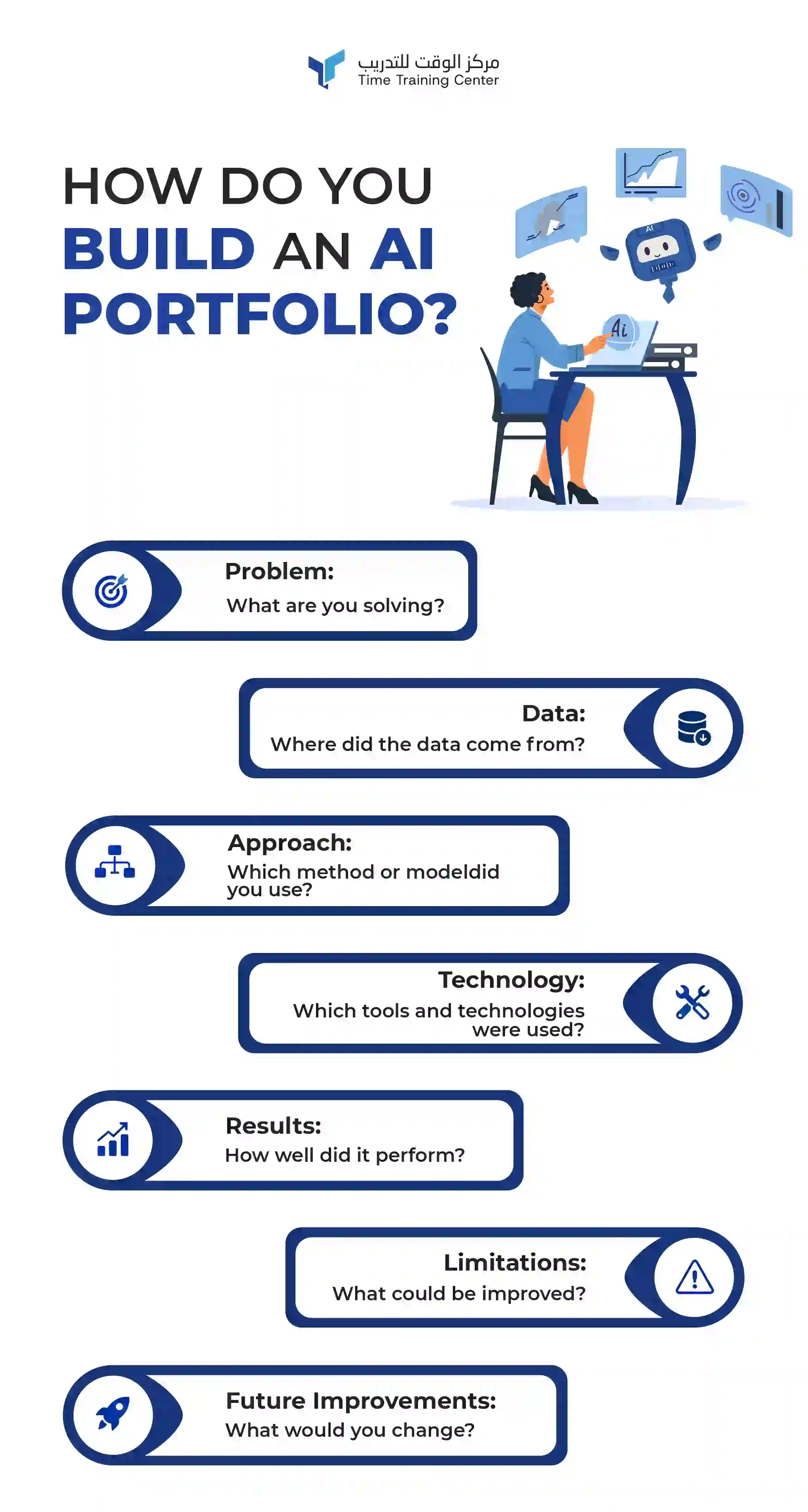
Once you understand the fundamentals, choose a specialisation that matches your career objective. Then focus heavily on practical application. Build AI projects. Document them. Create an AI portfolio. Develop communication and problem-solving skills. Consider relevant AI training or certification when it supports your career goal. The most important lesson is simple: Do not try to learn all of AI. Learn the fundamentals, choose a direction, build practical skills, and keep developing.
Find Out: How Time Training Prepares You for a Successful AI Career in Abu Dhabi
FAQ's
1. Can I learn AI while working full-time?
Yes. Many learners study AI alongside their existing jobs. A consistent schedule is usually more important than studying for long hours occasionally. Set weekly learning targets and divide your time between theory, coding, and practical projects.
2. What should I do if I have never written code before?
Start with basic programming rather than jumping directly into Machine Learning. Learn Python syntax, logic, functions, and data structures first. Once you can write simple programs independently, move into data analysis and Machine Learning.
3. How can I stay updated as AI technology changes?
Follow official documentation, technical publications, reputable research organisations, and developments from major AI platforms. Focus on understanding concepts rather than chasing every new tool. A strong foundation makes it easier to adapt to new technologies.
4. Can AI skills help me in a non-technical career?
Yes. AI can complement existing expertise in areas such as finance, marketing, healthcare, education, operations, and management. The combination of AI knowledge and domain expertise can help professionals identify and implement useful AI applications.
5. How can I demonstrate my AI skills during a job interview?
Use specific examples from your projects. Explain the problem, your approach, the tools you selected, the results, and the limitations. Be prepared to discuss decisions you made rather than simply describing the technologies you used
 +971 2 6713828