About Our Advanced IoT Development Course in Abu Dhabi
Time Training Center's 30-hour Advanced IoT Development course in Abu Dhabi helps learners build foundational IoT knowledge to create cloud-connected embedded systems using the versatile Raspberry Pi and Python platforms.
The course equips participants with the practical skills in Python programming, hardware interfacing, and cloud integration, specifically for IoT applications. The training is designed for developers, engineers, and technical professionals seeking to implement professional-grade IoT solutions.
Our IoT training in Dubai includes extensive hands-on laboratory sessions focused on Linux system operations, communication protocols, and cloud connectivity. Learners gain real-world experience using Raspberry Pi hardware, Python libraries, and Firebase cloud database. The IoT course covers essential embedded networking concepts, including SPI, I2C, and UART protocols, Cloud Integration Business Impact, and Device Set-up. These are critical for reliable device communication in IoT environments. Participants also work with analogue-to-digital conversion.
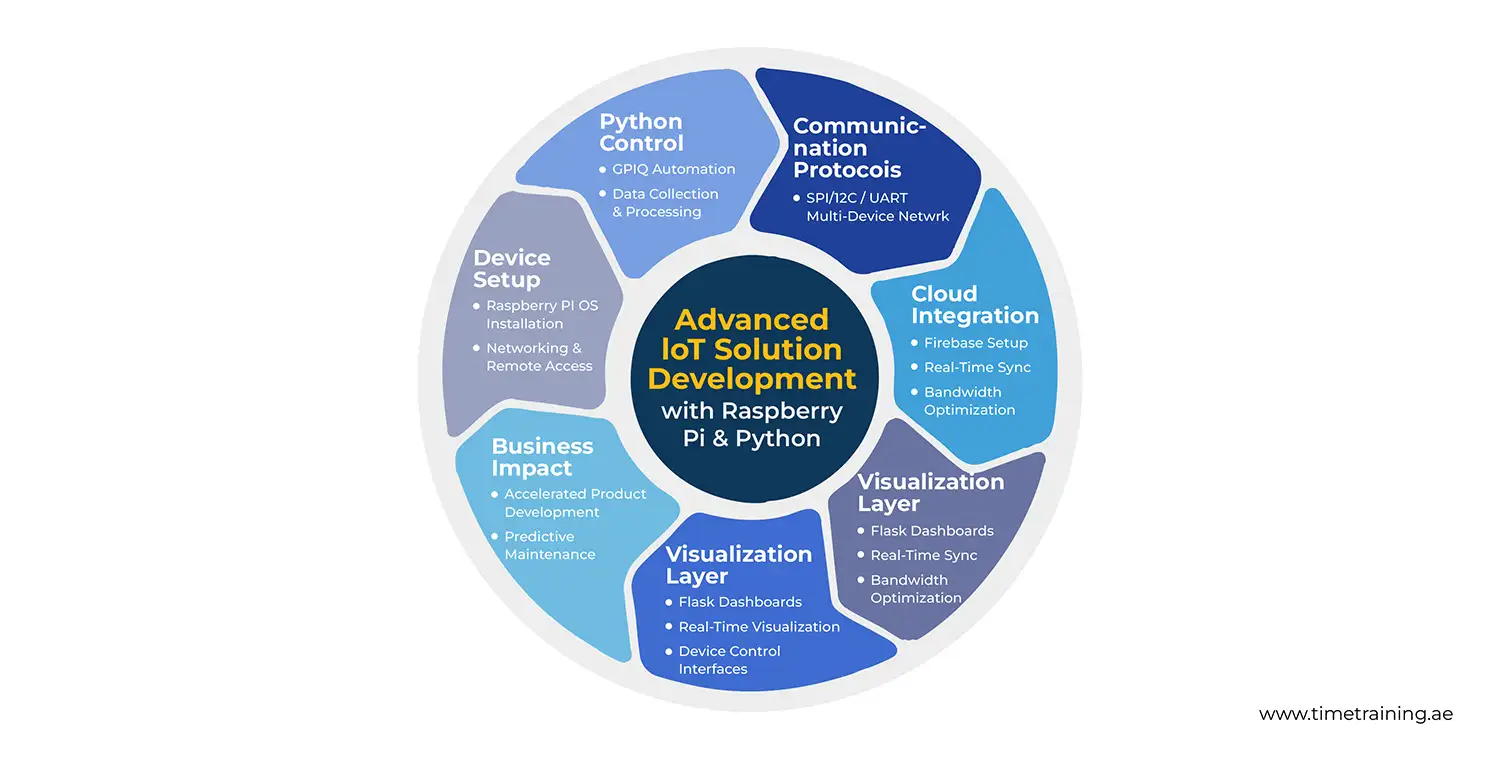
Students learn to design complete IoT solutions from hardware configuration to cloud deployment and user interface development. These skills are directly applicable to industrial automation, smart buildings, agricultural technology, and consumer IoT products. Organisations benefit from enhanced technical capabilities for digital transformation initiatives and IoT-driven process improvements
Industry-Specific Embedded Networks Training Approach
At Edoxi, we apply a domain-based IoT training approach focused on practical, application-driven learning. Each sector integrates key Raspberry Pi IoT concepts relevant to its needs. Some industry-specific approaches in our training include;
| Industry Sector |
Primary Focus |
Key Application Areas
|
| Industrial Automation |
Process Monitoring & Control |
• Factory Floor Automation • Predictive Maintenance • Production Monitoring
|
| Smart Building Technology |
Environmental Systems |
• HVAC Control • Energy Management • Security Integration
|
| Agricultural Technology |
Remote Sensing Networks |
• Irrigation Automation • Crop Monitoring • Weather Data Collection
|
| Energy Management |
Data Acquisition Systems |
• Power Consumption Analysis • Load Balancing • Grid Monitoring
|
| Robotics Applications |
Embedded Control Systems |
• Motion Control • Sensor Fusion • Real-time Data Processing
|
What You Will Learn from the Advanced IoT Development Course in Abu Dhabi?
Linux System Operations for Embedded IoT: Learn essential Linux commands and system management specifically optimised for Raspberry Pi environments. Configure networking settings and manage file systems for IoT applications.
Python Programming for IoT Automation: Master Python libraries like RPi.GPIO and gpiozero for hardware interfacing and automation. Develop efficient scripts for data collection, processing, and device control.
SPI, I2C, and UART Communication Protocols: Implement industry-standard communication protocols between the Raspberry Pi and peripheral devices. Configure bidirectional data transfer across multiple sensors and controllers.
ADC/DAC Integration Techniques: Connect analogue sensors and actuators using digital-to-analogue and analogue-to-digital converters. Process real-world signals and implement control systems using Python libraries.
Firebase Cloud Connectivity Solutions: Deploy IoT systems with real-time cloud database integration for remote monitoring and control. Implement secure data transfer between embedded devices and cloud infrastructure.
Interactive Web Dashboard Development: Create responsive web interfaces using a modern framework for IoT system visualization and control. Design custom dashboards displaying real-time data from connected Raspberry Pi networks.
Features of the Advanced IoT Development Course in Abu Dhabi
- Raspberry Pi Hardware Lab Environment: Get access to fully-equipped workstations with Raspberry Pi boards, sensors, and peripherals for hands-on learning and prototyping.
- Python Libraries for Hardware Control: Master RPi.GPIO and gpiozero libraries for interfacing with sensors, motors, and other hardware components.
- Communication Protocol Implementation Labs: Learn to configure and test SPI, I2C, and UART interfaces for reliable data exchange between microcontrollers and peripherals.
- Firebase Cloud Database Integration: Develop secure cloud connectivity solutions for real-time data storage, synchronisation, and remote system monitoring.
- Group Troubleshooting Sessions: Collaborate on debugging exercises and resolve embedded network challenges in an interactive lab environment.
Skills Covered in Time’s Advanced IoT Development with Raspberry Pi and Python Course in Abu Dhabi
Time Training Center in Abu Dhabi offers advanced IoT development courses incorporating Raspberry Pi and Python, focusing on hands-on projects for building IoT prototypes, sensor integration, and cloud connectivity.
- Raspberry Pi setup, OS installation, booting, and GPIO programming for input/output control.?
- Python programming fundamentals, including scripting for sensors, data processing, and automation.?
- Sensor and actuator interfacing (e.g., DHT for temperature/humidity, motion detectors) with real-time data logging and visualisation.?
- IoT communication protocols, networking, cloud integration (e.g., AWS deployment), and publish-subscribe architecture.?
- Building projects like anti-theft systems, atmosphere monitoring, smart home automation, web servers, and email notifications for sensor data.?
- Data transfer to cloud platforms, TCP/UDP client-server setups, and security basics for IoT devices.
Prerequisites for Joining Edoxi’s Advanced IoT Development with Raspberry Pi and Python Course in Abu Dhabi
There are no strict prerequisites for this course. However, it is recommended that learners have:
- Basic programming knowledge (Python or C)
- Understanding of basic electronics principles
- Familiarity with IoT concepts.
These skills help participants progress quickly in the technical modules and practical sessions.
Advanced IoT Development Course Module
Module 1: Linux and System Foundations
- Chapter 1.1: Introduction to Raspberry Pi and Operating Systems
- Lesson 1.1.1: Explore Raspberry Pi hardware and supported operating systems
- Lesson 1.1.2: Install and configure Raspberry Pi OS
- Lesson 1.1.3: Set up networking and remote access using SSH
- Chapter 1.2: Linux Essentials for IoT Development
- Lesson 1.2.1: Navigate the Linux file system and directory structure
- Lesson 1.2.2: Use essential terminal commands for device interaction
- Lesson 1.2.3: Manage users, permissions, and background processes
- Chapter 1.3: Software Management on Raspberry Pi
- Lesson 1.3.1: Install and update system packages with APT
- Lesson 1.3.2: Configure environment variables and system settings
- Lesson 1.3.3: Schedule and automate tasks using Cron
Module 2: Programming and Device Control
- Chapter 2.1: Python for IoT Programming
- Lesson 2.1.1: Set up Python and IDEs on Raspberry Pi
- Lesson 2.1.2: Work with RPi.GPIO and gpiozero libraries
- Lesson 2.1.3: Implement digital input and output controls
- Chapter 2.2: Peripheral Communication with Python
- Lesson 2.2.1: Interface with devices using SPI protocol
- Lesson 2.2.2: Communicate with multiple sensors via I2C
- Lesson 2.2.3: Use UART for serial communication with external modules
- Chapter 2.3: Python Scripting for IoT Automation
- Lesson 2.3.1: Write scripts to automate hardware tasks
- Lesson 2.3.2: Handle errors and debug hardware-related code
- Lesson 2.3.3: Log sensor data to CSV and JSON files
Module 3: Hardware Integration and Interfaces
- Chapter 3.1: Interfacing Techniques and Protocols
- Lesson 3.1.1: Connect Raspberry Pi to Arduino for hybrid projects
- Lesson 3.1.2: Use DACs for generating analogue signals
- Lesson 3.1.3: Capture analogue sensor input with ADCs
- Chapter 3.2: Sensor Networks and Real-Time Control
- Lesson 3.2.1: Monitor real-time sensor values on Raspberry Pi
- Lesson 3.2.2: Control actuators based on sensor thresholds
- Lesson 3.2.3: Design multi-device communication systems
Module 4: Cloud and Web Integration
- Chapter 4.1: Cloud Platforms for IoT
- Lesson 4.1.1: Understand Firebase Realtime Database and Firestore
- Lesson 4.1.2: Send and retrieve IoT data using cloud APIs
- Lesson 4.1.3: Design scalable cloud data structures
- Chapter 4.2: Building Cloud-Connected Systems
- Lesson 4.2.1: Build alert systems for cloud-based notifications
- Lesson 4.2.2: Display cloud data on Raspberry Pi dashboards
- Lesson 4.2.3: Apply basic security practices for cloud-linked IoT devices
Module 5: Web Interfaces and Visualization
- Chapter 5.1: Web Server Development on Raspberry Pi
- Lesson 5.1.1: Create RESTful APIs for device communication
- Lesson 5.1.2: Deploy local and cloud-based web applications
- Chapter 5.2: Interactive Dashboards and Control Panels
- Lesson 5.2.1: Design dashboards to visualize real-time sensor data
- Lesson 5.2.2: Integrate Firebase with web interfaces
- Lesson 5.2.3: Develop control panels for actuator management
Module 6: System Integration and Project Development
- Chapter 6.1: Advanced IoT Architectures
- Lesson 6.1.1: Combine SPI, I2C, and UART in one system
- Lesson 6.1.2: Design hybrid systems using Raspberry Pi and Arduino
- Lesson 6.1.3: Manage scalability for multiple IoT devices
- Chapter 6.2: IoT Security and Deployment
- Lesson 6.2.1: Apply IoT security practices for hardware and cloud
- Lesson 6.2.2: Perform threat modeling and secure communication
- Lesson 6.2.3: Encrypt data and implement authentication mechanisms
- Chapter 6.3: Capstone Project and Implementation
- Lesson 6.3.1: Plan, prototype, and develop a real-world IoT solution
- Lesson 6.3.2: Collaborate in teams and manage project workflows
- Lesson 6.3.3: Present final project with demonstration and documentation
Real-World Projects in Time’s Advanced IoT Development Course in Abu Dhabi
You will deepen your understanding of IoT and Embedded Networks through comprehensive hands-on projects. These practical sessions strengthen technical problem-solving and system development skills in real-world applications.
- Smart Agriculture System with Multi-Sensor Monitoring: Create an automated farming system with soil sensors, irrigation control, and a cloud-based monitoring dashboard using a Raspberry Pi.
- Raspberry Pi-Based Home Security and Intrusion Detection System: Build a security network with motion sensors, cameras, and notifications that provide real-time monitoring and alert capabilities.
- Industrial IoT Network for Remote Monitoring and Control: Develop an industrial automation system for remote sensor monitoring and actuator control through secure cloud-based interfaces.
- IoT Health Tracker with Wearable Sensors: Design a health monitoring platform connecting wearable sensors to Firebase databases with visualisation dashboards for biometric analysis.
- Smart Energy Management System with Real-Time Web Interface: Construct a power monitoring system with current sensors that displays real-time usage data and enables automated control.
- Weather Station with Local Logging and Cloud Reporting: Create a multi-parameter weather monitoring station with local storage capability and cloud synchronisation for remote data access.
- Cloud-Controlled Robotic Arm with Web Dashboard: Build a servo-driven robotic arm with web-based position control, movement sequencing, and remote operation capabilities.
Professional Benefits & Outcomes of the Advanced IoT Development with Raspberry Pi and Python Course in Abu Dhabi
Time Training Center's Advanced IoT Development Course enhances your:
- Python Programming Proficiency
- Embedded Linux System Skills
- Hardware Communication Expertise
- Cloud Integration Capabilities
- Interactive Dashboard Development
- Analogue Sensor Integration Techniques
Organisations can expect measurable improvements in IoT capability and innovation:
- Enhanced Digital Transformation Capabilities
- Accelerated IoT Product Development Cycles
- Improved Data Collection and Analysis Systems
- Advanced Remote Monitoring Solutions
- Reduced Dependency on External IoT Consultants
- Strengthened Technical Innovation Leadership
Job Roles After the Advanced IoT Development Course
- IoT Developer
- Embedded Systems Technician
- IoT Engineer
- Cloud Integration Specialist
- IoT Solutions Architect
- Embedded Systems Manager
Companies Hiring Advanced IoT Development Professionals in Abu Dhabi
- Etisalat Digital
- Technology Innovation Institute (TII)
- Toshiba EMEA
- ZEDEDA
- Siemens
- IBM Middle East
Advanced IoT Development Training Options
| Training Options |
Training Features |
| Classroom Training |
- 30 Hour Advanced IoT Development Course in Abu Dhabi
- Hands-On Raspberry Pi Programming Labs
- Interactive Protocol Configuration Sessions
- Real-Time Cloud Integration Projects
- Small Group Technical Mentoring
|
| Classroom Training |
- 30 Hour Online Advanced IoT Development Course
- Remote Access to Raspberry Pi Systems
- Interactive Python Programming Demonstrations
- Virtual Lab Environment for Testing
- Flexible Scheduling
|
| Corporate Training |
- Customised 3-Day Intensive Programs
- Flexible Delivery Options (On-Site / Edoxi Office / Hotel)
- Fly-Me-a-Trainer Option
- Industry-Specific Application Focus
- Team-Based Project Development Approach
|
Why Choose Time Training Center for the Advanced IoT Development Course in Abu Dhabi
Here are a few reasons why you should choose Time for the Advanced IoT Development Course in Abu Dhabi;
- Specialised IoT Laboratory Environment: Our dedicated lab features Raspberry Pi workstations, extensive sensor collections, and pre-configured cloud connectivity for immediate hands-on learning without setup delays.
- Industry Expert Trainers: Learn from experienced professionals with extensive expertise in Raspberry Pi development, Python programming, and cloud-based IoT solutions.
- Project-Based Learning Methodology: Every concept taught is reinforced through practical implementation in real-world IoT scenarios, ensuring students build working systems rather than theoretical knowledge.
- Trusted Corporate Training Partner: Time Training Center delivers customised programs for organisations across Abu Dhabi, focusing on industry-specific IoT implementations.
- Premium Technical Facilities: Our advanced learning environment features modern technology, comfortable settings, and purpose-built spaces designed specifically for IoT development.
- Strategic Location Advantage: Our Training Center in Abu Dhabi is situated near the Madinat Zayed shopping centre and offers excellent accessibility for professionals.
Meet Your Expert Trainer
Zaitoon
Zaitoon specialises in developing intelligent IoT solutions that integrate artificial intelligence, cloud computing, and embedded systems. His expertise covers platforms such as Raspberry Pi and ESP32/8266, focusing on scalable, real-time data applications.
He holds certifications including Google Cloud Certified Associate Cloud Engineer, Microsoft Certified: Azure AI Fundamentals, IBM AI Engineering Professional Certificate, and Stanford’s Machine Learning Specialisation. His experience bridges theory with real-world deployment, enabling students to build efficient, secure IoT systems for diverse applications.
 +971 2 6713828