To start a career in AI in Abu Dhabi, you need the following four skill sets: foundational skills such as Python, mathematics and data handling; technical skills in Machine Learning, Deep Learning and Generative AI; practical skills built through real projects and a portfolio; and soft skills such as communication, critical thinking and adaptability. Coding helps, but it is not the only route in. Many AI-adjacent roles reward strong data literacy, business understanding and clear communication just as much as programming ability.
Abu Dhabi is not simply watching this shift from the sidelines. The Abu Dhabi Government Digital Strategy 2025–2027 and the UAE National Strategy for Artificial Intelligence 2031 are pushing the emirate towards becoming an AI-native economy. This initiative is backed by an AED 13 billion digital infrastructure investment and a national ambition for AI to contribute around 20% of non-oil GDP by 2031. That momentum is opening genuine, structured career paths for students, IT professionals and career changers alike, not only for people who already know how to code.
This guide sets out the skills that matter for an AI career in Abu Dhabi in 2026-27. It explains how that skill demand is expected to change through 2030 and beyond, and finishes with a simple, beginner-friendly roadmap you can follow starting this week.
|
Table of Contents
|
|
1. The AI Skills You Need in 2026-27: A Quick-Reference Table
2. Python, Maths and Data: Your Foundation
3. Machine Learning, Deep Learning, Generative AI and Prompt Engineering
4. AI Tools, Projects and Building Your Portfolio
5. How AI Skill Demand May Shift from 2027 to 2030
6. The UAE's 2031 Vision and Abu Dhabi's AI-Native Government
7. Durable Skills vs Fast-Changing Skills
8. AI Career Paths and Opportunities in Abu Dhabi
9. A Simple AI Learning Roadmap for Beginners
10. Beyond 2030: What AI Careers Might Look Like by 2036
11. How Time Training Center Can Support Your AI Career
12. Questions People Often Ask About AI Careers in Abu Dhabi
13. Key Takeaways
|
The AI Skills You Need in 2026-27: A Quick-Reference Table
Before going deeper, here is the 2026-27 baseline. Employers hiring for AI-related roles in the UAE, including Abu Dhabi, currently look for a mix of foundational, technical and human skills rather than one single 'AI skill'. The table below outlines the top AI skills, why having these skills matters, and their demand in 2026 and 2027.
| Skill |
Category |
Why it matters |
2026-27 demand
|
| Python programming |
Foundational |
The standard language behind most AI and data tools |
Very High |
| AI literacy & fundamentals |
Foundational |
Understanding how AI models work and their limits |
Very High |
| Data analysis & SQL |
Foundational |
Most AI projects start with cleaning and querying data |
High |
| Statistics & mathematics |
Foundational |
Underpins Machine Learning and model evaluation |
High |
| Machine Learning |
Technical |
Core discipline behind prediction and classification tools |
High |
| Generative AI & LLMs |
Technical |
Fastest-growing area of AI adoption across sectors |
Very High |
| Prompt engineering |
Technical |
A practical, learnable skill for using AI tools well |
High |
| AI tools proficiency |
Practical |
Using tools like Copilot, ChatGPT or Power BI productively |
High |
| Communication & critical thinking |
Soft skill |
Needed to explain AI outputs and judge their accuracy |
Very High |
Source: skill patterns drawn from PwC's 2026 Global AI Jobs Barometer (UAE analysis, published 15 June 2026) and current Abu Dhabi/UAE AI-role job listings.
Python, Maths and Data: How to Build Your Foundation in AI?
Python remains the most requested programming skill across Abu Dhabi and wider UAE AI job listings, and for good reason. Check out the top seven reasons why Python is so popular. It is the language behind the majority of Machine Learning libraries, data pipelines and Generative AI tools used today. You do not need to master every corner of it. A working knowledge of Python basics, along with libraries used for data handling, is generally enough to start.
Mathematics and statistics sit underneath almost every AI concept, from how a Machine Learning model learns to how confident you should be in its output. SQL and data analysis skills matter just as much, since most AI projects begin with messy, real-world data rather than a clean dataset.
Together, these foundational skills explain why PwC's 2026 Global AI Jobs Barometer found that skills required for AI-exposed roles in the UAE are changing around 2.5 times faster than for other roles; employers increasingly expect a baseline of technical fluency even in non-engineering positions.
How to Progress with Machine Learning, Deep Learning, Generative AI and Prompt Engineering?
Once the foundations are in place, most AI learning paths follow a natural progression. Machine Learning teaches a system to recognise patterns in data. Deep Learning, a more advanced branch, uses layered neural networks to handle complex tasks such as image recognition or language understanding.
Generative AI, built on these same principles, produces new text, images or code rather than simply classifying data. This is the technology behind tools such as ChatGPT and Microsoft Copilot.
Prompt engineering has emerged as a genuinely practical, learnable skill sitting on top of all this. It is the ability to communicate clearly with an AI model to get a useful, accurate result, and it is relevant to far more than software engineers.
Abu Dhabi's own digital transformation programme illustrates the scale of this shift: the government has deployed more than 200 AI-driven solutions as part of the Digital Strategy 2025– 2027, most of them built on Machine Learning, Generative AI and automation.
How to Move On with AI Tools, Projects and Building Your Portfolio?
AI tools can genuinely speed up how you learn, practise and work. They work best as a support to fundamental skills rather than a replacement for them. Here are the top Generative AI Tools for you to check out. Employers can generally tell the difference between someone who understands what a model is doing and someone who is simply copying prompts.
This is where practical projects matter.
A small Machine Learning model, a Generative AI chatbot, or a data dashboard built from a real dataset demonstrates far more to a hiring manager than a certificate alone. As hiring shifts towards a skills-first approach globally, with a growing share of employers relaxing formal degree requirements for specific roles, a visible portfolio on a platform such as GitHub is becoming a genuine differentiator for career changers entering AI without a technical degree.
How AI Skill Demand May Shift from 2027 to 2030?
The skills above form a solid 2026 baseline, but AI careers reward people who plan a few years. The World Economic Forum's Future of Jobs Report 2025, based on a survey of more than 1,000 global employers, offers the most widely cited forecast horizon to 2030. It is a global study rather than an Abu Dhabi-specific one, but it points to a clear direction of travel that regional hiring data increasingly echoes.
The Shift in AI Skills Demand from 2026 to 2030 Outlook
| Skill area |
2026 status |
2027–2030 outlook |
Confidence |
| AI & data literacy |
Very High demand |
Named the fastest-growing skill category globally to 2030 |
High |
| Analytical & critical thinking |
High demand |
Remains among the top two fastest-growing skills through 2030 |
High |
Generative AI & prompt
engineering |
High demand |
Expected to broaden from specialist to mainstream workplace use |
Moderate |
| AI agents & automation |
Emerging in 2026 |
Job postings for agentic AI skills rose 986% between 2023 and 2024 |
Emerging |
| AI governance & ethics |
Medium demand |
Likely to grow as more autonomous systems reach production |
Moderate |
Human skills (leadership,
creativity) |
High demand |
Flagged by WEF as a durable differentiator as routine tasks automate |
High |
Sources: World Economic Forum, Future of Jobs Report 2025 (global forecast to 2030); agentic AI job-posting growth figure from 2026 workforce transformation research. Global figures, presented as forecasts, not confirmed Abu Dhabi statistics.
How The UAE's 2031 Vision and Abu Dhabi's AI-Native Government Help Your AI Career?
Beyond 2030, the clearest signal for AI careers in the UAE comes from government policy rather than private-sector forecasting. The UAE National Strategy for Artificial Intelligence 2031 sets a national ambition for the UAE to become a global AI leader, targeting an estimated AED 335 billion in added economic value and roughly 20% of non-oil GDP from AI. It is supported by large-scale talent programmes, including national initiatives to train UAE residents in practical AI skills. See the top AI skills in demand in Abu Dhabi.
At the Abu Dhabi level, the Digital Strategy 2025–2027 is backed by an AED 13 billion investment delivered through a sovereign cloud partnership with Microsoft and Core42 (a G42 company), targeting full automation of government processes and an estimated AED 24 billion contribution to Abu Dhabi's GDP by 2027. Ahmed Hisham Al Kuttab, Chairman of Abu Dhabi's Department of Government Enablement, has spoken about how this kind of technology is reshaping government services to be more efficient and responsive for residents.
The UAE's 2031 Vision and Target
| Horizon |
Type |
Key figure/target |
Source |
| 2025–2027 |
Abu Dhabi policy target |
AED 13bn investment; AED 24bn projected GDP contribution; 5,000+ new jobs |
Abu Dhabi
Digital Strategy 2025–2027
|
| 2031 |
UAE national policy target |
AED 335bn added economic value; ~20% of non-oil GDP from AI |
UAE National
AI Strategy
2031 |
| 2031 |
UAE talent target |
National programme to train large numbers of residents in practical AI skills |
UAE AI for All / national talent initiatives
|
| 2032–2035 |
Long-range scenario |
Continued growth in agentic AI, AI governance and multi-agent systems roles |
Emerging
evidence —
treat as
directional, not a confirmed
forecast
|
Government figures are policy targets, not guaranteed employment forecasts. They indicate direction and investment, not a promise of individual job outcomes.
For a deeper look at how this national strategy connects to specific sectors and career paths, see our detailed guide to the UAE AI Strategy 2031 and its career impact.
Durable Skills vs Fast-Changing Skills- A Comparison of AI Skills
A common mistake beginners make is learning only today's most popular tool. Tools change quickly; the thinking behind them tends to last far longer.
Building an adaptable AI career means prioritising the skills on the left of this table, while treating the skills on the right as things to refresh regularly rather than master once.
Durable AI Skills vs Fast-Changing AI Skills
| Durable skills (likely to stay valuable) |
Fast-changing skills (need regular refreshing)
|
| Mathematics & statistics fundamentals |
Syntax of a specific AI tool or platform
|
| Programming logic and problem-solving |
Today's most popular Generative AI model
|
| Data literacy and analytical thinking |
Exact prompt formats and prompting trends
|
| Communication and domain expertise |
Specific software interfaces and dashboards
|
| AI ethics, evaluation and responsible use |
Individual cloud platform certifications
|
| Adaptability and lifelong learning habits |
Framework-specific coding shortcuts
|
What are the AI Career Paths and Opportunities in Abu Dhabi?
Abu Dhabi's AI ecosystem extends well beyond government. Hub71, the emirate's flagship technology ecosystem, hosts hundreds of active start-ups, with a large majority of its most recent intake building products around AI across healthcare, finance and climate technology.
Its dedicated Hub71+ AI programme was created specifically to support AI-focused founders and teams. Combined with the priority sectors named in the UAE AI Strategy 2031 — energy, logistics, tourism, healthcare and cybersecurity. This points to a wide, and widening, range of entry points for people with the right AI skills. Check out what AI skills Abu Dhabi employers are seeking. In the table below, see the AI career and the top sectors hiring these skills.
AI Career Paths and Opportunities in Abu Dhabi
| Role |
Typical entry point |
Relevant sectors in Abu Dhabi
|
| AI/Machine Learning Engineer |
Python, ML fundamentals, a portfolio project |
Technology, Hub71 start-ups,
government tech
|
| Data Analyst / Data Scientist |
SQL, statistics, data visualisation tools |
Finance, energy, government, logistics
|
| AI or Prompt Specialist |
Prompt engineering, Generative AI tools |
Marketing, customer service,
professional services
|
| AI Business Analyst |
AI literacy plus a business or domain background |
Government, banking, healthcare
|
| AI Governance/Ethics support roles |
AI fundamentals plus policy or
compliance awareness |
Government, financial services,
healthcare
|
A Simple AI Learning Roadmap for Beginners
You do not need to learn everything at once. This step-by-step order reflects how most successful AI career changers in the UAE, including here in Abu Dhabi, tend to build their skills.
-
Build your foundation: Spend time on Python basics, everyday statistics and simple data handling before touching advanced tools.
-
Learn core AI and Machine Learning concepts: Understand how models are trained, tested and evaluated, even at a beginner level.
-
Get hands-on with Generative AI and prompt engineering: Practise using popular AI tools for real, everyday tasks.
-
Build two or three small projects: A simple prediction model, a chatbot, or a data dashboard, published where employers can see it.
-
Pursue a recognised AI certification: Structured training brings order to self-taught knowledge and signals credibility to employers.
-
Apply for entry-level or transitional roles while continuing to learn: AI knowledge compounds quickly once you are working with it daily.
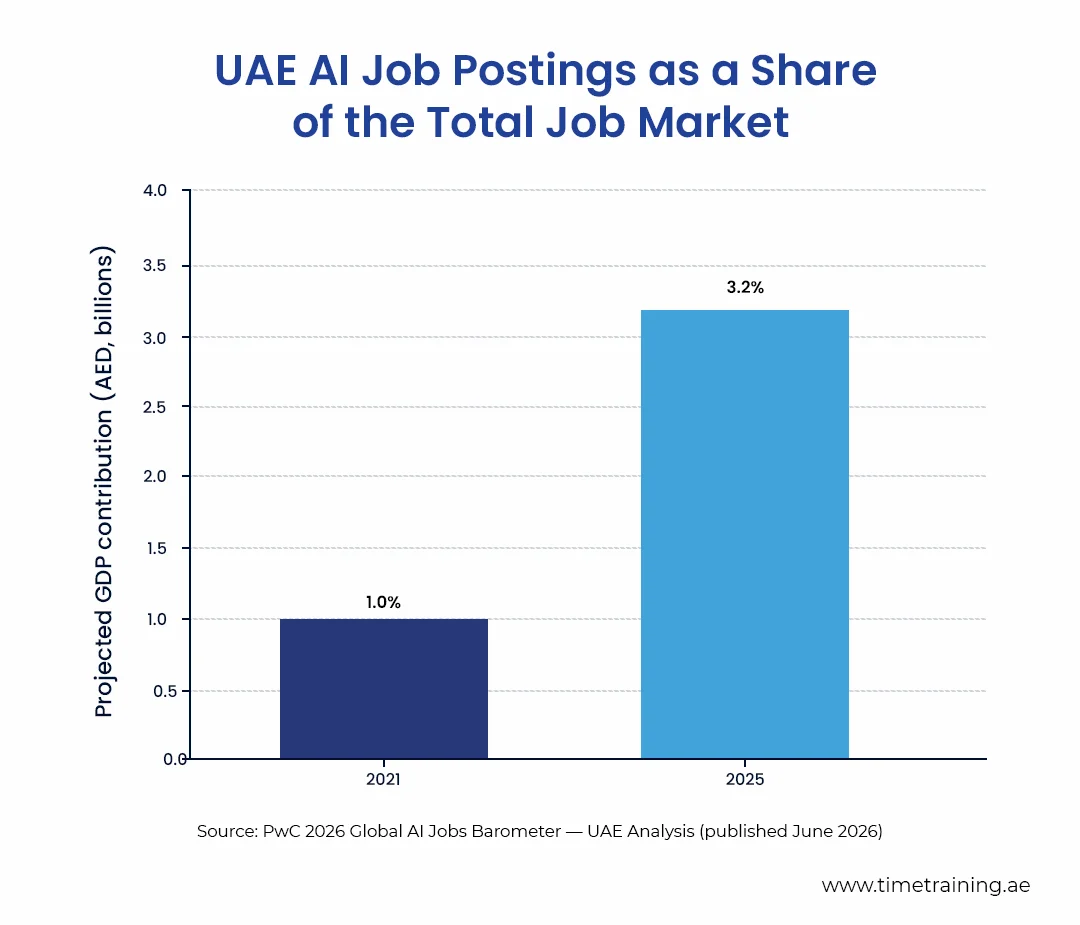
UAE AI Job Postings Are Rising Fast
The chart below shows how quickly AI-related hiring has grown as a share of the total UAE job market, based on PwC's 2026 Global AI Jobs Barometer.
Beyond 2030: What AI Careers Might Look Like by 2036?
Reliable job-market numbers become harder to find the further out you look, so this section focuses on direction rather than figures. Current evidence points towards continued growth in agentic AI, where systems pursue a goal with limited human supervision, along with growing attention to AI governance, AI security and human-AI collaboration as these systems move into everyday business use. This trend suggests that professionals who pair strong AI fundamentals with judgement, ethics and adaptability are likely to remain in demand, even as the specific tools in use change several times over.
The most useful mindset for a beginner in Abu Dhabi is this: master the durable foundations now, then add emerging capabilities such as Generative AI, AI agents and AI governance as the market evolves around you, rather than trying to predict exactly which tool wins next.
How Time Training Center Can Support Your AI Career
Building AI skills alone, from scattered videos and articles, generally takes longer and leaves gaps that employers notice. Time Training Center's Artificial Intelligence Training in Abu Dhabi is structured around exactly the foundations and technical skills covered in this guide, from Python and data fundamentals through to Machine Learning, Generative AI and prompt engineering, with practical, workplace-ready outcomes rather than theory alone.
Whether you are a fresh graduate, an IT professional planning a move into AI, or a working professional upskilling for your current role, our AI Training in Abu Dhabi is designed to take you from the basics through to a genuinely usable, in-demand skill set. You may also find it useful to browse further reading on AI, data and technology careers on our Learning Hub.
FAQ's
1. Do I need to know how to code to start an AI career in Abu Dhabi?
No, not always. Coding helps for engineering-focused roles, but AI business analyst, AI-literate marketing and data-facing roles often value data literacy, communication and domain knowledge just as much as programming.
2. Is Python necessary for an AI career, or can I start with a different language?
Python is the most widely requested language across Abu Dhabi and UAE AI job listings, largely because most Machine Learning and Generative AI tools are built around it. It is the most practical starting point for most beginners.
3. Which AI certification is best for beginners in Abu Dhabi?
The best certification for a beginner is one that covers AI fundamentals, Python, data handling and Generative AI together, with practical projects rather than theory alone, such as Time Training Center's AI training programme.
4. How long does it typically take to build enough AI skills for a career change?
This varies by starting point and time invested, but a structured, practical training path generally moves a motivated beginner from fundamentals to a workable, portfolio-ready skill set faster than self-study alone.
5. Are AI jobs actually available in Abu Dhabi right now, in 2026?
Yes. UAE job postings requiring AI skills rose by around 2,700 between 2024 and 2025, according to PwC's 2026 Global AI Jobs Barometer, with Abu Dhabi's Digital Strategy and Hub71 ecosystem adding further AI-related opportunities across government and start-ups.
6. What is the real difference between AI, Machine Learning and Generative AI?
AI is the broad field of building systems that perform tasks associated with human intelligence. Machine Learning is a method within AI where systems learn patterns from data. Generative AI is a further branch that creates new text, images or code, rather than only classifying or predicting.
Key Takeaways
-
Foundations first: Python, mathematics, statistics and data analysis underpin nearly every AI role in Abu Dhabi.
-
Layer on technical skills: Machine Learning, Deep Learning, Generative AI and prompt engineering build naturally on those foundations.
-
Coding is not mandatory for every path: business, communication and domain expertise matter for many AI-adjacent roles.
-
Abu Dhabi's momentum is real: the Digital Strategy 2025–2027 and UAE AI Strategy 2031 are backing genuine, growing career pathways.
-
Durable skills outlast tools: analytical thinking, ethics and adaptability tend to matter longer than any single AI platform.
-
Projects beat theory: a small, real portfolio project demonstrates capability far more convincingly than a certificate alone.
 +971 2 6713828