Hey! So, why is Python such a big player in artificial intelligence (AI)? Well, it’s really easy to read and super flexible, which makes it perfect for tackling complex tasks. Plus, it comes with the largest collection of machine learning tools of any programming language. That's why you’ll find it powering almost every major AI system out there today.
In 2025, the number of developers using Python jumped from 50.9% to 57.9%. That’s the largest single-year rise for any major programming language ever! This wasn’t just a random change; the growing field of AI largely drove it.
Areas like Machine Learning, Data Science, and even Generative AI tap into Python because its libraries handle all the tricky math, allowing engineers to focus on solving real-world problems without getting bogged down by complicated coding.
Now, let’s talk about Abu Dhabi. They’re making strides to become a leader in AI, and guess what? Python has become the go-to language for anyone wanting to jump into this exciting field.
If you're considering a Python course or just want to explore where to start with AI skills, this guide will help you understand why Python is a top choice, which key skills and libraries to focus on, and how to begin your learning journey right here in the UAE. Read on; exciting stuff ahead!
|
Table of Contents
|
|
1. Why Is Python So Important for Artificial Intelligence?
2. How Does Python Compare With Other Languages Used in AI?
3. How Does Python Power Machine Learning and Data Science?
4. How Is Python Used in Generative AI?
5. Which Python Libraries Should You Learn for AI?
6. What Python Skills Do You Need for an AI Career?
7. What AI Career Opportunities Can Python Skills Unlock in the UAE?
8. How Can Beginners Learn Python for AI?
9. Why Is Abu Dhabi a Great Base for Building Your Python and AI Career?
10. What Beginner Python AI Projects Can You Start With?
11. Frequently Asked Questions
12. More Questions People Ask About Python and AI Careers
13. Your Next Step Towards an AI Career Starts With Python
|
Why Is Python So Important for Artificial Intelligence?
Python is super important for AI because it’s really easy to read and understand, like talking in plain English. This simplicity helps new developers dive in without feeling overwhelmed. Plus, Python has a ton of libraries that handle all the complicated math behind machine learning, so developers can focus on creating and testing their models instead of getting stuck fixing tricky coding errors.
Here are a few key reasons why Python stands out in the AI world:
-
Readability first: Python code reads almost like plain instructions, which matters hugely when AI projects involve large, collaborative teams reviewing each other's work.
-
A genuinely massive community: with over 22.9 million active developers worldwide and roughly a million more joining every year, help, tutorials and troubleshooting are never far away.
-
An unmatched library ecosystem: more than 815,000 packages are available on the Python Package Index, meaning most AI tasks already have a tested, ready-made tool.
-
Built for speed where it counts: newer Rust-based tools such as uv now handle Python's package management up to 100 times faster, so performance is no longer a real drawback.
You know, even the creator of Python, Guido van Rossum, has pointed out how closely Python and AI have been developing together. In a recent interview on GitHub, he said something like, "Python isn’t just the language for AI; it helped AI become what it is today." This isn't just a catchy phrase; it really captures how both have evolved hand in hand over the past ten years or so. It’s pretty cool how one has helped the other grow!
How Does Python Compare With Other Languages Used in AI?
It strikes a great balance between being easy to learn and having a strong set of libraries that help with AI tasks. Other languages like R, Java, and C++ each have their strengths, but they tend to fall short in at least one area compared to Python.
So, if you're looking to dive into AI, Python is your most practical choice!
Comparison of Python with other languages used in AI
| Language |
Ease for Beginners |
AI/ML Library Support |
Best Suited For |
| Python |
Very high with readable syntax |
Extensive (PyTorch, TensorFlow, Scikit-learn) |
General-purpose AI, ML, Data Science, GenAI
|
| R |
Moderate with statistics-focused |
Strong for statistics, narrower for deep learning |
Academic research and statistical analysis
|
| Java |
Moderate with verbose syntax |
Decent, but fewer AI-specific libraries |
Large-scale enterprise systems
|
| C++ |
Low with a steep learning curve |
Used to build AI engines, not for daily coding |
High-performance model execution
|
How Python compares with other languages commonly used in AI development.
It's worth being clear about one thing: Python isn't the only language AI runs on. Frameworks like TensorFlow and PyTorch actually use C++ under the bonnet for speed, and Java still powers many large enterprise systems. But when it comes to writing, testing and iterating on AI models day to day, Python remains the language most teams reach for first. See the top seven reasons why Python is popular with developers.
How Does Python Power Machine Learning and Data Science?
Python powers Machine Learning and Data Science because it has powerful libraries like Pandas, NumPy, PyTorch, TensorFlow, and Scikit-learn. These tools are the go-to choices for most professionals in the field. They make building ML models easier and more efficient. That's why Python is so popular!
The graph below shows how popular are Python Tools among the developers.
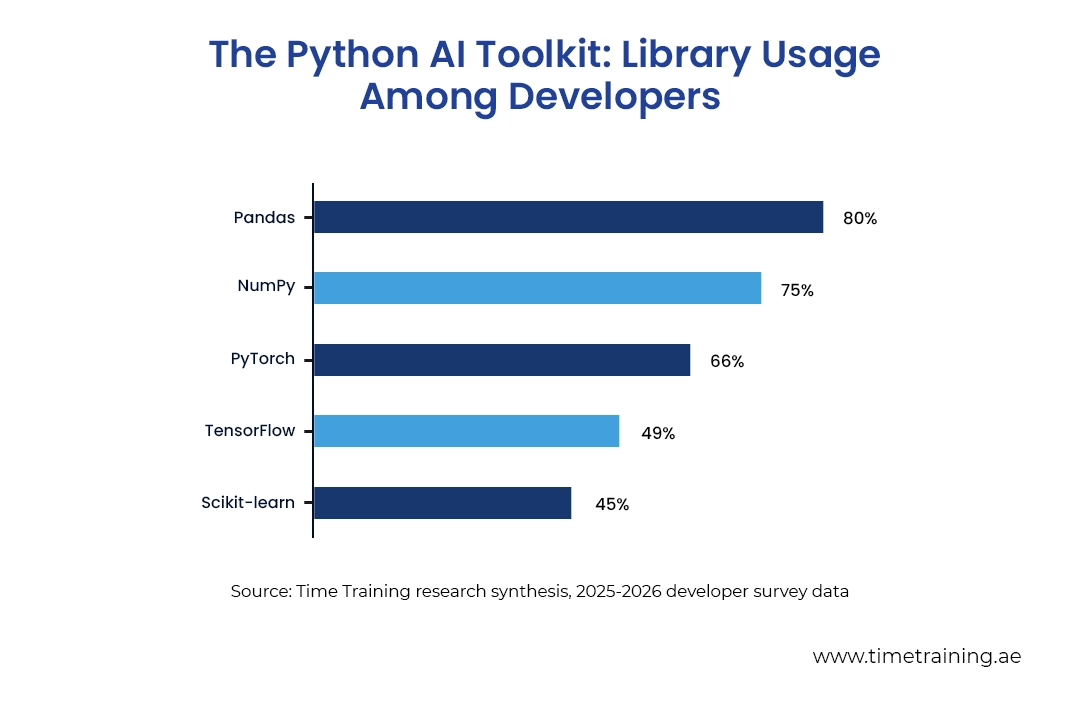
Share of AI and Data Science developers using each major Python library.
In practice, this means:
-
Data Science relies on Pandas and NumPy to clean, reshape and analyse datasets before any model ever sees the data.
-
Machine Learning uses Scikit-learn for classical algorithms like regression and clustering, and PyTorch or TensorFlow for deep learning and neural networks.
-
Model deployment increasingly happens through FastAPI, now used by 38% of professional Python developers building AI-powered applications and APIs.
For anyone starting, this is genuinely good news: you don't need to master every library at once. Most learners begin with Pandas and NumPy for data handling, then move into Scikit-learn before tackling deep learning frameworks, a natural, manageable progression rather than an overwhelming leap.
How Is Python Used in Generative AI?
Python sits at the centre of Generative AI because the frameworks used to build chatbots, image generators and language models (Hugging Face, LangChain and Keras among them) are all Python-first by design.
Generative AI covers tools that create new content: text, images, code or audio, based on patterns learned from huge datasets. When you use a chatbot, an AI writing assistant, or an image generator, Python is almost certainly running somewhere in that pipeline. Two ideas are worth understanding early on, since they come up constantly in AI job descriptions:
-
Neural networks — layered systems loosely inspired by the brain, which learn patterns from data rather than following fixed rules.
-
RAG (Retrieval-Augmented Generation) — a method that connects a language model to an external knowledge base, so its answers are more accurate and up to date. It's currently one of the most sought-after skills for senior AI engineers.
Generative AI is also where the GCC region is investing heavily. The UAE's own Falcon LLM project, developed under the Technology Innovation Institute in Abu Dhabi, is a Python-built large language model, proof that this isn't a distant, foreign trend but something happening in the local job market right now.
Which Python Libraries Should You Learn for AI?
The Python libraries worth learning for AI depend on your goal, but five consistently appear across almost every job description and beginner roadmap: NumPy, Pandas, Scikit-learn, TensorFlow and PyTorch.
Python Libraries You Should Learn for AI
| Library |
What It Does |
Where You'll Use It
|
| NumPy |
Handles fast numerical and array-based computation |
Foundation for almost every AI/ML task
|
| Pandas |
Organises, cleans and analyses tabular data |
Data preparation and exploration
|
| Scikit-learn |
Provides ready-made classical ML algorithms |
Regression, classification, clustering
|
| TensorFlow |
Builds and trains large-scale deep learning models |
Production-grade AI systems
|
| PyTorch |
Offers flexible, research-friendly deep learning tools |
Generative AI and research projects
|
What Python Skills Do You Need for an AI Career?
You need a working mix of core programming skills and applied data skills to move into AI, not mastery of every advanced concept on day one. Employers consistently look for the same foundational set:
-
Core Python fundamentals – This includes variables, loops, functions, and object-oriented basics.
-
Data handling – It’s about comfortably using Pandas and NumPy to clean and explore datasets.
-
Basic statistics and maths – This skill is enough to understand what a model is actually doing, not a full maths degree.
-
Familiarity with at least one ML library – Scikit-learn is the natural starting point.
-
Version control – This skill can be achieved using GitHub to track, share and collaborate on code, now the most desired collaboration tool among developers.
-
Problem-solving mindset – It’s about having the ability to break a messy, real-world problem into steps a model can actually learn from.
Notice what's missing from that list: nothing there requires years of experience. It's a realistic, buildable skill set, which is precisely why Python remains the most accessible entry point into AI careers for students, career changers and working professionals alike. And that’s why Python remains one of the top AI skills in demand in Abu Dhabi.
What AI Career Opportunities Can Python Skills Unlock in the UAE?
Python skills open doors across a genuinely wide range of AI-related roles in the UAE, from junior data analyst positions through to specialised Generative AI engineering. The demand across Abu Dhabi and Dubai continues to grow as the country's national AI strategy scales up. See the UAE AI Strategy in 2031: Key opportunities, industries and careers created and impacted.
The graph below shows how Python Adoption for AI is increasing.
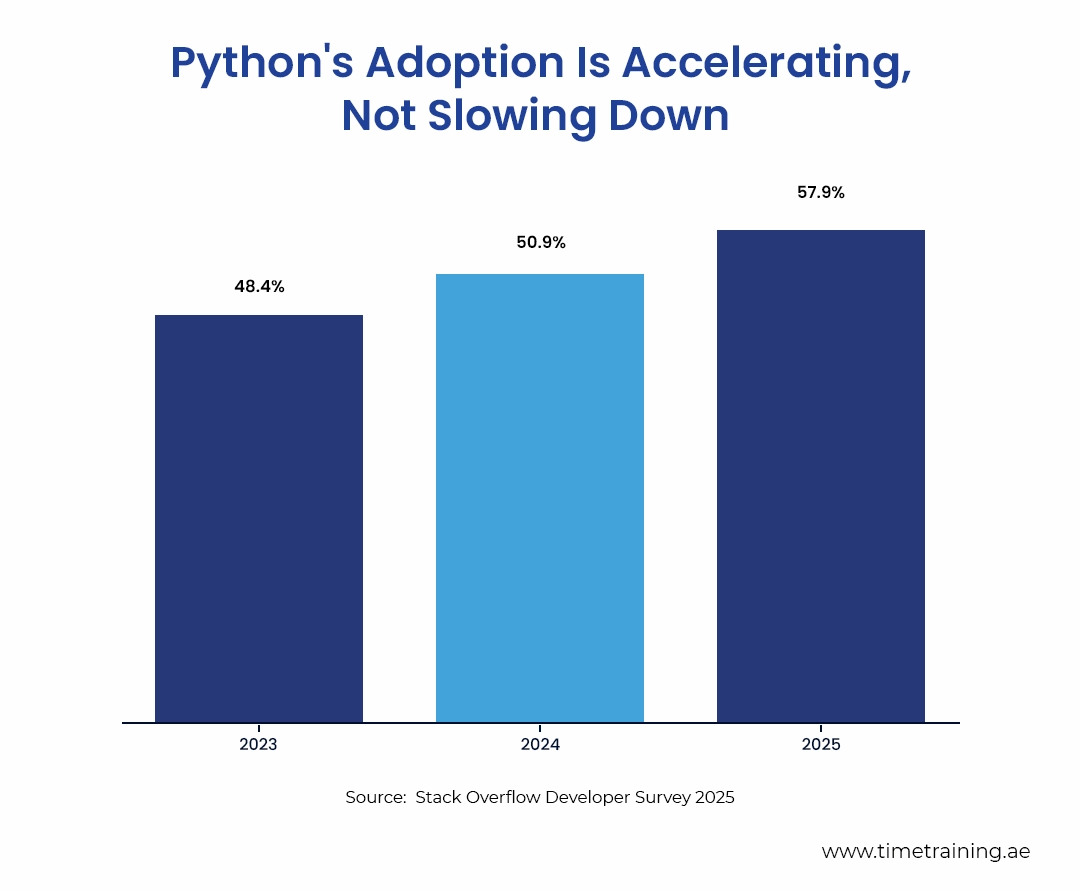
Global developer adoption of Python, 2023–2025.
UAE job portals and regional salary reports show that AI-related roles requiring Python span a broad range, generally rising with experience and specialisation. These figures vary considerably by employer, sector and negotiated package, so treat any single number as a guide rather than a guarantee:
The table below shows the demand for Python skills for AI careers by experience level and focus areas.
| Experience Level |
Typical Focus Areas
|
| Entry-level (0–3 years) |
Data pipelines, model support, junior analyst work
|
| Mid-level (3–6 years) |
Production deployment, applied ML, NLP or CV projects
|
| Senior (6–10 years) |
Architecting AI/LLM systems, technical leadership
|
| Principal / Lead (10+ years) |
AI strategy, sovereign AI projects, research direction
|
Broad experience bands for Python-related AI roles in the UAE market.
Abu Dhabi in particular has become a regional hub for sovereign AI, through organisations such as G42 and the Technology Innovation Institute. While, Dubai's commercial sector focuses more on fintech, e-commerce and logistics applications. Python underpins both.
One point is worth repeating honestly: Python skills alone don't guarantee a job. Employers consistently want to see practical projects and a portfolio (not just a certificate) alongside your programming ability.
Check out what career opportunities an AI Engineer in Abu Dhabi can get.
How Can Beginners Learn Python for AI?
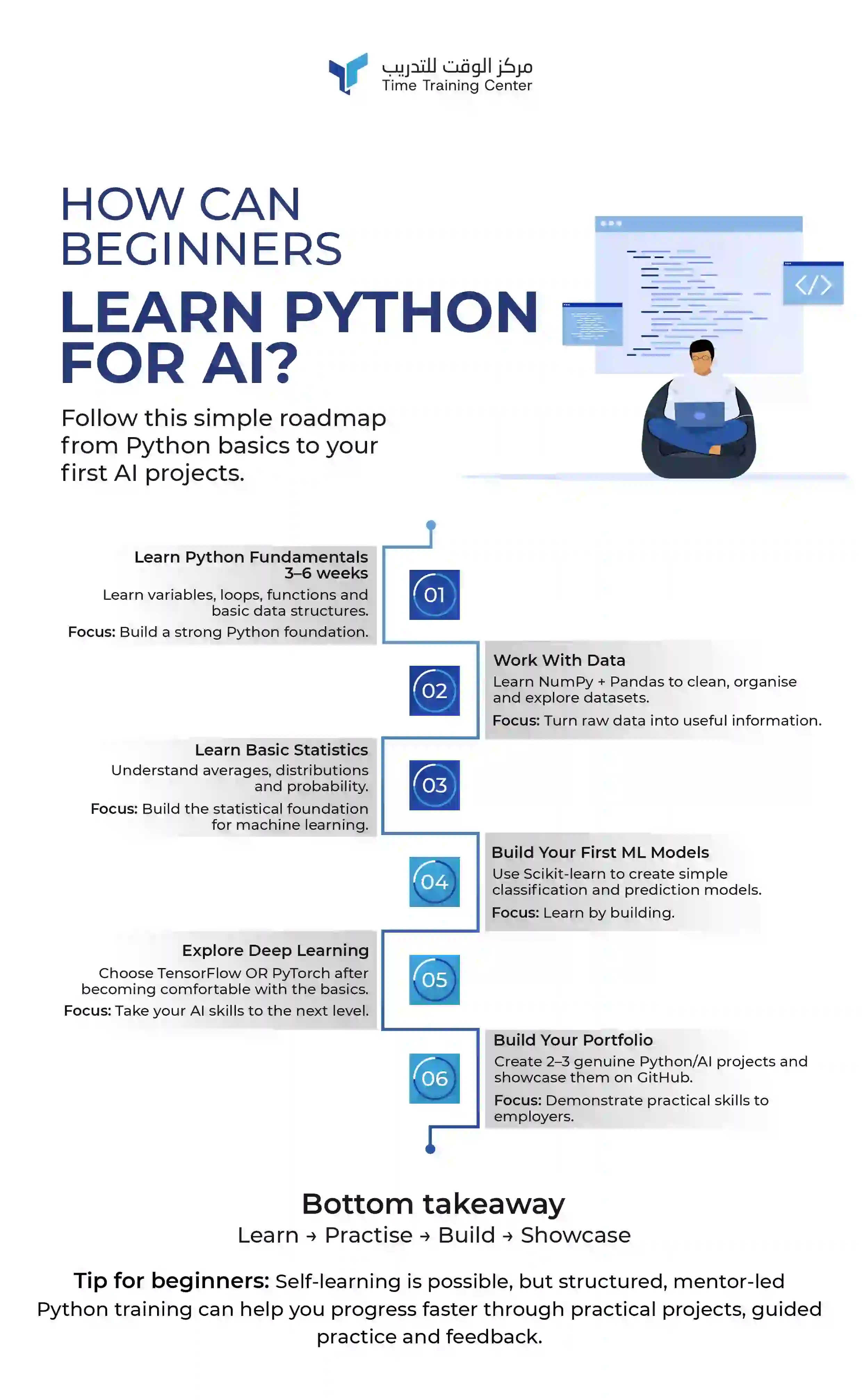
The most reliable way to learn Python for AI is to build fundamentals first, then apply them to small, real projects rather than jumping straight into advanced machine learning theory. A simple, proven roadmap looks like this:
-
Learn Python fundamentals: It covers variables, loops, functions and basic data structures, which usually takes 3 to 6 weeks of consistent practice.
-
Get comfortable with data handling: You practise cleaning and exploring datasets using Pandas and NumPy.
-
Learn basic statistics: Its about and enough to understand averages, distributions and probability, which are the major building blocks of ML.
-
Try your first ML models: You can use Scikit-learn to build simple classification or prediction models.
-
Explore one deep learning framework: Start with either TensorFlow or PyTorch once the basics feel comfortable.
-
Build a small portfolio: Two or three genuine projects on GitHub carry far more weight with employers than a stack of certificates alone.
Self-teaching is possible, but most learners find structured, mentor-led training gets them job-ready faster — particularly when a Python Certification combines the fundamentals with practical, hands-on projects rather than just theory.
Why Is Abu Dhabi a Great Base for Building Your Python and AI Career?
Abu Dhabi is a strong base for a Python and AI career because the emirate has made artificial intelligence a national priority. This has backed it with sovereign investment, world-class research institutions, and a fast-growing employer base actively hiring Python-skilled talent.
A few reasons this matters for learners specifically:
-
The UAE's national AI strategy aims to position the country among the world's AI leaders, with a knock-on effect of steady demand for Python-literate graduates across government and private sector roles.
-
Abu Dhabi is home to Mohamed bin Zayed University of Artificial Intelligence (MBZUAI), the world's first graduate-level university dedicated entirely to AI research, a strong signal of how seriously the emirate takes this field.
-
Sovereign AI initiatives such as G42's Falcon LLM project show that world-class, Python-built AI work is genuinely happening on the ground in Abu Dhabi, not just in Silicon Valley.
-
Local employers increasingly value candidates who understand regional context, for instance, adapting AI models for Arabic language processing, alongside solid core Python skills.
For learners based in Abu Dhabi, this creates a practical advantage: you can build in-demand skills through Time Training Center’s Python Course for AI and be close to the very organisations shaping the region's AI future. You can browse more career and technology insights on the Time Training Center’s Learning Hub as you plan your next steps.
What Beginner Python AI Projects Can You Start With?
The best beginner AI projects are small, achievable and directly tied to a skill you're trying to build, not ambitious, half-finished attempts at building the next big chatbot. A few sensible starting points:
-
A simple data analysis project: clean and visualise a public dataset using Pandas; UAE tourism or retail data works well.
-
A basic prediction model: use Scikit-learn to predict house prices or exam scores from sample data.
-
A spam or sentiment classifier: a classic, well-documented first step into natural language processing.
-
An image classifier: use a pre-trained model to sort images into categories, a gentle introduction to deep learning.
Each of these takes a weekend, not a semester, and gives you something concrete to show an employer which, as covered above, matters just as much as the programming knowledge itself.
Why Is Abu Dhabi a Great Base for Building Your Python and AI Career?
Abu Dhabi is a strong base for a Python and AI career because the emirate has made artificial intelligence a national priority. This has backed it with sovereign investment, world-class research institutions, and a fast-growing employer base actively hiring Python-skilled talent.
A few reasons this matters for learners specifically:
-
The UAE's national AI strategy aims to position the country among the world's AI leaders, with a knock-on effect of steady demand for Python-literate graduates across government and private sector roles.
-
Abu Dhabi is home to Mohamed bin Zayed University of Artificial Intelligence (MBZUAI), the world's first graduate-level university dedicated entirely to AI research, a strong signal of how seriously the emirate takes this field.
-
Sovereign AI initiatives such as G42's Falcon LLM project show that world-class, Python-built AI work is genuinely happening on the ground in Abu Dhabi, not just in Silicon Valley.
-
Local employers increasingly value candidates who understand regional context, for instance, adapting AI models for Arabic language processing, alongside solid core Python skills.
For learners based in Abu Dhabi, this creates a practical advantage: you can build in-demand skills through Time Training Center’s Python Course for AI and be close to the very organisations shaping the region's AI future. You can browse more career and technology insights on the Time Training Center’s Learning Hub as you plan your next steps.
What Beginner Python AI Projects Can You Start With?
The best beginner AI projects are small, achievable and directly tied to a skill you're trying to build, not ambitious, half-finished attempts at building the next big chatbot. A few sensible starting points:
-
A simple data analysis project: clean and visualise a public dataset using Pandas; UAE tourism or retail data works well.
-
A basic prediction model: use Scikit-learn to predict house prices or exam scores from sample data.
-
A spam or sentiment classifier: a classic, well-documented first step into natural language processing.
-
An image classifier: use a pre-trained model to sort images into categories, a gentle introduction to deep learning.
Each of these takes a weekend, not a semester, and gives you something concrete to show an employer which, as covered above, matters just as much as the programming knowledge itself.
More Questions People Ask About Python and AI Careers
Do I need a computer science degree to learn Python for AI?
No. Many successful AI practitioners are self-taught or came through short, structured training programmes rather than a formal computer science degree. Practical skills and a project portfolio typically matter more to employers.
How long does it take to learn Python for an AI career?
Most learners reach a job-ready foundation in Python and basic AI/ML concepts within three to six months of consistent, structured study, though genuine specialisation in areas like Generative AI takes longer.
What is the difference between Python for Data Science and Python for AI?
Data Science focuses on analysing and interpreting data using tools like Pandas, while AI extends this further into building predictive and generative models with libraries like TensorFlow and PyTorch. The Python foundations overlap heavily.
Which pays more: general Python development or AI specialisation?
AI and Generative AI specialisations generally command a premium over general Python development roles, though exact figures vary widely by employer, experience and sector, so it's worth researching current listings rather than relying on a single benchmark.
Your Next Step Towards an AI Career Starts With Python
Getting into AI? Start with Python! It’s crucial because it takes a complex world and makes it easier to navigate. With its simple syntax and a rich set of tools made especially for Machine Learning, Data Science, and Generative AI, Python is your best friend in this field. The buzz around Python isn’t just talk; surveys show that more and more developers are embracing it, and even Abu Dhabi is backing it in their national AI strategy.
Here’s the best part: you don’t need to know everything right away! Focus on grasping the basics of Python, learn a few key libraries, and get ready to dive into real projects. By combining structured training with hands-on experience, you’ll see that an AI career isn’t just a dream; it’s completely within your reach!
See how Time Training Center prepares you for a successful career in AI in Abu Dhabi.
FAQ's
1. Why is Python used for AI and Machine Learning?
Python is used for AI and Machine Learning because its simple syntax speeds up development, and its libraries like PyTorch, TensorFlow and Scikit-learn already handle the complex mathematics behind most models. That combination lets developers build and test ideas quickly.
2. Is Python good for beginners starting out in AI?
Yes. Python's readable, near-English syntax makes it one of the most approachable languages for beginners, which is why it's usually the first language recommended for anyone starting a career in AI, Machine Learning or Data Science.
3. What Python libraries do I need to learn for AI?
Start with NumPy and Pandas for data handling, then move to Scikit-learn for classical machine learning, before exploring TensorFlow or PyTorch for deep learning and generative AI projects.
4. How do I start learning Python for AI as a complete beginner?
Begin with core Python fundamentals, then practise data handling with Pandas and NumPy, build a few small ML projects with Scikit-learn, and gradually introduce deep learning tools. Structured training can shorten this path considerably. Check out the top AI courses for beginners and professionals in Abu Dhabi.
5. Can Python skills alone get me an AI job in the UAE?
Not on their own. Python is the essential entry skill, but employers in Abu Dhabi and Dubai also expect practical projects, some statistical understanding, and continuous learning — Python opens the door, but a portfolio gets you through it.
6. Is Python still relevant for AI in 2026, or should I learn something else?
Python remains the dominant language for AI development in 2026, holding the top position on major popularity indexes. Learning Rust-based tools like uv alongside it is useful, but Python remains the essential foundation.
 +971 2 6713828